
2026-10-01
Ford Duratec Intake Manifold: OEM Weak Points, Plenum Swaps and ITB Kits Explained
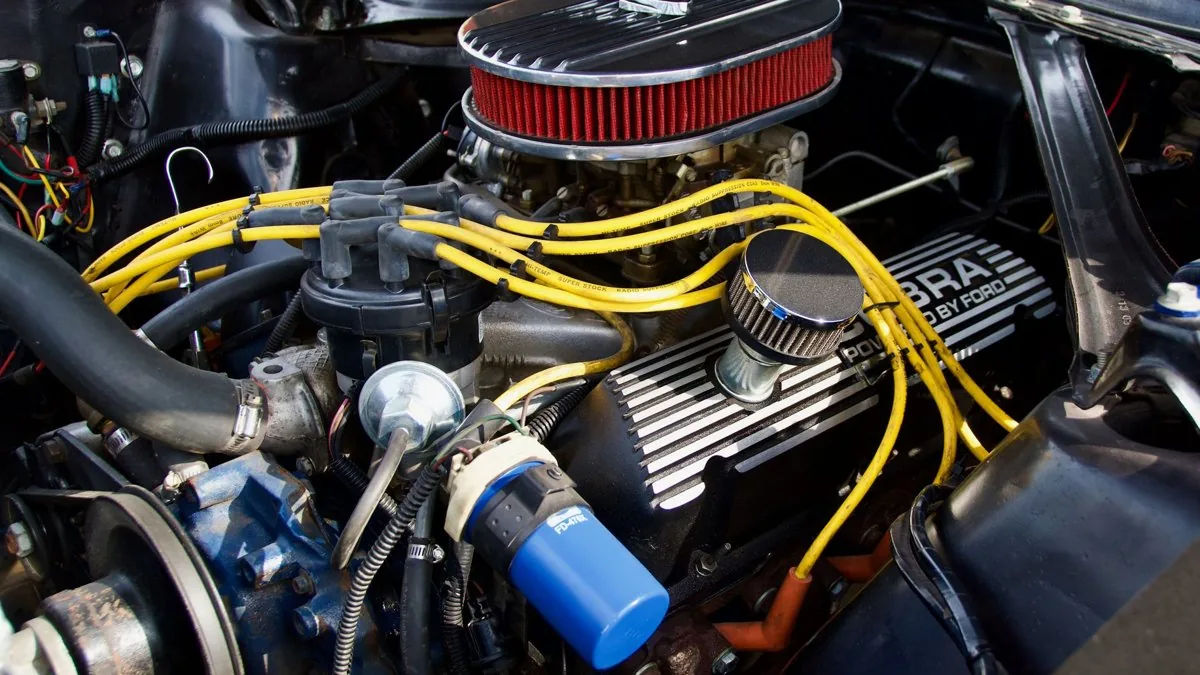
The single most important number when choosing a Ford Duratec intake manifold isn't the plenum volume or the throttle body bore — it's the port geometry of the head you're bolting it to. On the 1.8/2.0/2.3 HE four-cylinder the inlet port measures roughly 47 × 35mm at the flange with a 20° port angle, and the 2.5 HE is a completely different casting with larger ports — so a manifold that bolts straight onto a 2.0 will not port-match a 2.5. Get that wrong and no amount of plenum cleverness recovers the airflow you've lost at the short-side radius. Everything else on this page flows from that.
This guide covers the OEM manifold, why the swirl-flap system fails, and the two real upgrade routes — a plenum/throttle-body swap or a full individual throttle body (ITB) conversion — with the actual dimensions you need to spec parts against your engine.
Which Duratec are we talking about?
The relevant engine for most of GMR's customers — kit cars, Caterham, Westfield, hillclimb and ST150-based builds — is the Duratec HE inline-four, a joint Ford/Mazda design (the Mazda MZR / L-series). It's a chain-driven DOHC 16-valve four with solid tappets, spanning 1.8L, 2.0L, 2.3L and 2.5L. The 2.0 HE runs an 87.5mm bore, 83.1mm stroke, 1999cc, 10.8:1 compression and firing order 1-3-4-2, making 141–155hp at 6000rpm in standard trim.
Don't confuse it with the 60° Duratec V6 (2.5/3.0) — that's a separate engine with a Dual-Stage Intake system and nothing in common with the four's manifold. When people search "Ford Duratec intake manifold" and land on V6 parts, builds go wrong.
| Variant | Capacity | Bore | Stroke | Inlet port | Port angle |
|---|---|---|---|---|---|
| 1.8 HE | 1,798cc | 83mm | 83.1mm | ~47 × 35mm | 20° |
| 2.0 HE | 1,999cc | 87.5mm | 83.1mm | ~47 × 35mm | 20° |
| 2.3 HE | 2,261cc | 87.5mm | 94mm | ~47 × 35mm | 20° |
| 2.5 HE | 2,488cc | 89mm | 100mm | 48mm (to ~52mm ported) | 12.5° |
Two things to take from that table. The 1.8/2.0/2.3 share a flange, so manifolds interchange across them. The 2.5 is the odd one out: larger ports, a shallower 12.5° angle and a deeper port (99.1mm in the centre on the Jenvey MF16 reference). Fit a 2.0 manifold to a 2.5 and you've created a step at the flange that spoils the very flow you paid for.
The OEM manifold and why the swirl flaps fail
Factory HE manifolds are moulded composite plastic with two clever features that are also their two weaknesses. First, variable-length runners: internal flaps switch between a long runner path for low-rpm torque and a short path for top-end. Second, on many applications, Intake Manifold Runner Control (IMRC) — butterfly "swirl flaps" in the runners that bias airflow length and velocity, torque low down and power up top.
The mechanism is simple enough: each runner carries a passage that is always open plus a second passage closed by a spring-loaded butterfly. Below roughly 3000rpm the actuator is de-energised and the plates stay shut; above that they open. On the HE fours the actuator is usually vacuum-operated via a solenoid pack rather than the motorised version seen on some V-engines — so implementation varies by application, and you should confirm yours before ordering parts.
The failure is well documented and almost universal with age:
- The IMRC flap linkage wears or breaks, producing a loud rattle that's routinely mistaken for tappets or timing chain noise.
- The vacuum solenoid pack that drives the actuator fails.
- On the four-cylinder, you frequently have to replace the entire manifold — the shutter valve is only sometimes available separately.
Quick diagnosis: if disconnecting the vacuum line from the manifold to the IMRC solenoid silences the rattle, you've found it. A common field fix is to wire the flaps open, leave the actuator in place and connected so the PCM sees no fault, and accept the trade-off — a slight drop in fuel economy and a minor low-rpm torque loss. It's honest work, but it's a patch on a plastic part that's near the end of its life, and it's exactly the point at which most builders start looking at a proper upgrade.
Upgrade route 1: plenum and throttle-body swap
If you're running a single throttle body — especially boosted — a cast or billet aluminium plenum is the pragmatic step. It deletes the fragile variable-runner flaps, removes the plastic manifold that likes to split under boost, and typically bolts to the OE head using your existing throttle body, MAP sensor and fuel rail.
Representative options on the 1.8/2.0/2.3:
- Barbarian Racing aluminium plenum — deletes the flaps, replaces the swirl flaps to raise air velocity into the head, ~4kg, uses the original throttle body/MAP/fuel rail. Pitched at boosted cars to stop the plastic manifold splitting.
- Cosworth plenum (2.0/2.3 MZR) — increased plenum volume for top-end, torque-biasing velocity stacks to hold the mid-range, cast alloy with a machined billet anodised cover; front-drive oriented, turbo-capable.
- Plazmaman billet (MX-5 NC 2.0) — runner-length and dome options for RWD conversions.
Be sceptical of vendor airflow claims. Headline figures like "up to 10% hp" or "20% more airflow" from cast "high-flow" plenums are marketing, not dyno data traceable to your combination. A plenum helps most where the OE plastic part is the limiter — under boost, or where it's physically failing. On a naturally aspirated engine chasing throttle response and top-end, the manifold choice matters far more, which brings us to ITBs.
Upgrade route 2: individual throttle bodies
For a serious naturally aspirated Duratec — the Caterham/Westfield/hillclimb use case — individual throttle bodies are the route that actually transforms the engine. One throttle per cylinder, a short runner feeding each port, and airflow that responds instantly because there's no shared plenum to fill and empty.
The flange geometry you'll see referenced:
| Manifold type | Bores available | Body 2–3 spacing | Orientation | Notes |
|---|---|---|---|---|
| danST short DCOE-style (ST150) | 45 / 48 / 50mm | 93mm | Horizontal | 2.0/2.3 only, not 2.5 |
| danST angled TB-specific | 40 / 45 / 48 / 50mm | 93mm | 15° upward | Not carb-suitable |
| DCOE carburettor version | Weber/Dellorto 45 | 97mm | Horizontal | Different spacing to TB |
| Classic Carbs billet | 45 DCOE / DHLA45 / 45mm Alpha | — | Horizontal | 35mm face-to-face, short |
Note the spacing difference — 93mm for throttle bodies vs 97mm for carbs at bodies 2–3. That's not a rounding error; a carb manifold and a TB manifold are not interchangeable, and this is a classic source of "it won't line up" grief.
Jenvey's port-matched kits are the benchmark reference for geometry done properly:
- Jenvey SF51 taper kit — port-matched and aligned to the 2.0 HE's 20° port angle, 48mm butterfly taper-bore bodies, 90mm airhorns, large-bore fuel rail; Jenvey spec Bosch 412cc injectors. Injectors sit further upstream, in the part-throttle turbulence of the butterfly, giving fuel more distance and time to mix — which lifts both torque and power. Spindles are profiled to minimise frontal area at full throttle, with a shallow 8° shut angle for finer control off idle.
- Jenvey TH 45mm DCOE kit — twin 45mm bodies, alloy fuel rails, 60mm airhorns; 80mm shorter than the TB kit for tight bays. Needs a standalone ECU.
Where GMR's DDM composite manifold fits
Here's where I'll be straight with you about what we build and why. GMR produces DDM composite intake parts — Direct Digital Manufactured components printed in PPA-CF (carbon-fibre reinforced polyphthalamide). That is a genuine carbon composite; the honest distinction is the manufacturing route — DDM composite versus laminated/autoclave composite or machined aluminium — not "composite vs printed".
Three concrete reasons this route earns its place on a Duratec intake:
First, geometry you cannot make any other way. DDM lets me build hollow, closed internal cavities, tuned-length runners and smooth internal transitions in a single piece — features that can't be laminated or machined in one part. On a plenum that means an internal transition optimised for flow rather than for what a mould can release.
Second, thermal insulation where it counts. Aluminium has a density of 2.70 g/cm³ and a thermal conductivity of 150–220 W/m·K — it soaks heat into the intake charge, worst of all at idle and heat-soak. PPA-CF's conductivity is orders of magnitude lower (I won't quote a single figure because it isn't published for this grade), and a DDM part can carry a trapped-air cavity that drops charge heat-pickup further. Be clear on where this helps: it's a real win at idle and in traffic heat-soak; at sustained wide-open throttle the airflow dominates and the effect narrows. I'll tell you which case is yours.
Third, weight and engine-specific fit. PPA-CF is 1.25 g/cm³ — under half aluminium's density before you even count the hollow section. And because every part is modelled to your head, you get true port matching to the 20° (or 12.5° on the 2.5) geometry, with no "universal fit" compromise. CAD-to-dyno iteration is fast, so geometry gets optimised on real data, not guesswork.
On material limits, I'll be equally honest. PPA-CF is semi-crystalline and fibre-reinforced, so its 85°C glass transition is not the service ceiling — load-bearing capability persists well above it, which is why heat deflection temperature is 196°C at 1.8 MPa and 227°C at 0.45 MPa, with Vicat softening at 232°C. For under-bonnet intake use those HDT numbers are what matter. Where the Z-axis strength governs a highly stressed, directional load (XY tensile is 168 MPa but Z is 57 MPa), or where sustained temperature is genuinely extreme, a laminated/autoclave part or aluminium can be the right call — and I'll say so rather than sell you the wrong thing.
| Property (PPA-CF) | Value |
|---|---|
| Tensile strength (XY / Z) | 168±4 / 57±5 MPa |
| Young's modulus (XY) | 11,800±670 MPa |
| Bending strength (XY) | 208±6 MPa |
| Density | 1.25 g/cm³ |
| HDT @1.8 MPa / @0.45 MPa | 196°C / 227°C |
| Vicat softening | 232°C |
| Saturated water absorption | 1.30% |
How to choose, in order
- Confirm the engine. 1.8/2.0/2.3 share a flange; the 2.5 needs its own manifold. Measure your port and angle — don't assume.
- Decide forced induction or NA. Boosted and keeping a single throttle? A plenum swap that deletes the flaps is the sensible, robust fix. NA and chasing response and top-end? Go ITB.
- Match flange spacing to hardware. 93mm for throttle bodies, 97mm for carbs — never mix the two.
- Size the bore to the engine, not the catalogue. 45mm suits a near-standard 2.0; 48–50mm as cams, head work and rpm climb.
- Spec injectors and ECU together. ITB kits need a standalone ECU and correctly sized injectors (e.g. ~412cc on the SF51 reference).
For the detail behind each of these, read our guides to the Ford Duratec ITB kit, the bike throttle body kit and the bike carburettor conversion. If you're weighing the whole project up, the bike carbs vs ITB conversion cost breakdown has the honest UK numbers, and the billet fuel rail guide covers sealing the fuel side properly.
FAQ
Can I fit a 2.0 Duratec intake manifold to a 2.5?
No. The 2.5 HE has larger inlet ports (48mm, portable to ~52mm), a shallower 12.5° port angle and a deeper port than the 1.8/2.0/2.3. A manifold made for the smaller engines will leave a step at the flange and won't port-match. Use a 2.5-specific manifold.
Is the rattling noise from my Duratec the intake manifold?
Very likely. The IMRC swirl-flap linkage wears and rattles, and it's routinely mistaken for tappets or chain noise. Disconnect the vacuum line from the manifold to the IMRC solenoid — if the rattle stops, the manifold flaps are the source.
Do I need a new ECU for a Duratec ITB conversion?
Yes. ITBs lose the OEM MAP-based load signal and need alpha-N or a blended strategy, so a standalone or fully remappable ECU is required. Pair it with correctly sized injectors — around 412cc on the Jenvey SF51 reference kit.
Will a composite intake manifold really run cooler than aluminium?
At idle and in heat-soak, yes — meaningfully. A DDM composite part in PPA-CF conducts heat orders of magnitude less than aluminium and can carry a trapped-air cavity, so it picks up far less charge heat. At sustained wide-open throttle the benefit narrows because airflow dominates. I'll tell you honestly which case applies to your build.