
2026-09-25
Ford Duratec Bike Carburettor Conversion Kit: How to Spec, Fit and Jet One Properly
A bike carburettor conversion on a Ford Duratec replaces the OE port injection with four motorcycle carbs on a bespoke inlet manifold — and the two details that make or break it are almost never the carbs themselves. They are the ignition control and the fuel supply pressure. Get those right and a healthy 1.8/2.0 Duratec HE will pick up 10–20bhp with a sharper throttle response and a proper induction snarl. Get them wrong and you'll either cook a piston on a lean cruise or spend a weekend chasing a misfire that was never a fuelling problem to begin with.
This guide covers what actually goes into a working Ford Duratec bike carburettor conversion kit: manifold and carb sizing, the low-pressure fuel system, the crank-triggered ignition the Duratec forces on you, injector-port blanking, and the jetting discipline that keeps the engine alive. First, a point of order on which "Duratec" we're talking about, because Ford's badging causes more grief here than any single spec.
Which Duratec? Get this right before you buy anything
The engine this article addresses is the Duratec HE — the 1.8/2.0/2.3 four-cylinder that's actually a Mazda-designed unit (the L-series / MZR family; the 2.0 is Mazda's LF). It runs a timing chain rather than a belt, and uses shim-and-bucket valve clearances with no hydraulic tappets, so periodic clearance checks are part of ownership.
What it is not is the "Duratec" badged onto the Focus RS Mk1 and the ST170 (SVT), both of which are Zetec-R engines wearing a Duratec sticker — one of Ford's marketing quirks. Many parts differ. If you've got a Zetec-R and you buy Duratec HE parts, nothing lines up. If your engine is genuinely a Zetec, read our Zetec bike carburettor conversion guide instead. The rest of this piece assumes the Duratec HE/MZR.
| Variant | Displacement | Bore | Stroke | Compression | Output (OE) |
|---|---|---|---|---|---|
| 1.8 (L8) | 1,798cc | 83.0mm | 83.1mm | 10.8:1 | 115–125hp @ 6,000rpm |
| 2.0 (LF) | 1,999cc | 87.5mm | 83.1mm | 10.8:1 | 141–155hp @ 6,000rpm |
| 2.3 | 2,261cc | 89.0mm | — | — | — |
Carbs or ITBs? A quick honest steer
Bike carbs are a genuinely good, low-cost route to more power and a livelier engine, and on modified and kit-car builds they've long been the alternative to the old Weber twin-40 DCOE setups — better fuel economy and reliability than Webers, with the same visceral character. But be clear about the compromise: carburettors are open-loop mechanical fuelling. There's no closed-loop trim, no cold-start map, no load compensation for altitude or air temperature beyond what the carb's circuits do passively.
If you want mappable, repeatable fuelling with a modern ECU — and you're chasing the last few per cent — individual throttle bodies are the tool for that job, and on the Duratec you even have the option of retaining the head-mounted injectors. Carbs win on cost, simplicity and the fact you never touch a laptop once they're jetted. Decide which of those matters to you before you spend.
Manifold and carb sizing: the number that decides everything
The manifold is a bolt-on TIG-welded aluminium item: a water-jet-cut 10mm-thick head flange, 45mm OD runners with a 3mm wall, and internal joints ported and ground so the flow path is smooth across the welds. That last detail matters more than people expect — an unblended weld root at the flange-to-runner joint is a step the airflow has to negotiate on every cycle, and it's exactly where cheap manifolds lose the gains the carbs were supposed to add.
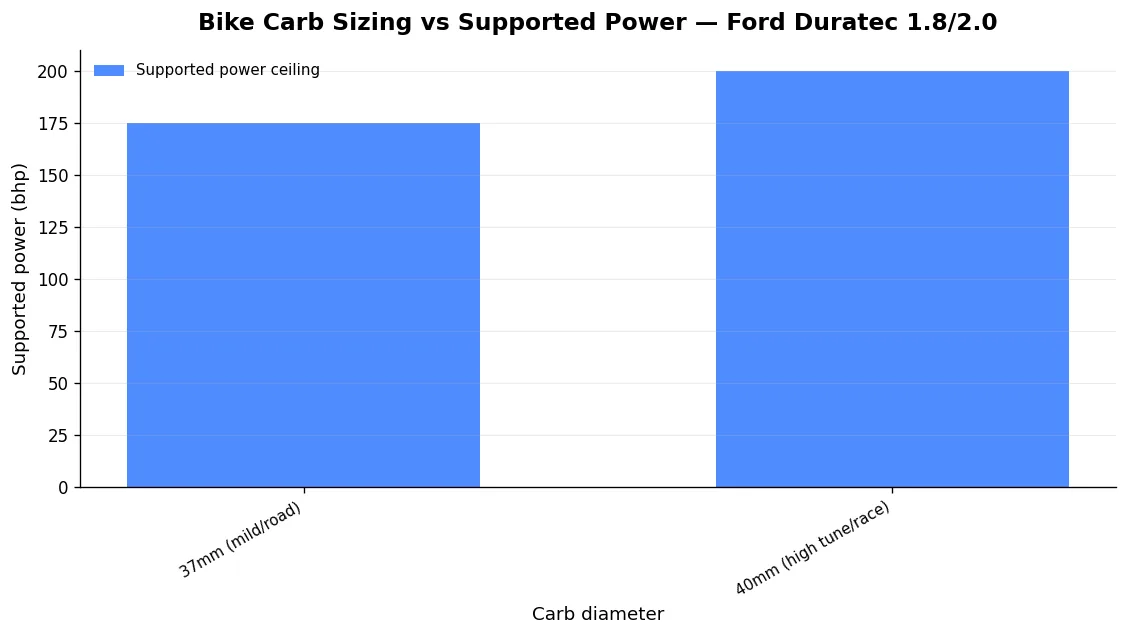
Carb diameter is the selection decision that governs the whole character of the engine, and bigger is not better:
| Carb size | Supports | Best for | Character |
|---|---|---|---|
| 37mm | Up to ~175bhp | 1800/2000cc, standard to mild tune | Better torque and drivability; road and occasional track |
| 40mm | 200bhp+ | 1800/2000cc, high tune | High-revving race spec; track and race use |
The mechanism behind "37mm makes better torque" is air velocity. A smaller venturi keeps intake-charge velocity higher at part throttle and mid-rpm, which sharpens throttle response and strengthens cylinder filling where a road engine actually lives. Oversize the carbs and velocity drops, the signal to the emulsion circuits weakens, and you get a soft, laggy bottom end in exchange for top-end you'll rarely use. Unless the engine is a genuine high-tune, high-revving build, 37mm is the right answer for an 1.8 or 2.0.
The actual carb model is stock-dependent — typically Keihin FCR or Mikuni flatslide units off sportsbikes such as the ZX7R, ZX9R, CBR900, ZZR1100, R1, ZX6R, ZZR600, CBR600 and GSXR families. Don't fixate on a specific bike carb; the jetting and slide spec are what you tune, not the badge.
What gains to actually expect
The honest rule of thumb on a healthy engine with a good ignition setup is 10–20bhp, and those gains are complementary rather than standalone. Bike carbs reward an engine that can already breathe: an upgraded exhaust manifold and system is the sensible minimum, and camshafts plus headwork are where the carbs really start to pay, filling out both the power and torque curves. Bolt carbs onto an otherwise stock, restricted engine and you'll see a fraction of the potential.
For context on the platform's naturally aspirated ceiling: these engines will reach around 180hp NA fairly comfortably; meaningfully beyond that means opening the engine up with more serious internal work. Treat that as anecdotal but directionally right — it sets realistic expectations for a carb build.
The fuel system: low pressure, non-negotiable
This is where OE-injection Duratec conversions most often go wrong. Motorcycle carburettors want a supply pressure of just 2–3psi. The factory Duratec pump is a high-pressure injection pump feeding rail pressure many times that — plumb it straight to bike carbs and you'll blow past the float needles, flood the engine and pour fuel into the cylinders. You have two clean routes:
- Dedicated bike fuel pump. The purpose-made low-pressure bike pumps are designed to run with the carbs directly — no fuel pressure regulator needed. It's a simple inline job: fuel in, fuel out, a 12V supply. Mount it low down, close to the tank and horizontal — these pumps are far happier pushing than pulling, and mounting them high or vertical causes lift and priming trouble.
- Aftermarket electric pump plus fuel pressure regulator set to the 2–3psi window. If you're converting from a previous aftermarket carb setup, you likely already have exactly this in place.
Ignition: the Duratec has no distributor, so you must control the spark
Here's the detail that catches Weber-era converters out. The Duratec is coil-pack and crank-triggered — there's no distributor to fall back on. Strip the OE injection ECU off and you've removed the thing that was firing the coils. You have to either retain suitable ECU control or fit a standalone ignition controller.
The standard route is a mappable ignition-only ECU — a digital, fully programmable ignition controller for four-cylinder spark engines that exists precisely to run carburettors on modern engines with no distributor drive. It takes its inputs from:
- A crank sensor — retro-fitted if the engine doesn't already have one. The genuine Ford part for the Duratec is ref 1129988 / 1S7F 6D315 AA / 1642157, supplied with its bracket.
- A throttle position sensor or a MAP sensor for load reference.
The controller's drivers fire a coil pack, typically wasted spark, so the engine needs a coil pack and matching leads. Most modern Duratecs already have one; older carburetted engines being converted will need one fitted.
The VVT noise caveat
On VVT Duratec variants there's a real, documented problem: electrical noise interference between the coil pack and the cam sensor / VVT solenoid. The fix is a dedicated coil-pack kit developed specifically to beat that interference, designed to run alongside a standalone ECU with a terminated Duratec loom, and usable generally on Duratec engines needing a wasted-spark setup. If you're on a VVT engine, don't improvise the coil-pack wiring — this is a known trap.
If you retain an OE-style ECU for load reference
If your setup keeps an ECU that wants a manifold vacuum signal for its load axis, a single tapping into one runner is not enough — you'll get a pulsed, unusable signal because each cylinder's intake pulse dominates that one port. A vacuum balance bar across the manifold is required to average the four runners into a stable reference. Without a clean vacuum signal the ECU will typically revert to a basic 2D ignition map — no better than running a distributor. Retain all original sensors and connections; the only thing that comes out is the injectors.
Injector ports: blank them
Because the Duratec's injectors sit in the cylinder head rather than in the manifold, removing injection leaves four open injector bores straight into the ports. Those must be sealed with a set of four Duratec injector-port blanking plugs (the 2.0/2.3/2.5 heads use the same plug set). Leave them open and you've got four uncontrolled air leaks downstream of the carbs — the engine will run lean, idle badly and refuse to tune. It's a cheap part and a five-minute job; just don't forget it.
Jetting: base settings get you running, the rolling road keeps you alive
Kits are supplied with base jets and settings so the engine will start and drive off the trailer. Treat those as approximate only. The carbs are bench-tested to run, not tuned to your engine, exhaust, cams and altitude. Final jetting must be done with wideband AFR equipment under real load, ideally on a rolling road. This isn't a nice-to-have — an untuned bike-carb car can sit dangerously lean at part-throttle cruise, and that's how you lose a piston.
Indicative targets for bike carbs on a car engine (use them as starting references, not gospel):
| Condition | Target AFR |
|---|---|
| Idle | ~14.0–14.7 |
| Acceleration (max torque) | ~12.0 |
| WOT — acceptable | ~14.0 |
| WOT — solid max power | ~12.5 |
Tune by circuit, in order. Off-idle to roughly quarter throttle is governed by the throttle slide cutaway — more cutaway leans it out, less cutaway richens it; some aftermarket carbs offer replacement slides to shift that region. From there the pilot/idle jet, needle position and main jet each own their own throttle band. Chase them in sequence rather than fighting one against another, and log AFR across the whole map before you sign it off.
Lead time and build order
These kits are made to order — expect around a 10 working-day lead time, since the manifold is fabricated and the carbs prepped per order. Plan the build in the right sequence: manifold and carbs fitted, injector ports blanked, low-pressure fuel system plumbed and pressure-checked, crank sensor and ignition control wired and verified, then straight onto the rolling road for jetting. Don't drive it hard on base settings between fitting and the dyno.
Where a DDM composite intake fits
Once the carb question is settled, the intake path in front of them is worth engineering rather than leaving to chance. This is where our DDM composite parts — Direct Digital Manufactured components printed in PPA-CF (carbon-fibre reinforced polyphthalamide) — do things a welded aluminium part or a hand laminated composite part cannot.
First, thermal: PPA-CF is a reinforced polymer, and orders of magnitude lower in thermal conductivity than aluminium (2.70 g/cm³, 150–220 W/m·K). Add a trapped-air cavity and intake-charge heat pickup drops sharply — most valuable at idle and heat-soak, less so at sustained WOT, so it's a genuine gain in the traffic-and-paddock use that road-and-occasional carb builds actually see. Second, geometric: DDM lets us print hollow closed cavities, tuned-length runners and internal transitions in one piece that simply can't be laminated or machined. Third, mass: at 1.25 g/cm³, PPA-CF is under half aluminium's density before you even count the hollow section. And the material carries real structural numbers — 168±4 MPa tensile and 11,800±670 MPa modulus in XY, with heat deflection of 196°C at 1.8 MPa and 227°C at 0.45 MPa, and a 232°C Vicat softening point. Note its 85°C glass transition is not a service ceiling — because the material is semi-crystalline and fibre-reinforced, load-bearing capability persists well above Tg, which is exactly why the HDT and Vicat figures are so much higher.
Where a laminated/autoclave part is still the right call — very high sustained temperature, or where Z-axis strength governs the load path (PPA-CF is 57±5 MPa in Z versus 168 MPa in XY, so print orientation matters) — we'll say so. But for a tuned-length, thermally-isolated intake around bike carbs, a DDM composite part is a serious engineered option, not a compromise.
FAQ
Can I run bike carbs on a Duratec with the standard fuel pump?
No. The OE injection pump is high-pressure; bike carbs need 2–3psi. Either fit a dedicated low-pressure bike pump (no regulator required, mounted low, close to the tank and horizontal) or run an aftermarket electric pump with a fuel pressure regulator set to that window.
Do I need an ECU if I'm fitting carburettors?
Yes — for ignition. The Duratec is crank-triggered with no distributor, so you need a mappable ignition controller taking a crank sensor and a TPS or MAP input, firing a coil pack. On VVT variants, use the dedicated coil-pack kit to avoid noise interference with the cam sensor and VVT solenoid.
How much power will a bike carb conversion add?
On a healthy engine with good ignition, expect 10–20bhp. Gains are complementary — an upgraded exhaust is the minimum, and cams plus headwork add more. NA these engines reach around 180hp fairly readily; beyond that needs serious internal work.
Do I have to blank the injector holes?
Yes. The Duratec's injectors sit in the head, so once carbs replace injection those bores must be sealed with the correct set of four Duratec injector-port blanking plugs — otherwise they act as air leaks and the engine won't idle or tune.
Is a rolling road really necessary for jetting?
Effectively, yes. Supplied base jets only get the engine running. Final jetting must be set with wideband AFR equipment under real load to hit sensible targets and, critically, to avoid a lean cruise that damages the engine. It's the single most important step after fitting.