Before you buy a single part, read the regulations for your championship. In UK club racing the technical envelope is defined by Motorsport UK, the FIA-recognised national governing body for four-wheel motorsport, and its rules live in the National Competition Rules — the document the trade still calls the Blue Book. Circuit racing has traditionally sat under Section Q, but section structure and format change (the switch to discipline-specific digital Yearbooks was largely a format overhaul), so verify the current wording against the latest Yearbook rather than trusting last season’s memory. In sealed and production classes an engine can be sealed at any time by a Licensed Eligibility Scrutineer and checked against a standard pattern part. That single fact governs how you choose club racing engine parts in the UK: the fastest legal engine is worth nothing if a scrutineer strips it and finds an ineligible piston.
So the job isn’t “find the most power”. It’s to build a legal, repeatable engine that survives a full season of heat cycles and over-rev. Below is how I approach the parts that actually decide whether an engine finishes — and where the money is well spent versus wasted.
Start with your class, not the catalogue
UK club racing spans a huge technical range. The BRSCC runs around thirty circuit championships across everything from Citroëns to BMWs to Mazdas; the 750 Motor Club — founded in 1939 around the near-750cc Austin 7 — runs sealed-engine formulae like CSP2, which uses a sealed 1600 K-series making a controlled 125bhp, and CSP1, which allows up to 2000cc/200bhp from road-derived fours or motorcycle engines up to 1600cc. Those two regimes demand completely different parts strategies.
In a sealed class your engineering effort goes into everything the seal doesn’t cover — cooling, oil control, gearing, cornering. In an open class you’re building internals to a power and RPM target, and every component has to be chosen as a matched set. Decide which you are before you spend anything.
Pistons: cast, hypereutectic or forged
The piston is where most people over- or under-buy. The honest rule of thumb from the piston makers: if the engine makes over roughly 450bhp or spends real time at high RPM, go forged. Below that, and especially in a controlled sealed class, a good cast or hypereutectic piston can be the better race part.
The mechanism is the alloy. Forging forces the material to flow around a die, giving a denser grain structure that absorbs heat and shock and resists the detonation and thermal spikes that crack or melt cast pistons. But the alloy matters more than the word “forged”:
| Property |
4032 forged |
2618 forged |
| Silicon content |
~10–12% |
<1% |
| Thermal expansion |
Lower — runs tighter clearances |
Higher — needs looser clearances |
| Tensile strength |
Good |
Notably higher |
| Malleability / impact |
Moderate |
High — tolerates abuse |
| Best for |
Quieter, lower-expansion builds, less piston slap cold |
High RPM, high boost, endurance heat cycling |
The high silicon in 4032 (like many hypereutectic cast pistons) reduces expansion, so you can run tighter piston-to-wall clearance — that means less blow-by, longer ring life and less cold-start piston slap. 2618, with under 1% silicon, is the racing default: more malleable, higher tensile strength, happier under extreme pressure and repeated heat cycling, which is why endurance builders reach for it. The trade-off is expansion, so it needs slightly more clearance and can rattle a touch when cold. Take the clearance figure from the piston maker’s card, not a forum.
Connecting rod bolts: torque is not clamp load
If there’s one assembly detail that separates a built engine from a bodged one, it’s how the rod bolts go in. At 8500 RPM the engine cycles 140-plus times a second, and the rod bolts are the only thing stopping the cap being flung off the rod on every one of those cycles. Get the preload wrong and the engine dies — often not on the bench, but three laps into a race.
A torque wrench alone only gives you an approximate preload, because friction under the bolt head and in the threads eats a variable share of that torque. The only reliable method is a rod-bolt stretch gauge: measure the bolt’s free length, then tighten until the specified stretch is reached. The numbers are unforgiving — a bolt just 5–10 ft·lb under-stretched can back off and unfasten while running. Lubricant matters too: independent testing showed 30wt oil varied clamp load by as much as 17%, while ARP Ultra-Torque held to around 3%.
| Fastener (example) |
Length |
Stretch target |
Torque (with maker’s lube) |
| ARP 2000 3/8″ |
1.500″ |
0.0050–0.0055″ |
45 ft·lb (61 Nm) |
| ARP L19 3/8″ |
1.500″ |
0.0060–0.0065″ |
50 ft·lb (68 Nm) |
| Manley (example) |
— |
0.0060–0.0065″ |
95 ft·lb (Manley lube) / 90–100 ft·lb (30wt) |
These figures are illustrative — stretch and torque for aftermarket rods are set by the rod manufacturer, not just the bolt, so use the spec that came with your rods. Two working rules I never skip: burnish new threads by tightening and loosening to 75–80% of nominal torque three times before the final pull with fresh lube; and retire any bolt that shows a permanent increase of 0.001″ or more in free length, because it has yielded and won’t clamp reliably again.
Camshaft and valve springs: choose them as a set
Valve springs cause more premature camshaft failures than almost anything else — too much pressure, too little, or simply worn out. The rule is to pick the whole valvetrain together: you cannot select a spring in isolation from the cam, retainers, seals and rockers and expect the engine to reach its potential.
Get the pressure wrong and it costs you either way. Too light and the valve floats, then hardware breaks. Too stiff and you burn horsepower to friction and chew through the valvetrain. Three values must be set deliberately on the spec card: installed height (which determines the others), seat pressure (the most critical figure — the load holding the valve shut) and open pressure. Street flat-tappet references of 85–105 lb seat pressure, or 105–130 lb for hotter builds, are just that — street references. A serious circuit cam runs to the cam maker’s card, and those pressures are higher.
Two clearance checks prevent early cam death. First, the recommended spring’s outside diameter often needs the head’s spring pocket machining, and a spring that isn’t positively located is one of the most expensive mistakes in a race engine. Second, measure from the bottom of the retainer to the top of the valve seal — that gap must exceed valve lift, or the guide has to be machined. Skipping it is a very common cause of premature failure. Treat springs as consumables; at high RPM, coil tension drops and many racers change them every season. And on flat-tappet cams: keep used lifters in order (they mate to their lobes), you may run new lifters on a good used cam, but never used lifters on a new cam.
Bearings, clearances and blueprinting
Blueprinting is simply refusing to accept the factory’s tolerance band. Where the manual says “anything from 0.0015 to 0.0030 is in spec”, blueprinting picks a target — say 0.00275″ main clearance — and holds every bore to it. That consistency is what makes an engine repeatable from rebuild to rebuild, which matters far more in a season-long club campaign than a headline dyno figure. Match bearings to the crank you actually have: race-series and oversize shells exist precisely to suit reground cranks, and the good UK distributors stock road, performance and race grades accordingly.
Where GMR fits: intake and induction done to your engine
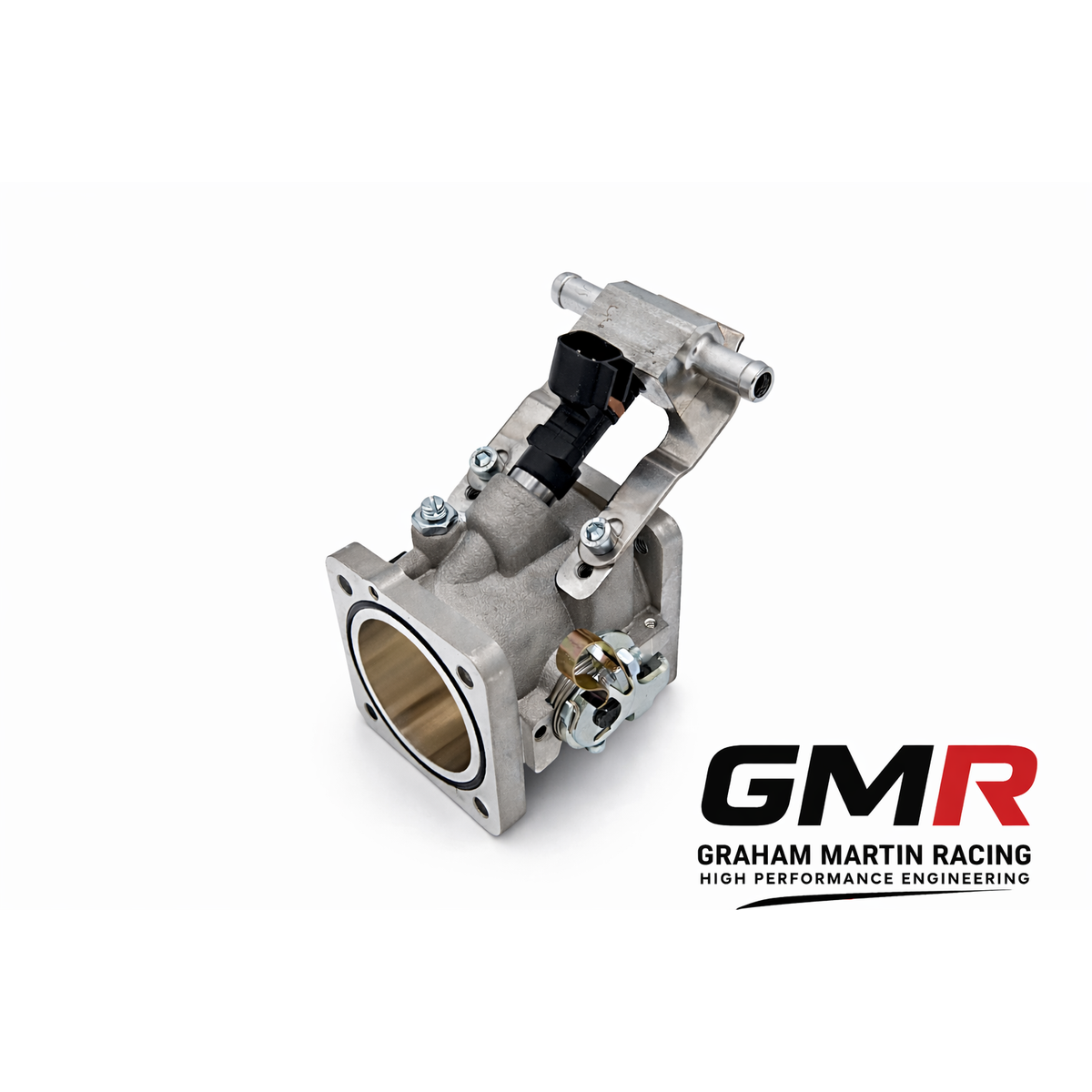
Internals set the ceiling; the induction system decides how much of it you actually breathe. This is the part of the engine most often ruined by “universal fit” thinking, and it’s where we build. GMR designs and manufactures individual throttle body kits, manifolds, airboxes, velocity stacks, injectors and throttle linkages for platforms including Honda K20, Subaru EJ, Peugeot XU/TU and GTi6 — engineered around your head, not a catalogue average.
For intake parts we increasingly reach for DDM composite: components Direct Digital Manufactured in PPA-CF, a carbon-fibre-reinforced polyphthalamide. It’s a genuine composite, just produced by a different manufacturing route to laminated/autoclave prepreg. What that buys you on a race engine is concrete:
- Geometry you cannot laminate or machine in one piece: hollow closed cavities, tuned-length runners and smooth internal transitions built as a single part — no split lines, no bonded joints in the airflow path.
- Thermal insulation: a reinforced polymer plus a trapped-air cavity picks up far less heat into the charge than an aluminium part. Aluminium sits at 150–220 W/m·K thermal conductivity; PPA-CF is orders of magnitude lower. That matters most at idle and heat-soak in the assembly area, less at sustained wide-open throttle — I’ll tell you honestly which case is yours.
- Lightweight: PPA-CF density is 1.25 g/cm³, under half aluminium’s 2.70 g/cm³ before you even count the hollow section.
- Genuine port matching and rapid iteration: CAD-to-dyno turnaround means the geometry is optimised on your real data, not a compromise shape.
The material earns it on numbers, not adjectives: tensile strength 168±4 MPa (XY), Young’s modulus 11,800±670 MPa (XY), bending strength 208±6 MPa (XY), impact strength 41.7±2.8 kJ/m² (XY). On under-bonnet heat, lead with heat deflection — 196°C at 1.8 MPa and 227°C at 0.45 MPa (ISO 75) — and Vicat softening of 232°C. PPA-CF is semi-crystalline and fibre-reinforced, so its 85°C glass transition is not a service ceiling: load-bearing capability persists well above it, which is why the HDT and Vicat figures are where they are.
Where a laminated/autoclave part is genuinely the right call, I’ll say so — for very high sustained temperatures, or where load runs through the weak axis, since PPA-CF Z-axis tensile strength is 57±5 MPa against 168 MPa in XY, so part orientation is a design decision, not an afterthought. If you want the full argument, see our pieces on the carbon intake manifold and how DDM fits the motorsport workflow.
Assembly and calibration tie it together
Parts don’t make power on their own. What separates a properly built engine is that every clearance is measured, every fastener is set to stretch, and the whole induction path is sized and plumbed as a system — as covered in our guide to sizing and plumbing race injectors and ITBs. Finish it with a calibration done on your combination, on your fuel, and you have an engine that both passes scrutineering and finishes races.
FAQ
Do club racing engine parts have to be Motorsport UK approved?
There’s no blanket “MSUK approved parts” list — eligibility is defined by your championship’s technical regulations in the current National Competition Rules (Blue Book). In sealed and production classes, parts are checked against a standard pattern part by a Licensed Eligibility Scrutineer, so the question is always “is this legal for my class?”, not “is it approved in general”. Read your class regs first.
Do I need forged pistons for club racing?
Not always. The working rule is forged for engines over roughly 450bhp or seeing sustained high RPM, and 2618 alloy for high-boost or endurance heat cycling. Below that, or in a sealed class, a good cast or 4032 hypereutectic piston can be the smarter race part because its lower expansion allows tighter, more consistent clearances.
Why use a rod-bolt stretch gauge instead of a torque wrench?
Torque only approximates clamp load because friction absorbs a variable share of it — lubricant alone can swing clamp load by up to 17%. A stretch gauge measures the bolt’s actual elongation, which correlates directly with preload. Being just 5–10 ft·lb under-stretched can let a rod bolt back off and destroy the engine, so on a race build stretch is the method that matters.
Is a DDM composite intake as strong as a laminated carbon one?
For most intake duties, yes — PPA-CF offers 168±4 MPa XY tensile strength, high heat deflection (196–227°C) and lets us build single-piece hollow, tuned-length geometry that can’t be laminated. Where load runs through the Z axis (57±5 MPa) or temperatures are very high and sustained, a laminated/autoclave part can be the better tool. We pick the route the engine’s requirements point to.