Get the injector too small and you run out of fuel at the top of the rev range, lean out and hurt the engine; get it too big and idle quality, low-load metering and cold-start driveability all suffer because the injector spends its life at pulse widths it was never designed to control accurately. So the first job with performance injectors for the Honda K20 is not picking a brand — it’s sizing correctly for your actual power target, fuel and boost, then choosing a unit whose flow, impedance and characterisation data your ECU can actually use.
Below is how I size and select K20 injectors in practice, with the real flow figures, the pressure caveats that trip people up, and the honest trade-offs between OEM upgrades, modified production units and purpose-built motorsport injectors.
Start with the flow-rating convention — or you’ll compare the wrong numbers
Fuel injectors are rated at a reference pressure, and the industry standard is 3 bar (≈43.5 psi). That matters because the same physical injector flows very different numbers at different pressures. The classic example on K-series is the Acura RDX injector: it is rated 410 cc at 38 psi and 550 cc at 70 psi. Same part, two headline figures. Before you compare any two injectors, confirm both are quoted at the same reference pressure — otherwise you’re comparing nothing.
Flow scales roughly with the square root of the pressure ratio. Raise rail pressure and you gain flow, but you also shift the injector’s dynamic behaviour and shorten minimum controllable pulse width, so “just crank the fuel pressure” is not a free lunch.
Know your starting point: stock K20 injector sizes
Stock flow depends on the exact engine code, so verify against your car rather than assuming:
| Application |
Engine code |
Approx. stock flow (@ 3 bar) |
| Base RSX / Civic Si (2002–2006 RSX, 2002–2005 Si) |
K20A3 |
~270 cc |
| RSX Type-S / Type-S family |
K20A2 |
~310 cc |
You’ll also see a “240 cc” figure quoted in ECU multiplier discussions for certain K-series applications — treat exact stock cc as application-specific and confirm per engine code. The commonly quoted, reliable figures are 270 cc (base) and 310 cc (Type-S).
When do you actually need bigger injectors?
These are tuner and builder rules of thumb, not manufacturer guarantees, so treat them as approximate. Stock K20 injectors are generally cited as fine up to roughly 200 whp on bolt-ons, and some tuners report clearing stock injectors to around 260 whp before duty cycle becomes the limiting factor. Beyond that you want headroom.
The sizing principle I follow: run the smallest injector that maintains your target AFR under full load without excessive duty cycle. A smaller injector operating at a higher (but safe) duty cycle gives you finer low-load control and better idle than an oversized unit loafing at 3–4% duty.
The two duty-cycle targets to know
- Conservative maximum: Fuel Injector Clinic recommends a maximum of 90% injector duty cycle (IDC). Sizing to 90% max keeps a safety margin for hot days, richer fuel and voltage drop.
- Best-power window: A. Graham Bell’s 4-Stroke Performance Tuning method — widely used in the K community — targets 60–70% duty cycle at peak power with correctly phased sequential injection.
Bell’s quick sizing formula:
Fuel flow (cc/min) = (HP × K) ÷ C — where K = 4.6 for a naturally aspirated engine and C = number of cylinders. HP here is crank power, not wheel power.
For a 300 bhp (crank) NA K20: (300 × 4.6) ÷ 4 = 345 cc/min per injector at 60–70% duty — which is why a 410–550 cc injector is the natural fit for a strong all-motor build, and why you jump to 1000 cc-plus territory only once you add boost or E85 (which needs roughly 30% more fuel volume than petrol for the same power).
Tier 1 — OEM Acura RDX injectors (~410 cc): the sensible all-motor upgrade
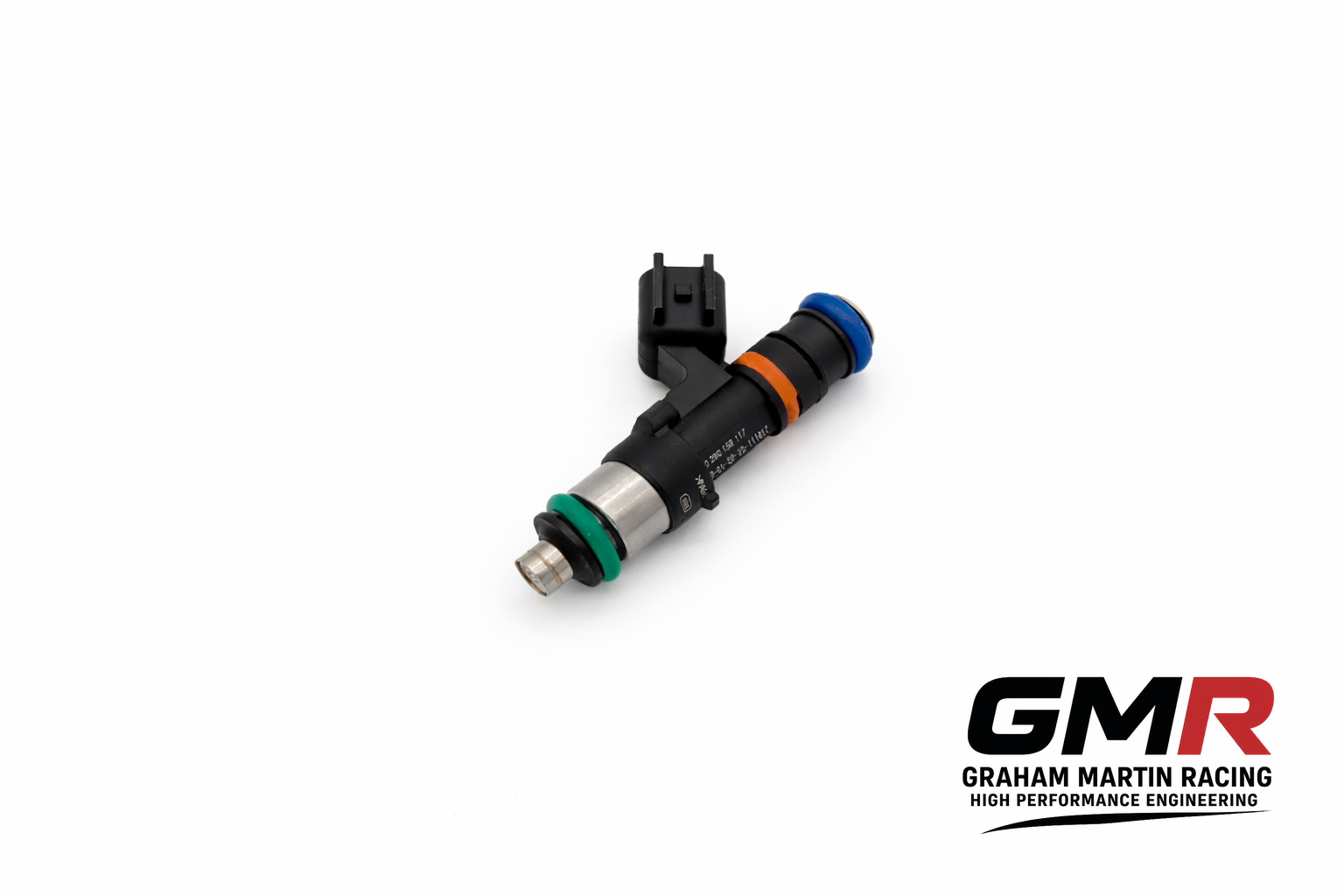
The go-to first upgrade is the genuine OEM Denso Acura RDX injector, part number 16450-RWC-A01. It’s a saturated, high-impedance unit rated 410 cc at 38 psi (550 cc at 70 psi) with an improved spray pattern over the factory 310 cc Type-S injector. It’s the standard choice for a modified all-motor K20 running cams, a header, a decent throttle body or a properly specified intake manifold, and builders generally rate it good for up to around 300 whp NA.
Two things people miss:
- Clips and pins. On most K20/K24 the RDX injector is a drop-in, but it needs RDX-specific injector clips/wires. On OBD1 (B/D-series swaps) you have to manually wire the harness adapters; K-series is generally direct fit.
- Engine management is essential. KPro, FlashPro, KTuner or equivalent to control the larger injectors and characterise them properly.
On the “does the swap make power” question, be honest with yourself: some claim a couple of lb·ft and 3–4 hp up top from finer atomisation, others measure nothing and treat it purely as headroom. I’d size it for headroom and treat any power as a bonus, not a reason to buy. If your build needs more than ~300 whp, move up a tier rather than chasing pressure on a 410.
Tier 2 — modified production injectors: 440cc / 550cc / 600cc
This tier covers Bosch EV14-based and modified Keihin units, and it’s where most fast road and club-level turbo or high-compression NA builds land. Key options:
| Injector |
Flow |
Notes |
| DeatschWerks 440cc (17U-08-0440-4) |
440 cc |
Set of 4 + O-rings, E85 compatible, flow-balanced to within 1–2% with flow report, 3-year warranty |
| DeatschWerks 600cc (21U-01-0600-4) |
600 cc |
K20/K24 & F22C fitment |
| DeatschWerks EV14 1000cc |
1000 cc |
40–80 psi range, min pulse 1.0 ms, max duty 93%, 12.4 Ω, USCAR connector |
| Keihin (FiveO) 440cc / 550cc |
440 / 550 cc |
Modified K20/K24 units, 36 psi (2.5 bar)–145 psi (10 bar), flow-matched sets with data sheet — “highly modified engines only” |
| Bosch EV14 0280158235 |
~600 cc (~65 lb/hr) |
Direct-fit K-series option cited by community |
DeatschWerks are drop-in for the application and engineered to fit the OEM harness, fuel rail and manifold — that matters, because a “close enough” injector that fouls a rail or sits proud of the manifold boss is a leak waiting to happen. Insist on a flow report so you know your set is balanced; 1–2% cylinder-to-cylinder variation is the difference between one cylinder running lean under load and all four seeing the same charge.
Tier 3 — purpose-built motorsport injectors: Injector Dynamics & FIC
For big-turbo, high-boost or serious E85/flex builds, you want injectors characterised specifically for repeatable metering at low pulse widths, not just a big headline flow number.
| Injector |
Flow @ 3.0 bar (43.5 psi) |
Max differential pressure |
Fuel compatibility |
| Injector Dynamics ID1050x |
1065 cc/min (petrol @ 52°C) |
10.0 bar (145 psi) |
All known fuels |
| Injector Dynamics ID1300x |
1335 cc/min (iso-octane @ 52°C) |
7.0 bar (101.5 psi) |
Designed for alternative fuels |
| Injector Dynamics ID1700x |
1725 cc/min (iso-octane @ 52°C) |
7.0 bar (101.5 psi) |
Methanol/ethanol/all hydrocarbon fuels |
| Injector Dynamics ID1750 / ID1750X |
1728 cc/min |
— |
K20/K20A2/K20A3/K20Z1, 14mm config |
| Fuel Injector Clinic 2150cc (BlueMAX) |
2150 cc/min |
— |
E85/high flow; NOT for VP Import, Q16 or MTBE oxygenated fuels |
The ID1050x is worth understanding as a design philosophy: it’s not a modified production injector, it’s a built-to-spec motorsport unit from the ID/Bosch Motorsport partnership. What you’re really buying is the characterisation — ID batch-test and match sets on dynamic flow across the pulse-width range for tight cylinder-to-cylinder consistency even at very low pulse widths, and they supply dead-time compensation values across the full pressure and voltage range. That data is what lets your calibrator get idle and part-throttle right on a 1065 cc injector; without it, a big injector is a blunt instrument.
FIC’s 2150cc BlueMAX is saturated/high-impedance and needs no resistor pack or peak-and-hold driver, and ships with a Data Match sheet — but note the vendor’s own warning about MTBE oxygenated race fuels. Match the injector’s material compatibility to the fuel you’ll actually run.
Why the data sheet matters as much as the flow number
Two injectors with the same nominal cc can behave completely differently once you’re at 1.0–1.5 ms pulse widths at idle. The specs that decide whether your engine idles and cruises cleanly are minimum pulse width, dead-time (offset) values across voltage, and how tightly the set is flow-matched. This is exactly the kind of detail that separates a proper calibration from a “close enough” map — and it’s why I insist on injectors that come with real characterisation data before I’ll put them on a customer’s calibration. Feed the ECU the manufacturer’s dead-time table for your voltage and pressure, then verify against a wideband — don’t guess.
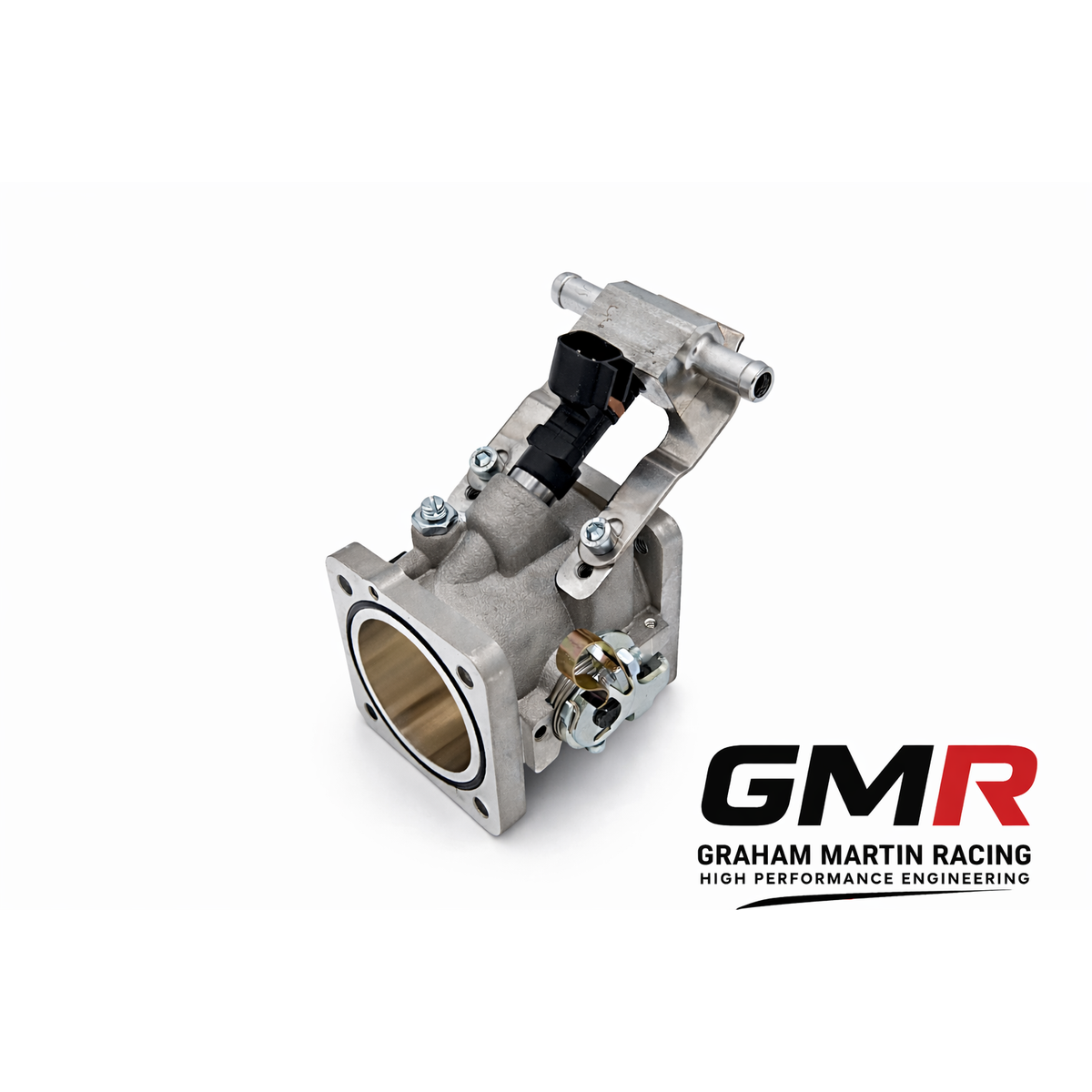
If you’re building the whole induction package rather than just swapping injectors, the injectors, throttle bodies and manifold need to be specified as a system. That’s the approach we take with our Honda K20 ITB kits and K20 individual throttle bodies — injector placement, spray targeting and rail packaging are part of the design, not an afterthought. It’s the same high performance engineering discipline we apply to custom race engine components.
Common mistakes I see
- Oversizing “for the future”. Fitting 1000 cc injectors to a 260 whp all-motor car buys you idle problems and worse low-load metering for headroom you may never use. Size for the build you’re running.
- Comparing flow at different pressures. Remember the RDX: 410 cc at 38 psi, 550 cc at 70 psi. Normalise to 3 bar.
- Skipping the flow/match data. Unmatched sets mean one cylinder is always the lean one under load.
- Ignoring fuel compatibility. E85 and certain oxygenated race fuels attack the wrong internals. Check the vendor’s compatibility statement.
- Forgetting the clips. The RDX swap needs RDX-specific clips/pins; plan for them.
FAQ
What size injectors do I need for a 300 whp K20?
Working from crank power (roughly 340–350 bhp at the flywheel for 300 whp, depending on drivetrain losses) and Bell’s formula, you’re looking at around 400–420 cc per injector at 60–70% duty on petrol. That’s exactly why the OEM Acura RDX 410 cc injector is the standard pick for a strong all-motor 300 whp build. If you’re running E85, add roughly 30% and step up to a 550–600 cc unit; if there’s boost involved, size against your actual target power and duty cycle rather than the wheel figure alone.
Are Acura RDX injectors a genuine upgrade or just headroom?
Primarily headroom, and that’s fine. Some builders measure a few horsepower and a little torque up top from the improved spray pattern; others see nothing on the dyno. Buy them because they give you fuelling margin to around 300 whp NA with proper management, not because you’re chasing power from the injector swap itself. Treat any gain as a bonus.
Can I just raise fuel pressure instead of fitting bigger injectors?
Up to a point, but it’s not a free lunch. Flow scales with the square root of the pressure ratio, so gains are modest, and higher rail pressure shortens your minimum controllable pulse width and shifts the injector’s dynamic behaviour — which hurts idle and low-load metering. It also loads the fuel pump harder. Raising pressure to claw back a small shortfall is reasonable; using it to double flow is not. Size the injector correctly instead.
Do I need engine management to change injectors on a K20?
Yes. To run anything other than the exact stock injector properly you need KPro, FlashPro, KTuner or equivalent so the ECU can be given the correct flow scaling and dead-time compensation. Without characterising the new injector, the ECU is metering blind — you’ll get poor idle, cold-start and part-throttle driveability even if wide-open throttle looks acceptable.
How do I know if my injector set is properly flow-matched?
It should ship with a flow report or data-match sheet listing each injector’s measured flow. Look for cylinder-to-cylinder variation within 1–2%. Anything wider and one cylinder will consistently run leaner or richer than the others under load — the sort of imbalance that shows up as a single hot cylinder on a proper tune. If a set arrives without data, that tells you something about how it was built.
The bottom line
Sizing K20 injectors is engineering, not shopping. Fix your reference pressure at 3 bar, confirm your stock starting point by engine code, calculate flow from crank power and a sensible duty-cycle target, then choose the smallest injector that meets it with a real characterisation data sheet behind it. Acura RDX 410 cc for most all-motor builds, modified EV14-based 440–600 cc units for fast-road turbo and flex-fuel, and purpose-built Injector Dynamics or FIC units once you’re in serious boost or E85 territory. Get the number right, feed the ECU the manufacturer’s dead-time data, verify against a wideband — and stop guessing.