
2026-06-27
GTI6 Individual Throttle Bodies: How to Get Real Power from an XU10J4RS
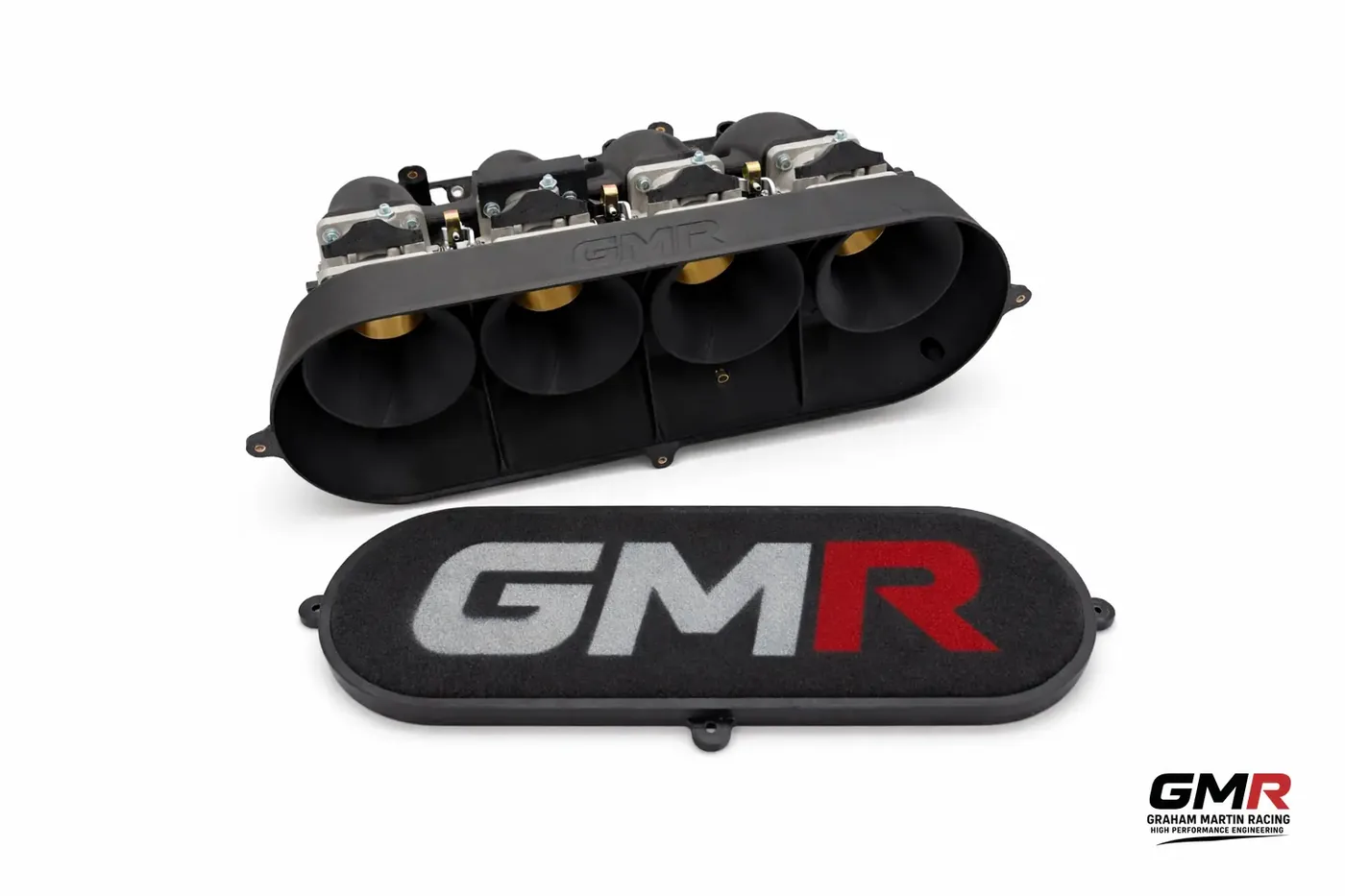
The Peugeot 306 GTI-6 is one of those cars that flatters its own induction system. From the factory the XU10J4RS gives you 167bhp at 6500rpm and 145 lb/ft at 5500rpm — a genuinely well-engineered 2.0-litre, 16-valve unit with a square 86mm bore and 86mm stroke, a 10.8:1 compression ratio and a reworked AS7 light-alloy head over the older S16. The factory did clever things to get there. But the moment you start chasing more, the standard single 64mm throttle and its Helmholtz-tuned plenum become the ceiling. That is exactly where GTI6 individual throttle bodies earn their keep.
I’m Graham Martin. I build induction and engine components for a living, and the GTI6/Mi16 family is one of the platforms I see most often. Here’s how I’d approach an ITB conversion on this engine — what the real options are, where the easy mistakes hide, and how to end up with a setup that actually makes measurable, repeatable power rather than just a nice induction noise.
Why the standard intake holds the XU10J4RS back
The OEM setup is acoustically clever, not airflow-generous. A single, progressively acting 64mm throttle body feeds a plenum that uses a Helmholtz resonator to tune the inlet and exhaust pulses into a smooth, fat torque curve. That’s why a stock GTI-6 drives so well in the mid-range — and also why owners who bolt on a free-flowing exhaust sometimes lose midrange torque: they’ve disrupted a balance the factory spent real money optimising.
Idle air, meanwhile, is handled by a separate stepper motor (ICV) fed from the airbox through a small rubber tube. Engine management is the Magneti Marelli AP10 with Flash EPROM, running speed-density off a MAP sensor above the throttle and a coil per cylinder.
When you go to individual throttle bodies, you throw away that resonator tuning entirely. Each cylinder now breathes through its own throttle and its own trumpet. That’s a huge airflow and throttle-response gain at the top, but it means runner length and trumpet selection are doing the torque-shaping job the OEM plenum used to do. Get that wrong and you’ll have a peaky engine that feels gutless below 4000rpm. Get it right and you keep the midrange and add the top end.
The three real routes to GTI6 ITBs
1. DCOE-pattern bolt-on throttle bodies
This is the most common and most proven GTI6 route. The throttle bodies bolt to a port-matched cast or fabricated inlet manifold using the classic Weber DCOE pattern, rather than mounting direct to the head.
Jenvey kits are the established option, built around the Jenvey/Longman MF013 inlet manifold — interestingly the same manifold used on the 405 Mi16 (XU9J4), so it’s a well-developed casting. They’re available in 45mm, 48mm and 50mm bore. A typical 45mm kit gives you the MF013 manifold, a set of 45mm DCOE bodies (MG023), plus alloy fuel rail, standoffs and injector clips. Step up to the 50mm kit and you get 50mm DCOE bodies (MG150) on the same manifold.
AT Power take the DCOE pattern further with a “shaftless” twin-housing design — billet aluminium, knife-edged butterfly valves, supplied fully assembled to bolt to the cylinder head intake face. Choice of 45mm or 48mm, with billet throttle linkage, runner extension tubes, billet ram pipes and a one-piece billet fuel rail. AT Power claim the shaftless layout removes the central shaft to cut turbulence and lift airflow by up to 10% over conventional shafted ITBs — that’s their figure, manufacturer marketing rather than an independently verified number, so treat it as directional.
2. Bike throttle bodies — the lower-cost route
If budget is the priority, bike-bodies are the sensible compromise. danST Engineering build a popular kit for the 306 GTI6 and 405 Mi16, based around a TIG-welded aluminium inlet manifold and a set of GSXR750 or GSXR1000 42mm throttle bodies. It retains the original 240cc injectors and is rated comfortably for outputs in excess of 240bhp — more than enough for most fast-road and clubman builds.
The kit comes with fluoro-lined silicone hoses, stainless Mikalor clamps, a 50mm aluminium trumpet set (25/50/90mm lengths to tune the curve) and a Pipercross filter. These are made to order on roughly a 10-working-day lead time, since the manifold is fabricated and the bodies prepared per order. It’s a clean, simple, reliable upgrade that’s earned its place in kit cars, hillclimb and clubman motorsport.
3. Sizing — bigger isn’t automatically better
For a road-and-track XU10J4RS staying near standard capacity and cam, 45mm is usually the sweet spot for throttle response and midrange. Jump to 48–50mm and you’ll see more at the very top, but you risk softening low-rpm driveability unless the cams, head and runner lengths justify it. On a square 84bhp/litre engine, throttle area is easy to over-spec. Match the bore to the actual build, not to the biggest number in the catalogue.
If you want the underlying theory before you commit, my deeper guides on getting real power from a GTI6 & Mi16 and choosing Peugeot XU throttle bodies that fit your head walk through the trade-offs in detail. If you’re weighing up the broader market, my guide on how to buy an individual throttle body kit in the UK covers what separates a kit that fits from one that doesn’t.
Trumpet and runner length: where the torque actually lives
Because ITBs delete the OEM resonator, the inlet tract length you build becomes your tuning lever. This is pressure-wave behaviour, not magic: a longer effective runner (manifold + trumpet) tunes the ram effect to a lower rpm, fattening midrange; a shorter tract pushes the peak higher up. That’s why a good bike-body kit ships with 25/50/90mm trumpet options — so you can move the torque curve to suit the engine and the gearing.
Radius matters as much as length. A well-profiled, organic trumpet entry conditions the air far better than a square-cut pipe, and the gains are real. I’ve covered the engineering properly in how velocity stack length and radius actually make power. Don’t treat trumpets as cosmetic — they’re a primary tuning component.
The bits people forget — and why they cost power
- Idle air. The OEM stepper-motor ICV is fed off the airbox. Go to ITBs and that source disappears, so you need a proper idle-air strategy — a dedicated idle valve or a calibrated bleed — or you’ll fight a hunting, stalling idle forever.
- Intake air temperature. ITBs sit closer to a hot engine bay. As a rule of thumb, roughly every 10°C of intake-air temperature rise costs about 3% power. A well-designed airbox or heat-managed feed is worth real numbers on a dyno — this is exactly where our carbon composite intake work pays off, with low thermal conductivity and, where specified, double-wall air-gap insulation keeping charge temperatures down.
- Calibration. ITBs on a MAP-based system change the whole fuelling picture. You’re no longer running the factory plenum’s smooth signal — throttle transients are sharper and the map has to reflect that. This is not a job for someone else’s base map.
Calibration: the part that turns hardware into power
I’ll be blunt: a set of ITBs bolted on with a guessed map is slower and less driveable than the standard car. The hardware only delivers once it’s mapped to the specific combination — bores, trumpets, cams, exhaust and all. Whether you keep the Magneti Marelli platform or move to a standalone ECU, the induction and the calibration have to be developed together. That’s how I work, and it’s covered in detail in how ECU calibration for motorsport is actually done.
If your build needs something beyond the off-the-shelf options — a different manifold geometry, a specific airbox package, or bespoke runners — that’s exactly the kind of custom race engine component work we do in-house, including DDM and carbon composite parts engineered around your exact engine rather than a universal-fit compromise. Related: if 3D printing is part of your prototyping plan, see how 3D printing fits the motorsport workflow @ Ask The Nozzle.
FAQ
How much power can I expect from GTI6 individual throttle bodies?
It depends entirely on supporting mods and calibration. On a near-standard XU10J4RS, ITBs plus a proper map typically sharpen response and lift top-end power while preserving midrange if the runners are sized right. Bike-body kits like the danST setup are rated comfortably beyond 240bhp on the original 240cc injectors, so the throttle hardware is rarely the limit — the head, cams, exhaust and calibration are.
Will ITBs ruin the GTI-6’s mid-range torque?
They can, if you fit them carelessly. The standard plenum uses a Helmholtz resonator to fatten the midrange, and ITBs remove that. You recover it with correctly chosen runner and trumpet lengths — a longer effective tract tunes the ram effect lower in the rev range. This is why trumpet length options matter and why calibration is non-negotiable.
DCOE-pattern or bike throttle bodies — which should I choose?
DCOE-pattern kits (Jenvey, AT Power) are the proven, refined route with 45/48/50mm options and strong development behind the manifolds. Bike bodies (GSXR-based) are the lower-cost, reliable route that still supports serious power. For a focused fast-road or clubman build on a budget, bike bodies are excellent; for a more developed or higher-revving engine, DCOE-pattern bodies and a tailored intake are worth the spend.
Do I need to change the ECU?
Not necessarily. The factory Magneti Marelli AP10 can be recalibrated, but ITBs change the fuelling and idle-air picture significantly, so it must be remapped — and you’ll need to address idle air, which the OEM stepper motor no longer supplies cleanly. Many builders move to a standalone ECU for the flexibility, but the right answer depends on your goals and budget.
Build it as a system, not a shopping list. Match the throttle bore to the engine, choose trumpet lengths to put the torque where you want it, manage intake temperature, sort the idle air and calibrate it properly. Do that and a GTI6 ITB conversion isn’t just louder — it’s measurably, repeatably faster.
Related: once the build’s sorted, put it to use — see this no-nonsense guide to UK car track days @ Trackday Finder.
Related: Made to Fit Throttle Body Kit: Why Engine-Specific Beats Universal Every Time