
2026-09-28
Bike Carbs vs ITB Conversion Cost: The Honest Numbers for a UK Build

The short version: a bike-carb conversion gets you running for the least money up front, but you pay it back in dyno time and fettling; an individual throttle body (ITB) conversion costs more to buy because you're also buying injectors, a fuel system and a standalone ECU — but it maps in a fraction of the time and gives you fuelling and ignition control a carb will never touch. For a typical UK four-cylinder build, the honest bike carbs vs ITB conversion cost gap is smaller than most people expect once you add up the whole picture, because the cheapest bit of hardware often carries the most expensive tuning bill.
Below I break down every line item — hardware, ECU, fuel system, filtration and mapping — with real UK and market figures, then set out where each route genuinely wins. Peak power, incidentally, is decided by throttle bore diameter in both cases; the difference between these two routes is almost entirely about driveability, repeatability and how much of your life you spend under the car with a jet drill.
Bike carbs vs ITB conversion cost: the headline numbers
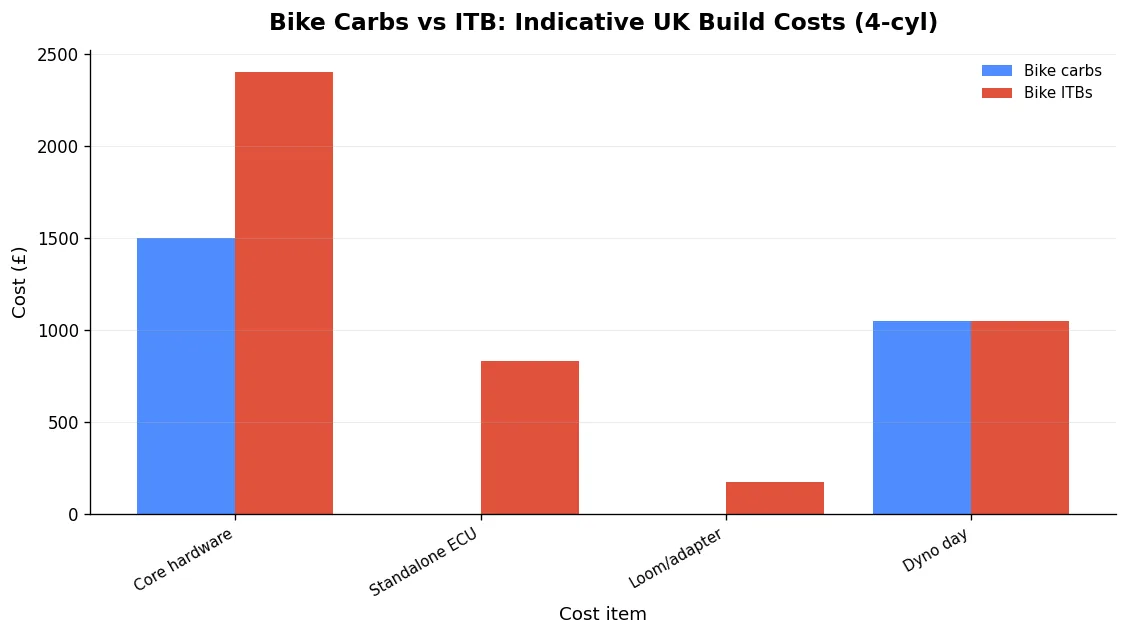
Here's the whole picture side by side for a four-cylinder conversion. Treat these as indicative market figures, not quotes — vendor pricing, VAT treatment and exchange rates move, so verify against current listings before you commit.
| Line item | Bike carbs | Bike ITBs | Purpose-made car ITBs |
|---|---|---|---|
| Core hardware (4-cyl) | ~£250 used to ~£1,500 new set | Starter pack ~£2,400 (incl. injectors, rail, sensors) | ~£1,000–£2,500+ before ECU/injectors |
| Standalone ECU | Not required (mechanical) | Required (~£695+) | Required (~£695+) |
| Loom / adapter | — | ~£145–£175 | ~£145–£175 |
| Fuel system | Low-pressure regulator + fittings | Pump, swirl pot, regulator, return lines | Pump, swirl pot, regulator, return lines |
| Airbox / filtration | Recommended for track | Recommended for track | Recommended for track |
| Dyno / mapping | Can eat most of a day (£400–£1,050) | Faster session (£400–£1,050) | Faster session (£400–£1,050) |
Notice the pattern from a single UK vendor: a bike-carb starter pack (for example a Ford Crossflow ZZR600 37mm kit at roughly £1,500) undercuts the equivalent bike-ITB starter pack (a Peugeot 106/Saxo GSXR 38mm kit at roughly £2,400) by a clear margin — and the whole of that difference is the injection system the ITBs need to run. Bike throttle bodies are popular for one honest reason: they're cheap and plentiful because the bike world moved to EFI, not because of any car-vs-bike volumetric-efficiency magic.
Hardware: where the money actually goes
Bike carbs
Keihin FCR-type flat-slides are the default choice. A set of four runs from around £600 used to £1,500 new, and bargains exist — people have picked up usable FCR sets for a couple of hundred pounds precisely because modern bikes went fuel-injected. Rebuild kits (jets and seals) are cheap at roughly £30–£60 a set, which matters, because on carbs you'll buy several as you dial the jetting in.
Two carb-specific catches. First, fuel pressure must be low — bike carbs are gravity-fed by origin, so you need a dedicated low-pressure regulator rather than EFI's ~3 bar; get this wrong and you'll flood float bowls. Second, bike carbs were designed for a machine that leans into a corner, so they deal with pressure changes rather than the lateral G a car generates. That's a real, configuration-dependent risk — some CV-carb race cars have pulled over 2 lateral G without drama — but it's something to design around, not ignore.
Bike ITBs vs car ITBs
Bike ITBs are cheaper to source than purpose-made car bodies, but the moment you fit them you're committed to injectors, a fuel rail, sensors and an ECU. Purpose-made car ITB kits from an established manufacturer are modular and better engineered for the job — a typical four-cylinder kit gives you a matched pair or set of bodies, an EFI inlet manifold, fuel rail and airhorns — but every one of them requires a standalone ECU. Some kits are clever about cost by retaining the OEM fuel rail, injectors, throttle-position and MAP sensors where the donor was injected from the factory; if your car came as EFI, that alone can save a heap.
On sizing: throttle bore isn't as critical as carb choke size, because a throttle plate isn't metering fuel. In most four-cylinder applications 45mm bodies are plenty — a pair of 45s has the flow potential for around 260bhp. Don't oversize; you lose air speed and part-throttle resolution for a peak-power number you'll never use.
The costs that sneak up on you
The throttle bodies and the ECU are the easy things to budget. It's the fuel system that ambushes people: pumps, swirl pots, regulators, fittings and return lines add up fast on any injection route. If your donor was carburetted from the factory, you're building an EFI fuel system from scratch.
Filtration is not optional on track. ITBs ingest a lot of air, and running them naked on a race-prepped engine is a fast route to bore and ring wear. Plan for a properly designed airbox or filtration matched to the engine — this is exactly the kind of engine-specific geometry we produce as DDM composite parts. Direct Digital Manufacturing lets us print hollow, closed internal cavities, tuned-length runners and internal transitions in one piece that simply cannot be laminated or machined, and print them in PPA-CF (carbon-fibre reinforced polyphthalamide) rather than cut them from aluminium.
That material choice pays off in two measurable ways. PPA-CF has a density of 1.25 g/cm³ — under half aluminium's 2.70 g/cm³ before you even count the hollow section — and as a reinforced polymer with a trapped-air cavity it picks up far less intake-charge heat than aluminium, whose thermal conductivity sits at 150–220 W/m·K. That insulation advantage is strongest at idle and heat-soak, and matters less at sustained wide-open throttle; I'll always tell you which case applies to your build. On under-bonnet heat, the number that matters isn't the 85°C glass transition — PPA-CF is semi-crystalline and fibre-reinforced, so it keeps working well above that, which is why its heat deflection temperature is 196°C at 1.8 MPa (227°C at 0.45 MPa) and Vicat softening is 232°C. Where sustained temperature is extreme, or where Z-axis strength governs the part (PPA-CF is 57 MPa in Z versus 168 MPa in the XY plane, so orientation matters), a laminated/autoclave composite can be the right call — I reach for it when the engine demands it, not by default.
The standalone ECU — the price of admission for ITBs
Any ITB or EFI route needs an aftermarket ECU. A UK-made Emerald K6+ is a sensible budget-professional benchmark at £695 ex-VAT (£834 inc.), plus a loom or plug-and-play adapter around £145 ex-VAT (£174 inc.). It ships with a base map — Emerald's generic K6+ comes pre-loaded for a naturally aspirated 200bhp 16v four — but both the base map and the ECU configuration will need modifying in every case. The market spans from ~£400 hobby units to £2,000+ professional systems (Motec, Link, Syvecs, Haltech, ECU Master, DTA, Omex and others).
One critical point specific to throttle bodies: ITBs give a poor, noisy MAP signal at idle and part-throttle because each cylinder breathes through its own plate. The standard strategy is Alpha-N (throttle-angle based) — on a grassroots MegaSquirt-on-bike-ITBs build, don't kid yourself that speed-density will work cleanly; tune Alpha-N. This is exactly why calibration isn't optional. A K20 ITB kit without proper calibration is half a job: the stock fuel and ignition maps were never written for the airflow signal ITBs produce, and you need a base map that understands MAP or Alpha-N strategy, correct throttle-plate idle bypass and careful transient fuelling. We do this work in-house alongside the hardware.
Mapping cost: the reason carbs aren't really "cheaper"
This is where the two routes diverge sharply. UK rolling-road rates run roughly £100–£170 per hour, with typical minimums of a £400 complete map and a full seven-hour dyno day around £1,050. On ITBs, mapping is software: the tuner changes a cell and the engine responds on the next pull.
Carbs are mechanical. Every change means dismantling or removing the carbs, swapping jets or needles, draining fuel, reassembling and running back up. It's easy to see how a carb tuning session eats most of a day — and if you're paying £100–£170 an hour for that, the cheap carbs get expensive quickly. That's the real lesson of the headline gap: the cheapest hardware often carries the priciest tuning bill.
Driveability and the mistakes that ruin a good conversion
Peak bhp is set by throttle bore in both cases; driveability is where they differ, and where people go wrong. A few concrete points:
- Butterfly throttles are non-linear. A flow bench shows a large inrush of airflow in the first few degrees of plate rotation that tapers off as it opens further. Linearising the cable pull does not linearise the airflow. Fix it with throttle geometry — a progressive throttle quadrant, or a lever instead of a pulley, gives you the progressive actuation you want.
- Don't keep the bike's small throttle wheel. The classic "twitchy pedal" complaint comes from leaving the motorcycle's small-diameter throttle wheel on a car pedal — small foot travel then equals a large plate movement. Match the pulley to the pedal.
- Bike carbs can lack a low-speed circuit compared with car carbs, which can hurt street manners — this is model-dependent, so verify against your specific carb before assuming the worst.
- Injection fuels better. Rather than air dragging fuel through a venturi, ITBs mist fuel directly at the port, which gives a cleaner charge and — with mappable fuelling and ignition — a driveability advantage carbs struggle to match.
If you want to go deeper on the ITB side, our platform-specific guides cover the detail: the Zetec ITB kit, Ford Duratec bike throttle body kit, Peugeot TU throttle bodies and Vauxhall XE throttle body kit. On the carb side, see our guides to the Ford Duratec bike carburettor conversion and Zetec bike carburettor conversion. If you're specifying the fuel side, the billet fuel rail guide is worth reading, and kit-car builders should start with choosing throttle bodies that actually fit.
Which route is right for your build?
The field consensus is straightforward and I agree with it: if you have the budget for the whole ITB package — bodies, ECU and mapping — do it, because mappable fuelling and ignition comprehensively outstrip carbs on driveability, cold starting and repeatability. If the budget isn't there and you're prepared to put real hours into fettling, a bike-carb conversion still makes strong power and can be made surprisingly driveable. There's a well-known cheap ITB datapoint too — a Ford ST170 on AEG bike ITBs and standard cams making just under 170bhp for roughly £1,500 all-in — but that was DIY labour and old prices; read it as "possible", not "typical".
Are bike carbs actually cheaper than ITBs overall?
At the hardware counter, yes — a bike-carb set can be a fraction of a bike-ITB kit, and you skip the ECU and injection fuel system entirely. Over the whole build, the gap narrows because carbs take far longer to tune on the dyno, and dyno time is charged by the hour. If you tune it yourself, carbs stay cheapest; if you pay a tuner, ITBs often come out closer than the sticker price suggests.
Do I need a standalone ECU for a bike-ITB conversion?
Yes. Bike ITBs need injectors, a fuel rail, sensors and a standalone ECU running an Alpha-N (throttle-angle) strategy, because the MAP signal from individual throttles is too noisy at idle and part-throttle to fuel cleanly. Budget from around £695 for the ECU plus £145 for a loom or adapter, then mapping on top.
What size throttle bodies do I need?
For most four-cylinder engines, 45mm bodies are plenty — a pair of 45s flows enough for around 260bhp. Throttle bore is far less critical than carb choke size because the plate isn't metering fuel, so resist oversizing, which costs you air speed and part-throttle control.
Can bike carbs cope with cornering loads in a car?
It depends on the carb and the installation. Bike carbs were designed for a leaning machine and a gravity feed, so lateral G and fuel-delivery pressure need designing around — but plenty of CV-carb cars have run over 2 lateral G without issue. Treat it as a solvable configuration problem, not an automatic disqualifier.
The bottom line
Bike carbs win on up-front hardware cost and let you avoid an ECU; ITBs win on driveability, mapping speed and long-term repeatability, at the price of an injection system and a standalone ECU. Whichever route you choose, the parts that make or break it are the ones nobody budgets for — the fuel system, a properly matched airbox and, on ITBs, the calibration. We build the intake geometry as engine-specific DDM composite parts and do the calibration in-house, so the whole combination is optimised on real dyno data rather than bolted together and hoped for. If you want a straight answer on which route suits your engine and budget, send me the spec and I'll tell you honestly.