K20 Individual Throttle Bodies: How to Spec, Fit and Tune Them Properly

Throttle plate size is where most K20 individual throttle bodies decisions go right or wrong, so let’s start there. The K-series intake port has an effective diameter of roughly 47 mm, and once you factor in flow loss across the butterfly and its shaft, the throttle body’s minimum working section wants to be larger than the port it feeds — not smaller. That single relationship explains why the sensible off-the-shelf range for a K20 sits between 50 and 60 mm, why 45 mm kits exist but rarely suit a serious build, and why there is no single “best” number: it depends entirely on where you want the engine to make power.

The K20 is a near-square engine — roughly 86 mm bore and 86 mm stroke — with a 16-valve DOHC i-VTEC head, 35 mm intake valves and 30 mm exhaust valves. The factory port shape is genuinely good; it’s widely regarded as one of the best OEM K-series ports, near-optimal in shape and size, which is why worthwhile gains come from expert porting rather than hogging material out. Bolting on K20 individual throttle bodies replaces a single 62 mm throttle valve feeding a shared plenum with one throttle per cylinder — the reason throttle response and part-throttle control transform even when peak power barely moves.

Throttle plate sizing: the trade-off nobody can settle for you

Manufacturers typically offer 45, 48, 50, 52 and 55 mm plates, with a few going to 57 and 60 mm. Jenvey’s standard K20 kit is a good reference point because the geometry is published: a tapered bore over 66 mm length, 51 mm at the opening, 48 mm at the butterfly and 45 mm at the exit. That taper is deliberate — it accelerates the charge toward the port and matches the K20/K24 port angle of 17.5 degrees.

The big-bore school argues the opposite. Given a ~47 mm-equivalent port, the case runs that you need a minimum ~54 mm to recover the flow lost to the plate and shaft, and that 57 mm suits a stock long block while 60 mm suits a fully built K20. There’s data behind it — but read the application. Those recommendations come largely from the drag world, where close-ratio gearboxes keep the engine above 7,500 rpm and mid-range torque is almost irrelevant. Size everything big and you win on a drag strip.

On a road or road-race car, the picture inverts. Throttle diameter has a surprisingly small effect on peak power — one road-course K-series tuner measured only around a 1% peak VE change going from 70 mm to 68 mm. What you gain from the smaller plate is resolution in the first 20% of pedal travel, which is where a road-course driver lives. Trading one or two peak horsepower for that control is a good deal.

Plate size Best suited to Trade-off
45–48 mm Under-bonnet street kits, factory ancillaries retained Restrictive on a built engine; fine for driveability
50–52 mm Street/road-race stock or lightly built K20 The pragmatic default; strong mid-range, minor top-end give-away
55 mm Fast road / track, ported head Balanced; needs the airflow to justify it
57–60 mm Drag / high-rpm built engines, close-ratio boxes Softens mid-range; wants a high, narrow power band

My rule of thumb: 50 mm is the smallest I’d generally put on a K20, 52 mm is often the sweet spot for a street or road-race car, and I only reach for 57–60 mm when the cams, head and gearbox mean the engine genuinely lives at the top of the range. There’s more detail on matching plate size to your build in our guide on how to spec, fit and tune K20 ITBs that actually deliver.

Runner and trumpet length: it’s the whole tract that tunes

Here’s the point that gets missed: it is the total intake tract length that sets resonance, not the trumpet on its own. The tuned length runs from the back of the intake valve all the way to the radiused mouth of the stack. The trumpet is simply the adjustable end of that pipe — and it has two jobs. First, its flared bell mouth keeps flow attached and laminar as air turns into the tract. Second, together with the runner it sets the intake as a resonating pipe, and total length dictates the frequency at which the pressure pulses arrive.

The mechanism is ram tuning. As the intake valve shuts, the moving air column slams to a stop and reflects a positive pressure wave back up the runner. Tune the length so that reflected wave arrives back at the valve just as it reopens, and you ram-charge the cylinder — free volumetric efficiency at a specific rpm. Longer tracts time slower waves and build low-end and mid-range torque; shorter tracts favour top-end power where the waves cycle faster. AT Power, Jenvey and every credible source agree on the direction of that effect.

Kit / component Length reference
Clockwise Motion 50 mm air horns, ~220 mm total tract
Toda Standard trumpet 33 mm; delivery pipe sized for OEM K20A/DC5 injector nozzle
AT Power Runner extensions of 70, 100 or 130 mm
RZ Crew Maximum recommended trumpet length 75 mm

Best practice is not to fix a single length and hope. Buy or make several extension and trumpet lengths and dyno them, moving the power band to where you want it. A “trumpet” and “bellmouth” (UK terms) do the same job as an “air horn” (US), and runner, inlet tract and stack all describe the extension between throttle and trumpet.

Where DDM composite intake parts change the calculation

This is where I’ll be specific about what we build, because the manufacturing route matters. The traditional choices are billet aluminium throttle housings and hand-laid or autoclaved laminate airboxes and trumpet stacks. Both are valid. But a lot of intake geometry that genuinely helps a K20 simply cannot be laminated or machined in one piece — and that’s the case for our DDM composite parts, printed in PPA-CF (carbon-fibre reinforced polyphthalamide) by Direct Digital Manufacturing.

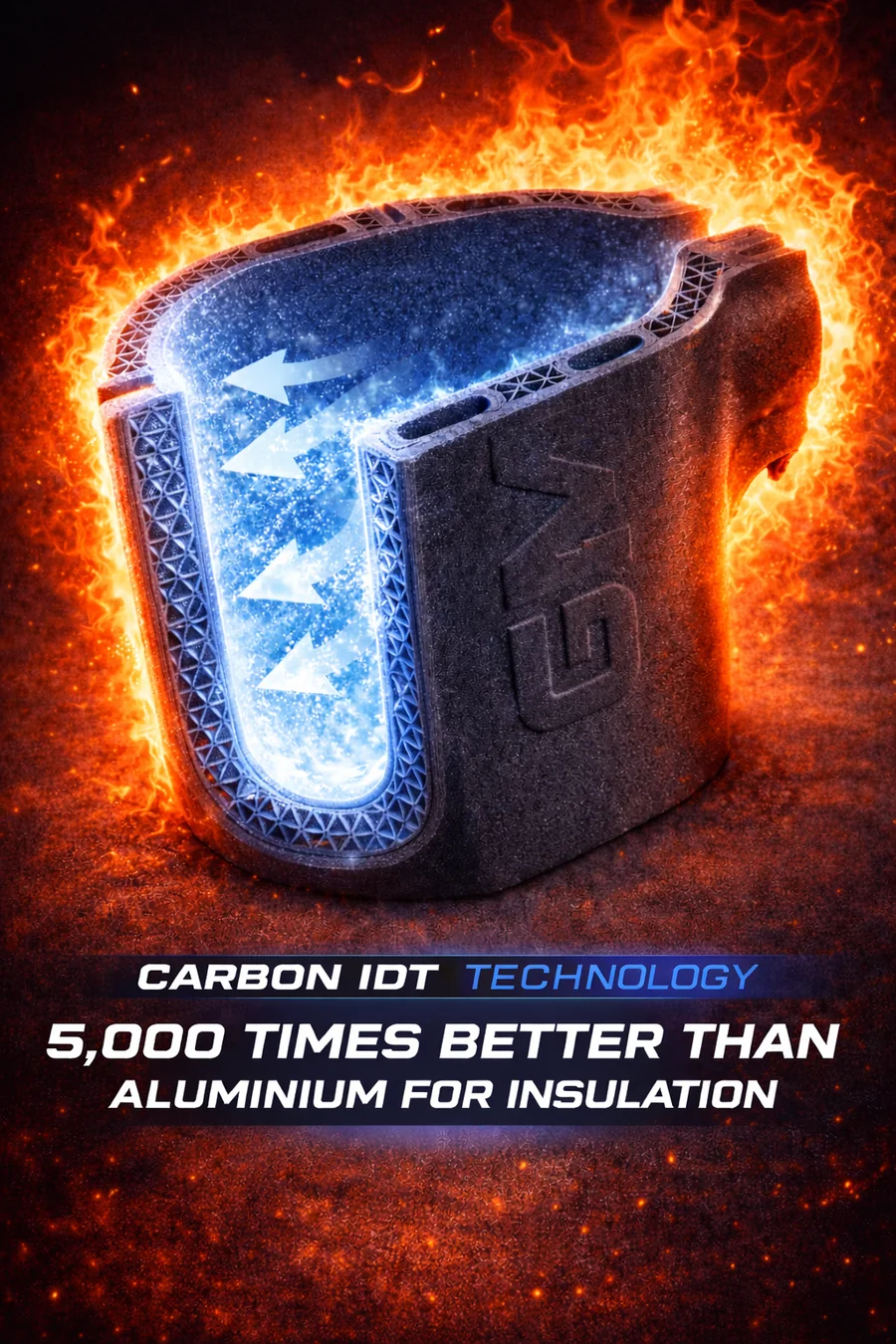
The advantages break down cleanly. First, geometry: DDM lets us build hollow, closed internal cavities, tuned-length runners and internal transitions in a single part that no layup or CNC operation could produce without splitting and bonding. Second, thermal insulation: a fibre-reinforced polymer wall plus a trapped-air cavity picks up dramatically less heat into the intake charge than aluminium, which has a density of 2.70 g/cm³ and thermal conductivity of 150–220 W/m·K — orders of magnitude higher than the polymer. That matters most at idle and during heat-soak in traffic; at sustained wide-open throttle the effect is smaller, and I’ll always tell you which case applies to your car. Third, weight: PPA-CF is 1.25 g/cm³, under half aluminium’s density before you even count the hollow section. Fourth, fit: the part is engineered to your exact port and packaging — genuine port matching, no “universal fit” compromise. Fifth, iteration: we go from CAD to dyno quickly, so runner geometry is optimised on real data rather than a catalogue.

On the material itself, the number people fixate on is the 85°C glass transition, and they misread it. PPA-CF is semi-crystalline and fibre-reinforced, so load-bearing capability persists well above Tg — which is exactly why its heat deflection temperature is 196°C at 1.8 MPa (227°C at 0.45 MPa) and Vicat softening is 232°C. For under-bonnet intake duty, HDT is the figure to lead with, and it comfortably covers intake-charge and radiated engine-bay temperatures.

PPA-CF property Value
Tensile strength (XY / Z) 168±4 MPa / 57±5 MPa
Young’s modulus (XY) 11,800±670 MPa
Bending strength (XY) 208±6 MPa
Impact strength (XY) 41.7±2.8 kJ/m²
Density 1.25 g/cm³
Heat deflection (1.8 / 0.45 MPa) 196°C / 227°C
Vicat softening 232°C
Saturated water absorption 1.30%

I’ll be honest about the limits. Note the Z-axis tensile strength — 57 MPa against 168 MPa in XY — so print orientation governs, and any highly loaded feature has to be oriented and detailed with that anisotropy in mind. Where the duty is very high sustained temperature, or where load runs squarely along the weak axis, a laminated/autoclave part can genuinely be the right call. I recommend DDM composite when the engineering supports it, not as dogma. For a deeper look at where each route wins, see our pieces on the carbon composite airbox for the K20 and building an enclosed induction system that actually lowers intake temps. There’s also useful background on the DDM workflow itself over at how 3D printing fits the motorsport workflow.

Tuning: alpha-N vs speed-density is the biggest gotcha

The single thing that catches people out with K20 individual throttle bodies is fuelling strategy. A standalone or fully aftermarket ECU is effectively mandatory — Jenvey and RZ Crew both state it plainly, and RZ Crew go further: even though their system follows the stock TPS for install simplicity, you need a standalone ECU to start and tune the car properly, and a professional tuner is strongly advised.

Why does the factory MAP strategy struggle? With ITBs the manifold vacuum collapses the instant you crack the throttles off idle, so the MAP signal is very low and very unstable at idle, and any throttle movement generates huge MAP swings the ECU can’t keep up with. Speed-density loses its reference.

The fix is alpha-N — TPS versus RPM. On a naturally aspirated engine, throttle opening and RPM together determine intake pressure, so TPS and RPM are all the ECU needs, and reading a fast resistor beats waiting on a slow MAP sensor. Alpha-N does need correction: apply barometric (atmospheric) pressure and air-temperature compensation, or lambda will drift with load — uphill versus downhill at the same TPS gives slightly different actual MAP, nudging the mixture rich or lean. Some ECUs offer a blended ITB mode that mixes alpha-N with speed-density to cover low-throttle MAP instability; whether full alpha-N or blended is better depends on your throttle size and MAP plumbing.

Two practical notes. If you do plumb MAP, take a signal from each runner into a common vacuum block sized large enough to average the pulsations, shared with the brake-booster feed. And trigger acceleration enrichment from TPS, not MAP. Get this right and driveability is a non-issue — plenty of K-Pro cars daily-drive in stop-and-go traffic, idle cleanly and never stall; you’d never know the ITBs were there until the bonnet’s up. It comes down to the tune. If you’d rather not learn alpha-N the hard way, this is exactly the kind of work our bespoke calibration service exists for.

Fitment realities that decide which kit you can actually run

  • Water pump clearance. Most direct-to-head kits foul the OEM water pump area. Jenvey’s 60 mm kit makes no compromise and requires the water pump removed or modified; the EP3 51 mm kit needs the water pump housing modified. Taller motorsport and some 50/55 mm kits push you to an electric water pump — budget for it.
  • Injectors. Standard Honda injectors won’t fit every kit, and many kits move the injector further upstream into the butterfly’s part-throttle turbulence to aid atomisation. Toda is the exception, designed around the OEM injector nozzle. Size the injectors to the build — our K20 injector sizing guide walks through it.
  • Port matching. Good kits are cut to the K-series port and the 17.5-degree K20/K24 port angle. On a K24 head you may need light porting to match.
  • Bonnet clearance. Tall 60 mm motorsport kits suit Formula and sports-prototype cars with no bonnet above them. Under-bonnet kits like AT Power’s 45 mm sit below the factory bonnet line and keep the factory fuel rail, injectors, throttle cable, intake gasket and thermostat housing.
  • Actuation. OEM CTR/RSX-S throttles are drive-by-wire. Converting to cable ITBs or fitting an electronic throttle actuator is a real decision — see our guide to getting the ITB throttle linkage right.

What about shaftless bodies and peak power?

AT Power’s patented shaftless butterfly design removes the central shaft to cut turbulence, claimed to raise airflow by up to 10% against conventional shafted bodies (their 45 mm units are twin-housing oval shaftless billet). Treat that 10% as a manufacturer claim, not independently verified — but the principle is sound: the shaft and its wake are a real restriction, which is partly why the big-bore camp oversizes to compensate.

Set expectations honestly: on a stock long block, ITBs are not primarily a peak-power mod. The transformation is in throttle response, part-throttle control and the character of the engine. Peak power gains grow as the rest of the build — cams, head, exhaust — catches up and the intake finally becomes the limit.

FAQ

What size throttle bodies do I need for a K20?

50 mm is the smallest I’d generally recommend; 52 mm is a strong street/road-race default. Go to 55 mm for a ported fast-road/track engine, and only to 57–60 mm for a built, high-rpm drag engine with a close-ratio gearbox where mid-range torque doesn’t matter.

Do K20 ITBs need a standalone ECU?

In practice, yes. Manifold vacuum collapses off idle, so the factory MAP-based strategy can’t tune reliably. You want a standalone ECU running alpha-N (TPS vs RPM) with baro and air-temp correction, and ideally a professional tuner.

Will ITBs make my stock K20 more powerful?

Only modestly on a stock long block — the headline gain is throttle response and driveability. Real peak-power gains arrive once cams, head porting and exhaust make the intake the limiting factor.

Do longer or shorter trumpets make more power?

Neither universally. Longer total intake tracts build low-end and mid-range torque; shorter tracts favour top-end power. Because it’s the whole tract that tunes, dyno several lengths and place the power where your car needs it.

Share the Post:

Related Posts

Stay in the loop