Ask ten people what a “remap” is and you’ll get ten different answers. That’s the first problem with ECU calibration in motorsport: the language is vague, and vague language hides shortcuts. When someone sells you a “remap,” they haven’t actually told you anything — it could mean a fresh chip, an OBD flash, an off-the-shelf custom file, or a full live map developed on a dyno. Those are not the same job, and they don’t produce the same result.
I’m Graham Martin. I calibrate engines for a living, on both OEM and aftermarket ECUs, alongside designing and manufacturing the intake hardware that calibration has to work with. This is a straight-talking guide to ECU calibration for motorsport in the UK — what it actually involves, what separates a proper job from a “close enough” one, and what you should expect to pay and receive.
What ECU calibration actually means
Calibration is the process of telling the engine management system exactly what to do across the entire operating range — not just at peak power. A modern ECU manages fuel quantity, injection timing, ignition advance, boost pressure, cam phasing, throttle maps, torque limits, lambda targets, knock detection and a stack of engine-protection logic, all simultaneously. On a representative OEM unit like the Bosch MED17.5.1 you’re working with injection timing and fuelling, high-pressure fuel pump control, ignition mapping, turbo boost management, electronic throttle calibration, lambda monitoring, knock control and protection strategies — each as its own set of tables.
Calibration is the art and science of getting all of those tables to agree with each other, and with the physical engine in front of you. That’s why intake hardware and calibration are two halves of the same problem — change the airflow and every fuelling and ignition cell needs revisiting.
The terminology, decoded
- Chipping — historical. Cars built before roughly 1998 used EPROMs in the ECU that had to be removed, recalibrated and refitted; some were plug-in, others soldered. Largely obsolete now.
- Flash tuning — modify the ECU software directly through the diagnostic port, no ECU removal. The mainstream method for stock-based units.
- Bench tuning — ECU removed and worked on a bench. Common for locked or older units.
- Live mapping — an emulator accesses the ECU’s data while the engine is running, letting you adjust values in real time. Invaluable for chasing hesitations, flat spots and glitches on engines with uprated cams, ported heads or altered compression.
One important distinction: most stock ECUs can’t be changed in real time while running — edits must be written to the ECU by flashing. Factory race ECUs and standalone systems are the exception; they support genuine live tuning.
Mechanical health comes before the laptop
This is non-negotiable, and it’s where the cowboys reveal themselves. You do not calibrate a sick engine. Before any tables get touched, the engine’s mechanical condition must be verified — compression test, leak-down test, and a proper boost-leak assessment on forced-induction cars. If the data shows an underlying fault, a competent calibrator stops and tells you to fix it, rather than papering over it with fuel and retard.
And always back up the original ECU data before changing anything. If you ever need to restore factory settings, you’ll want that file. Skipping the backup is the kind of “it’ll be fine” shortcut I have no time for.
If the pre-checks throw up a problem, the calibration stops there. Pushing on regardless isn’t tuning — it’s gambling with someone else’s engine.
The dyno: why the type matters
The dyno is the feedback loop. It gives you real-time torque and air–fuel ratio data so you can find the genuine sweet spot for drivability, reliability and power — not a guess. But not all dynos are equal for calibration work.
Steady-state load is essential
A dyno with a power absorber — an eddy-current retarder, water brake or hydraulic brake — can control and vary load, holding RPM steady regardless of throttle position. That steady-state capability is essential for properly mapping an aftermarket ECU, because it lets you sit in a single load/RPM cell and dial it in before moving on. You map the whole site, not just the headline run.
An inertia dyno has no brake — just a single roller of known mass. From the mass, roller diameter and acceleration rate you can calculate power, but with no load control it’s really only useful for wide-open-throttle tuning. Fine for a headline figure; not enough for a complete map.
Engine dyno vs chassis dyno
An engine dyno requires the engine out and mounted to a fixture; a chassis dyno tunes it in the car. Engine dynos are better for development — easy access, fast part swaps — which is why professional race teams, engine builders and OEMs favour them. A chassis dyno is more convenient and tunes the complete vehicle as it’ll actually run.
How long it takes, and what it costs
An ECU cannot be calibrated properly in an hour or two unless it was nearly perfect to begin with. The honest answer for most custom or live mapping work is a full day. The car goes on the dyno, the calibration is developed iteratively, and you leave with printouts of flywheel and wheel power, torque, AFR and boost — evidence, not promises.
On pricing, one UK specialist quotes around £900 including VAT for custom mapping on their dyno, covering dyno cell hire and two professional operators/calibrators. Treat that as an indicative single-vendor figure rather than a market-wide standard — bespoke motorsport calibration varies with platform, ECU and scope.
The remote calibration workflow
Remote calibration has become genuinely common and, done right, it works. You run the car, log data, and send it to the calibrator. They review the logs, revise the calibration file, and send it back. You flash it and run again. That cycle repeats until the calibration is where it needs to be. The key is disciplined data — proper logging of intake air temperature, exhaust gas temperature, RPM, throttle position, knock and wideband AFR — because the calibrator is reading the engine through your data, not standing next to it.
Lambda, AFR and getting fuelling right
Here’s a point people routinely get wrong: stoichiometric AFR is fuel-specific, but Lambda 1.0 always equals stoichiometric, whatever the fuel. That’s why serious calibration is done in lambda, not a single AFR number — it stays correct whether you’re on pump petrol, race fuel or ethanol blends. Set your targets in lambda and the maths takes care of itself across fuel types.
Throttle position calibration deserves the same rigour: the TPS signal should sweep cleanly from roughly 0 to 5 volts as the throttle moves from fully closed to fully open. Get that wrong and every throttle-based table is referencing a lie.
Hardware and calibration are one system
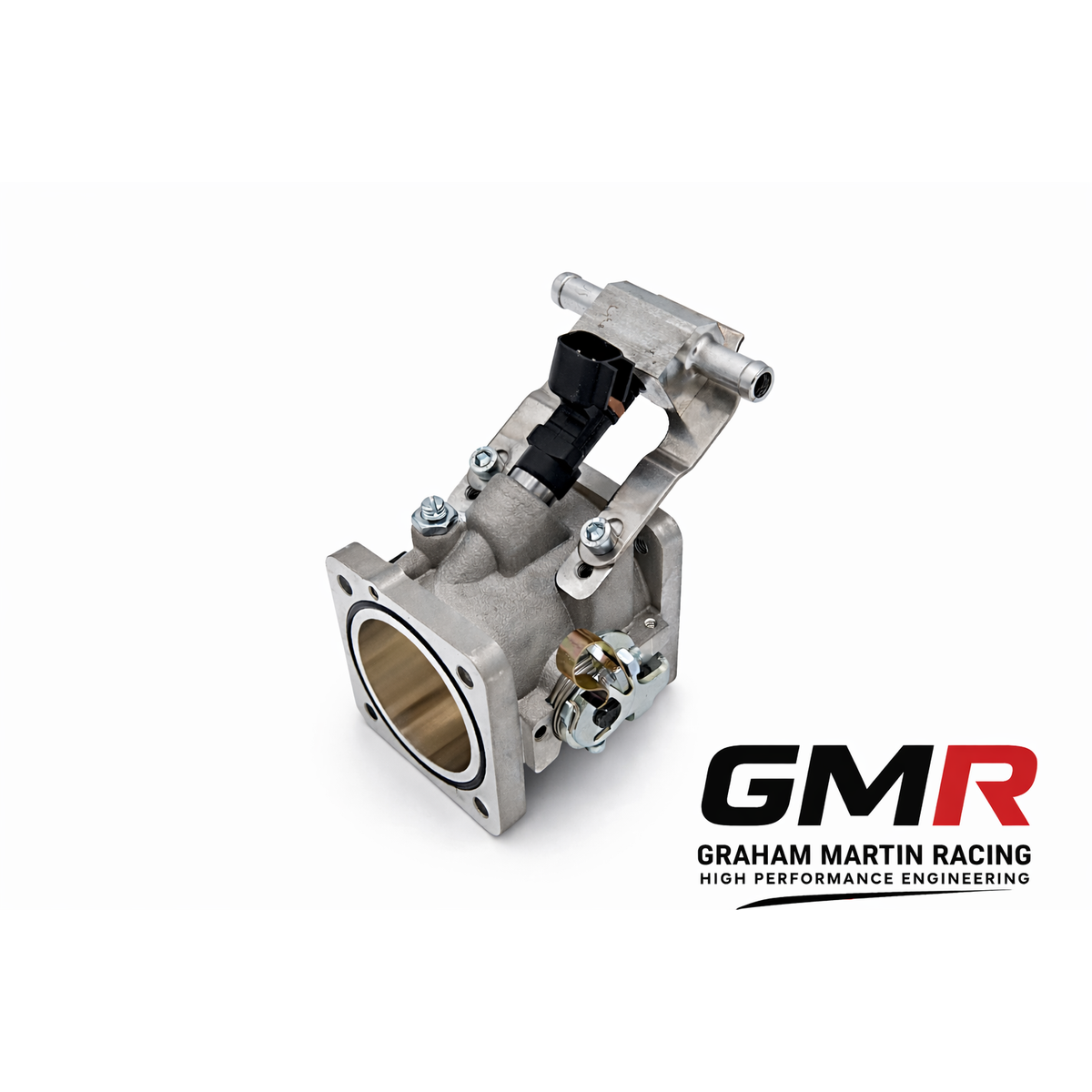
You can’t calibrate your way out of bad airflow, and you can’t get clean airflow without calibration that respects it. When we build an ITB kit or intake for a platform like the Peugeot GTi6/Mi16 or the Honda K20, the geometry is designed around the engine’s combination, then the calibration is developed to suit. That’s the whole philosophy behind performance engineering at GMR: measurable, repeatable results, not universal-fit guesswork. If you want to go deeper, here’s what high performance engineering really demands.
If you’re heading to a circuit to validate the work, plan your sessions sensibly — comparing and booking the right track day gives you the running you need to confirm the map holds up under sustained load and heat. Related: if you’re tuning at Silverstone, here’s how the costs, layouts and noise limits work.
Frequently asked questions
Can I calibrate a standalone ECU myself?
Technically yes — standalones support live tuning, which is part of their appeal. But without steady-state dyno control, wideband lambda and knock detection, you’re tuning blind. If you don’t have the equipment and the experience to interpret it, get it done or developed by someone who does. The cost of a thrown engine dwarfs the cost of a proper map.
How long does motorsport ECU calibration take?
Budget a full day on the dyno for most custom or live mapping work. It only takes an hour or two if the starting calibration was already very close — which, on a modified engine, it rarely is.
Do I need a new ECU, or can my factory one be remapped?
It depends on the platform and how far you’re going. Many factory ECUs can be flash-tuned to a high level. For serious motorsport with aggressive cams, high boost or alternative fuels, a standalone or factory race ECU gives you the live-tuning headroom and table resolution you need. We calibrate both OEM and aftermarket systems and will advise honestly based on your combination.
Why does fuel type matter for the calibration?
Because stoichiometric AFR changes with fuel, but Lambda 1.0 is always stoichiometric. Targeting lambda rather than a fixed AFR keeps fuelling correct across petrol, race fuel and ethanol blends — essential if you ever switch fuels.
The bottom line
Good ECU calibration for motorsport in the UK isn’t a black box and it isn’t a one-hour quick fix. It’s mechanical verification first, disciplined data, the right dyno with steady-state load control, lambda-based targets, and an iterative process that ends with printed proof. Do it properly and the engine is faster, safer and repeatable. Cut corners and you’ve simply hidden the problems until they find you on track. If you want calibration developed around your actual combination — hardware and software as one system — get in touch.
Related: Aftermarket ECU Tuning Specialist: What Actually Gets Changed, and How to Choose One