
2026-07-13
Bespoke Carbon Parts for Your Engine in the UK: What Actually Survives Under the Bonnet
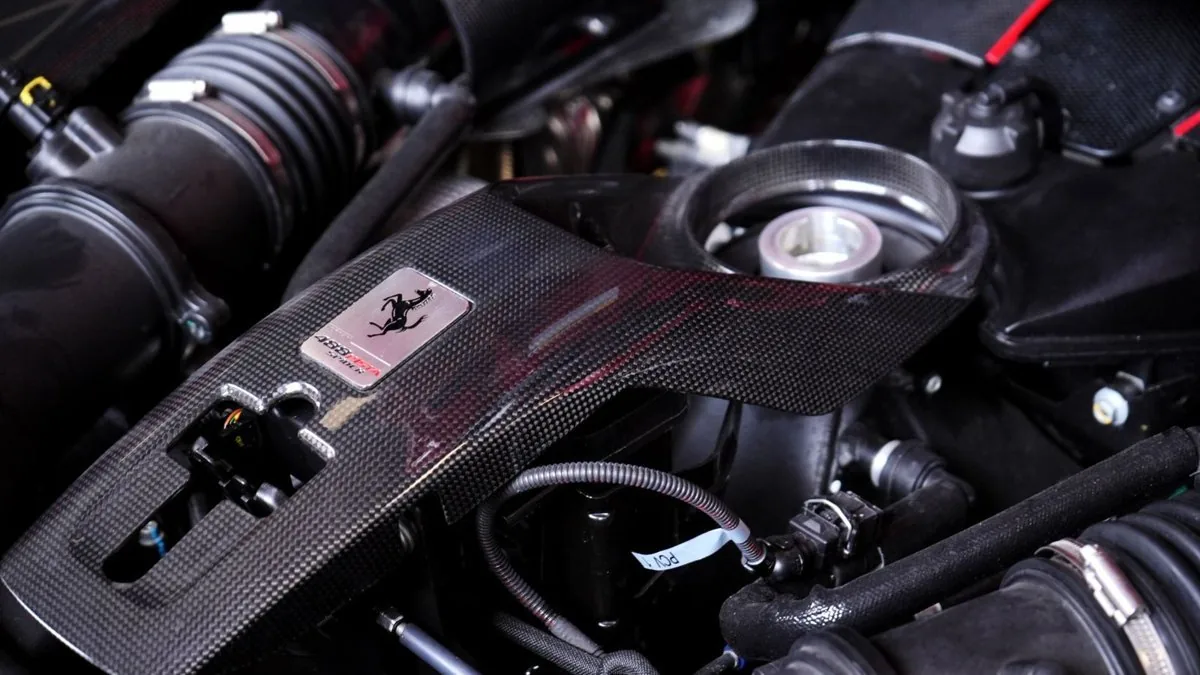
Search for bespoke carbon parts engine UK and you’ll find plenty of shiny weave and very little engineering. I’ve spent enough time at the sharp end of motorsport to know that a pretty part which softens at 120 °C or feeds the engine unevenly is worse than useless — it’s a liability you paid a premium for. So let me walk you through what actually matters when you commission carbon composite components for an engine, from the resin system upward, and where GMR draws the line between “looks the part” and “does the job”.
Why “carbon” alone tells you nothing
Here’s the uncomfortable truth most sellers won’t put in writing: with a carbon composite part, the fibre is rarely the limiting factor. The resin matrix is. Carbon fibre itself is astonishingly heat-tolerant — it holds together above 2000 °C in an inert environment, and only begins to oxidise in open air from around 400–500 °C. Your engine bay will never trouble the fibre. What it will trouble is the plastic holding those fibres in place.
Standard epoxy resins soften and lose stiffness from roughly 120 °C upward, and most break down somewhere between 120 °C and 200 °C depending on the system. That softening point — the glass transition temperature (Tg) — is the single most important number on the datasheet, because a composite doesn’t burst into flames when it overheats. It goes soft. Modulus and strength fall off a cliff, layers begin to delaminate, and a part that was rigid on the bench turns into a floppy, cracking mess under load and heat.
If someone selling you an under-bonnet carbon part can’t tell you the Tg of the resin system, they don’t know what they’ve built. Walk away.
Designing to the temperature, not the photograph
Good composite engineering means designing a component to run at least 20–50 °C below its resin’s Tg, so there’s a genuine safety margin when things get hot and the part is carrying load. A composite under mechanical stress fails at a lower temperature than an unloaded one — so a bracket or a manifold that also has to resist pressure and vibration needs more headroom, not less.
That’s why matching resin to location matters:
- Standard epoxy (Tg ~120–150 °C): fine for cooler-air components away from direct heat — intake ducting, airbox lids, cold-side trim.
- High-temperature epoxy systems: hold shape and stiffness up to around 300 °C — the sensible baseline for anything living close to the engine.
- Phenolic composites (rigid to ~260 °C) and polyimide systems (300–450 °C): reached for when a part genuinely sees sustained, serious heat.
For comparison, aluminium holds its properties to about 150 °C before it starts to give up meaningful strength. A properly specified high-temp composite comfortably beats that — and saves considerable weight doing it. But I’ll be honest with you: for the hottest, most brutally heat-soaked zones, sometimes metal, a heat shield, or a ceramic/silicon-based coating on the composite is the right engineering answer. I’d rather tell you that than sell you a part that discolours and delaminates in a season.
DDM printed parts: where semi-crystalline matrices beat Tg
Everything above about Tg assumes an amorphous resin like epoxy — and for those, Tg really is the wall. But when we move to Direct Digital Manufactured (DDM) parts printed in carbon-reinforced semi-crystalline thermoplastics, the rules change, and this is where people who only know epoxy get caught out. Materials like PPA-CF, PPS-CF and PA6-CF/GF don’t lose all their useful stiffness at Tg the way an amorphous resin does. They start with high mechanical properties that decline gradually; the slope steepens as they approach Tg, then — unlike amorphous polymers — the rate of loss stabilises and the part stays genuinely useful right up until it nears its melting point.
The number that actually governs service temperature here is the heat deflection temperature (HDT), and for these reinforced semi-crystallines it sits well above Tg. The fibres — carbon or glass — restrict polymer chain movement and add thermal rigidity, and higher crystallinity pushes the HDT up further. The classic illustration is PPS: its Tg stays fixed at around 89 °C regardless of crystallinity, yet its HDT climbs from roughly 135 °C at 20% crystallinity to about 260 °C at 60% crystallinity. In other words, the working part can run some 150 °C above the resin’s glass transition and still do its job.
- PPS-CF (carbon-reinforced polyphenylene sulfide) — the highest-temperature option and the strongest demonstration of the point. Tg around 89 °C, yet an HDT up to 264 °C at 0.45 MPa and continuous operation above 200 °C — an HDT sitting roughly 175 °C above Tg. It holds about 90% of its mechanical properties at 200 °C (against ~50% for unfilled PPS) and adds excellent resistance to solvents, corrosion, heat and flame. It comfortably outperforms nylon-CF grades, which top out nearer 190 °C.
- PPA-CF (carbon-reinforced polyphthalamide, a high-temp nylon) — a semi-aromatic matrix with a headline HDT of around 220 °C against a Tg of ~125 °C (Tm ~265 °C), so roughly 95 °C of usable headroom above Tg. It brings very low moisture absorption and outstanding chemical resistance to fuels, oils, brake and transmission fluid and antifreeze — exactly the fluids an engine bay throws at a part. One caveat worth stating plainly: the quoted Tg for “PPA-CF” varies widely by formulation (published figures range from ~60 °C to ~125 °C), so I always work to the specific datasheet grade, not a generic number.
- PA6-CF/GF (carbon- and glass-reinforced nylon 6) — the workhorse. It doesn’t reach PPS or PPA temperatures, but reinforced it still retains useful strength and stiffness beyond its Tg, and it’s a cost-effective choice for parts that aren’t sitting in the worst of the heat.
The important nuance — and the one I’ll always flag honestly — is that this “runs above Tg” behaviour is specifically a property of these semi-crystalline matrices. It does not apply to amorphous filaments, and it doesn’t change what I said about epoxy laminates earlier. Pick the wrong process assumption and you either leave performance on the table or overheat a part that was never rated for it.
Prepreg vs wet lay-up: where the real quality gap lives
Two parts can look identical and be worlds apart in performance. The difference is usually how they were made.
Wet lay-up and infusion
Dry fibre is laid into a mould and impregnated with resin — by hand or via infusion — then cured at ambient or moderately elevated temperature. Done well, it produces perfectly usable parts. But the numbers tell the story of its ceiling: wet lay-up laminates typically land at a 40–55% fibre volume fraction, with more resin, more variability and higher void content.
Prepreg and autoclave
Prepreg is fabric pre-impregnated at the factory with a precisely metered resin system and partially cured (B-staged). It’s stored at around −20 °C so it doesn’t cure on the shelf, then laid up and cured under controlled heat and pressure. In an autoclave — a pressurised oven running typically 120–180 °C and 3–7 bar (roughly 80–100 psi) — that pressure consolidates the laminate, drives out trapped air and squeezes off excess resin.
The result is measurable: prepreg laminates typically achieve a 55–65% fibre volume fraction with void content below 1–3%. More fibre, less resin, fewer voids. That means a stiffer, stronger, lighter, more repeatable part — and repeatability is the word that matters when you’re building an engine programme, not a show car.
Where bespoke carbon parts actually earn their keep on an engine
Carbon composite isn’t a universal upgrade. It’s a tool you reach for when the engine calls for it. The applications where I’ll happily commit to it:
First, airflow components. This is where composite genuinely shines. Airboxes, intake plenums and intake ducting benefit from carbon’s stiffness-to-weight and — crucially — its low thermal conductivity, which keeps intake air cooler than an aluminium equivalent during idle and heat-soak. That advantage is real at idle and in traffic; it narrows at sustained wide-open throttle when air is moving fast, so I’ll always tell you honestly which case applies to your usage. Our carbon composite airbox for the K20 and carbon intake manifold work are built exactly around this reasoning. For a motorsport-focused take, see our guide to the carbon composite airbox for motorsport.
Second, geometric freedom. A moulded composite part can carry runner shapes, curvature and packaging that would be expensive or impossible to machine. That lets us optimise pressure-wave tuning and port matching to your engine rather than a generic template. If you want the detail on getting that geometry right, read our guide on how to spec a bespoke intake manifold.
Third, weight where it counts. Shaving mass off components that sit high or far out on the engine changes how the car behaves, not just what the scales say.
The GMR approach to bespoke carbon parts
I’m Graham Martin, and GMR is a Northampton-based motorsport engineering business. We design and manufacture race and performance engine components in the UK — carbon composite and Direct Digital Manufactured (DDM) parts including ITB kits, intake manifolds, airboxes, velocity stacks and throttle linkages for platforms like the Honda K20, Subaru EJ and Peugeot XU/TU and GTi6. If you’re on a Peugeot platform, see our guide to Peugeot TU individual throttle bodies.
What separates our parts from “universal fit” tat is simple: we engineer around your specific combination. We select the resin system to suit the part’s thermal environment, not to hit a price point. We port-match to your head. And where an application needs it, we’ll add heat shielding or a ceramic coating rather than pretend a standard epoxy will cope with a header’s radiant heat. If a job genuinely calls for a machined metal part instead of carbon, I’ll tell you that too — the same honesty runs through our bespoke race engine manufacture and calibration work. It’s also what separates a properly built engine from a bodged one, as we explain in our guide for choosing a motorsport engine builder in the UK.
Free UK delivery applies on orders over £100. If you’re planning to test the results, our friends at Trackday Finder can help you find and book a circuit day. Related: if you’re weighing up a marquee venue, their practical guide to Silverstone track days covers costs and noise limits.
FAQ
Can carbon fibre parts really survive engine bay heat?
The fibre can — easily. The resin is the limit. Standard epoxy softens from around 120 °C, so any part living near heat needs a high-temperature epoxy (good to ~300 °C), a phenolic or polyimide system, and often a ceramic or silicon-based heat-resistant coating. Specify the resin to the location and it’ll last.
Is prepreg carbon worth the extra cost over wet lay-up?
For engine components, yes. Prepreg laminates achieve 55–65% fibre volume fraction with under 1–3% voids, versus 40–55% for wet lay-up. That’s a stiffer, lighter, more repeatable part — and repeatability matters when the component is part of a build you need to trust.
Will a carbon intake actually make more power?
Sometimes directly, often indirectly. The gains come from cooler intake air at idle and heat-soak, optimised runner geometry and pressure-wave tuning, and reduced weight — not from the material itself. I’ll tell you honestly whether your usage will see a real benefit before you commit.
Can you make a one-off bespoke part for my engine?
Yes — bespoke and prototype work is core to what we do. Send us your platform, head details and packaging constraints and we’ll engineer the part around your combination, not a universal template.
Related: DDM Carbon Composite Parts for Motorsport: What Actually Survives, and How They’re Really Made
Related: Velocity Stacks in Carbon Fibre: What Actually Makes Power, and What Just Looks Good
Related: K20 Airbox Carbon: How to Build an Enclosed Induction System That Actually Lowers Intake Temps