If you’re searching for custom race engine components in the UK, you’ve already worked out the thing most catalogues won’t tell you: a “high-performance” part that wasn’t engineered around your specific combination is a compromise waiting to fail. I’ve spent enough time at the sharp end of motorsport to know that “close enough” and “universal fit” are how engines lose power on the dyno and how rods find their way through the side of a block at 8,000 rpm. This guide walks through what genuinely custom engine components involve — crankshafts, rods, valves, intakes — how they’re made here in Britain, and how to specify them so you get a part that fits, performs and repeats.
What “custom” actually means in race engine manufacture
There’s a difference between picking an off-the-shelf forged part from a parts bin and having a component engineered around your bore, stroke, target rpm, fuel and the loads your build will actually see. Real custom work starts with the numbers: combustion pressure, inertia loads, vibration modes and packaging. The UK has a deep bench of specialists who work this way. Arrow Precision in Farndon, for example, supplies crankshafts, connecting rods and flywheels to the world’s top manufacturers, tuners and engine builders — their hardware sits behind the Brabus E V12 street-legal saloon world speed record, the Radical SR3 Turbo Nürburgring lap record and LM2/LM1 class wins with Judd-powered cars at Le Mans.
What separates that level of work is process: a bespoke design service that takes a part from early concept through full 3D models and manufacturing drawings, with FEA testing to show exactly how combustion and inertia loads stress and deform the component, and how vibrations behave across the rev range. That’s performance engineering rather than parts-swapping — and it’s the same discipline we apply to every high-performance engineering project we take on.
Crankshafts: material and process do the heavy lifting
The crankshaft is where material choice matters most, and in the UK the premium race-crank steel is EN40B — the UK designation that equates to 722M24. It’s regarded as the toughest material commonly available for this job, offering hardening capability beyond standard 4340 billet steel. Arrow, for instance, use low-sulphur CORUS steel in EN40B. MED produce A-Series billet cranks in EN40B with extra-large C-shape counterbalance webs, exclusively manufactured in the UK by MED and Arrow.
You’ll see a long-running argument about forged versus billet. The forging case is that the grain pattern of a forging follows the shape of the webs and bearings, whereas a billet crank is machined across the grain. That’s a real metallurgical point — but treat it as application- and supplier-specific rather than settled, because many of the top UK suppliers ship billet EN40B cranks as their flagship race product. Both approaches win races.
What you should actually be checking is the processing. A proper race crank is stress relieved, shot peened, magnaflux inspected and nitrided through a multi-step heat treatment. Counterweights are fully profiled to cut windage through the crankcase, reducing oil resistance and the parasitic drag that quietly steals power. On the high end you’ll find gun-drilled, CNC-ground oil holes with a smooth surface, teardropped for oil-scoop effect, cross-drilled for priority main feeding to the rods and micro-polished to a mirror finish. Premium makers CNC-machine to tolerances of 0.0001″ (0.0025 mm) on 5-axis machines.
Two real-world examples show why this matters. On the three-main-bearing A-Series crank, an improved counterbalance reduces the ‘whip’ you get at higher rpm, improving both longevity and performance. On a TR/Morgan billet crank, hollowing the centre and big ends reduced rotating mass while increasing strength — total weight 17.5 kg, which is 1.3 kg lighter than the original, rated to 8,000 rpm. Less rotating mass means an engine that picks up faster; more strength means it survives doing it.
Connecting rods: three categories, one contested debate
Rods come in three material categories — cast, forged and billet. A billet rod is machined from a solid block (aluminium or steel) with no forging step. A forged rod starts from a forged blank where the metal grains are compressed and aligned to follow the part’s shape, which improves strength and fatigue resistance.
The forged-versus-billet debate here is genuinely contested, and I’d be wary of anyone who tells you it’s clear-cut. The pro-forging argument — made by manufacturers like CP-Carrillo, who don’t offer billet rods at all — is that forging compresses the material and gives better grain structure, grain flow, strength and fatigue resistance, with design freedom achieved through oversized forgings that are then 100% machined. The pro-billet camp counters that modern billet steel with full CNC machining delivers the geometry freedom and consistency they want. Both are right for different programmes. What matters is matching the rod to your rpm ceiling, your fuel and your boost or compression target — and pairing it with the right fasteners, because a rod is only as good as the bolts holding it together.
Valves and the rest of the valvetrain
Valves are a specialist discipline in their own right. G&S Valves in the UK have serviced the race car and bike industry for over 60 years, manufacturing everything from one-off prototypes for engine development through to ongoing scheduled contracts, with valves that have won at F1, Sports Car, Le Mans, Indy Car, the TT, World Super Sport 600 and club level. That breadth tells you something: a valve has to be specified around seat angles, flow, thermal load and the material it’s swallowing — not pulled from a generic size chart.
The UK’s wider specialist network reflects how niche this work gets. Trevor Morris Engines (established 1989) handle precision milling, turning, grinding and assemblies on CNC and conventional machines, specialising in Cosworth BDG/FVC and Hayabusa-based engines. Ridgeway Racing build and supply parts for historic Toyota Novamotor F3, BMW M12 and Ford BDA/BDG/GA/DFV engines. Pro-Race Engineering in Colchester focus on forged internals for VAG 1.8T/2.0T FSI, VR6/R32, SR20DET and 2JZ-GTE. Mass Racing offer cylinder head work, crankshaft grinding, camshaft lobe machining and valve work. The point is that “custom” in the UK isn’t one supplier — it’s an ecosystem of people who each do one thing properly.
Where GMR fits: intake-side custom components and DDM
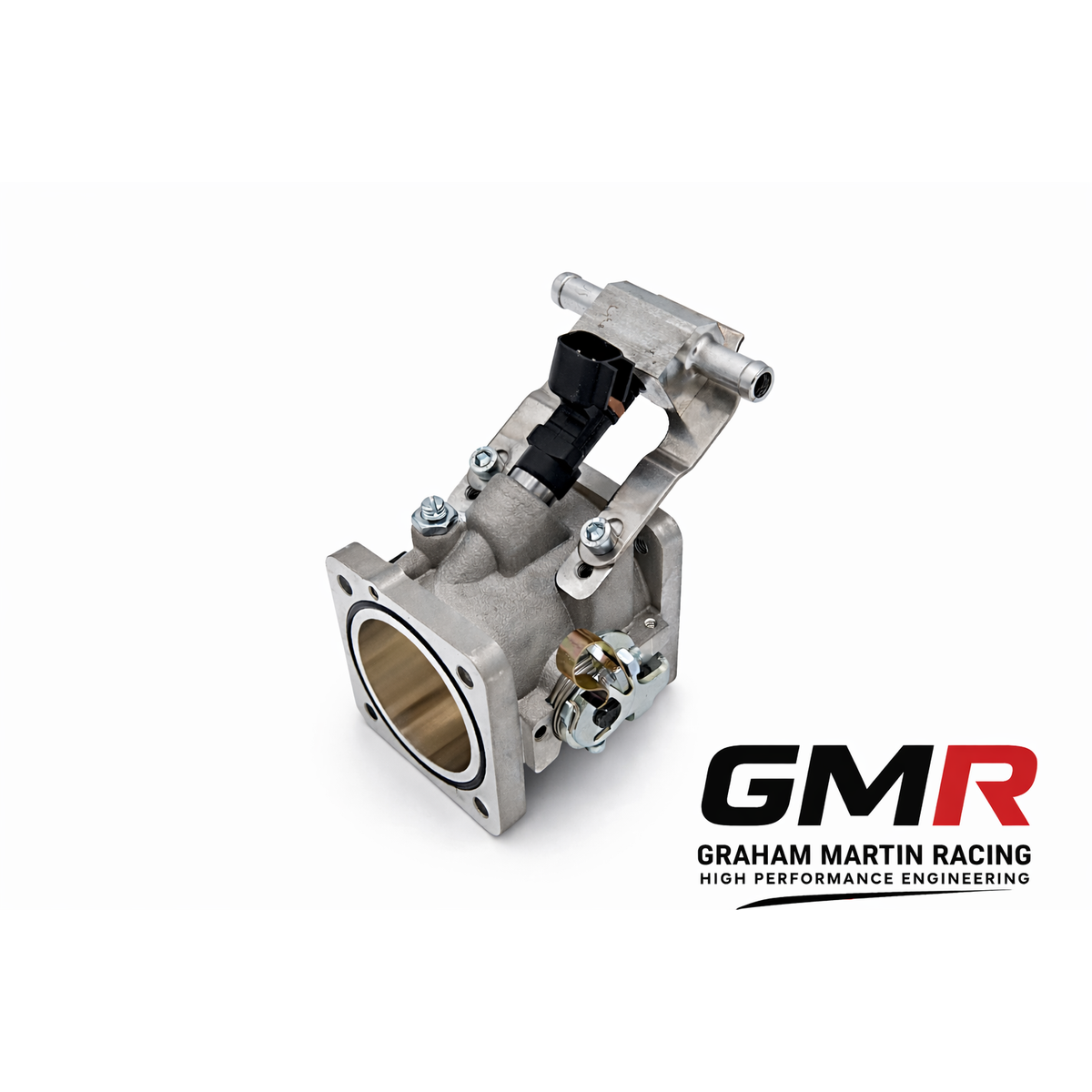
My side of this is the intake and induction system, plus the calibration that ties it together. We design and manufacture individual throttle body kits, intake manifolds, airboxes, velocity stacks, injectors and throttle linkages for platforms like the Honda K20, Subaru EJ, Peugeot XU/TU and GTi6/Mi16. We use carbon composite and Direct Digital Manufactured (DDM) parts because the process lets us build organic, flow-conducive geometry that’s lighter than aluminium or steel, corrosion-resistant and low in thermal conductivity — which matters when intake air temperature directly costs you power.
That thermal point is concrete: as a working rule of thumb, roughly every 10°C rise in intake temperature costs around 3% power, so keeping induction air cool with low-conductivity materials and features like double-wall air-gap insulation is real performance, not cosmetics. The pressure-wave behaviour inside a runner and plenum is just as measurable — runner length and plenum volume tune where in the rev range you make torque, which is why we test rather than guess. If you want the manufacturing side of that story, 3D printing as a real manufacturing method and our guide to how 3D printing fits the motorsport workflow go deeper. Related: see what digital manufacturing means for makers and the future of digital manufacturing.
We also do bespoke engine calibration for OEM and aftermarket ECUs — because a custom intake or set of internals without matched mapping is half a job. If you’re building for the track and want to compare events to validate your setup, Trackday Finder is a sensible place to start.
How to specify a custom component without wasting money
- Lead with the numbers. Bore, stroke, target rpm, fuel, boost or compression, and the duty cycle. A good UK specialist designs to those, not to a generic catalogue line.
- Ask about process, not just material. EN40B means little without the right nitriding, shot peening, magnaflux inspection and tolerance control.
- Match the whole system. Crank, rods, fasteners, valvetrain and intake have to agree with each other — and with the calibration.
- Be sceptical of “universal fit.” If a part claims to suit everything, it’s optimised for nothing.
FAQ
What is the best material for a custom race crankshaft in the UK?
For most serious UK race applications, EN40B (722M24) is the premium choice — it through-hardens and nitrides well and is tougher than standard 4340 billet steel. Material alone isn’t enough, though: the heat treatment, profiling, oiling design and machining tolerances determine whether it survives.
Are billet or forged connecting rods better?
It’s genuinely application-specific. Forging aligns grain flow for strength and fatigue resistance; modern billet rods offer geometry freedom and consistency through full CNC machining. Both win races — the right answer depends on your rpm, fuel and load, so specify against your build rather than the marketing.
Can I get custom engine components made for an unusual or historic engine?
Yes. The UK has specialists covering everything from Cosworth BDG and Ford DFV historic units to modern K20, EJ and VAG platforms, plus one-off valve and crank manufacture. If the geometry can be measured and the loads modelled, it can be made.
Why does GMR use carbon composite and DDM instead of machined metal?
Because for intake components the priorities are flow geometry, weight and keeping air cool. Carbon composite and DDM let us build organic, flow-conducive shapes that are lighter than aluminium or steel, corrosion-resistant and low in thermal conductivity — directly protecting the power a hot intake would otherwise cost you.
Related: ECU Calibration for Motorsport in the UK: How It’s Actually Done
Related: Carbon Intake Manifold for a Race Engine: What Actually Works
Related: Bespoke Race Engine Manufacture: How a Properly Built Unit Is Actually Made
Related: High Performance Engine Components UK: A Builder’s Guide to Pistons, Rods and Cranks
Related: Race Engine Calibration Service in the UK: How Proper Mapping Actually Works
Related: Race Fuel Injectors and ITBs: How to Size, Position and Plumb Them Properly