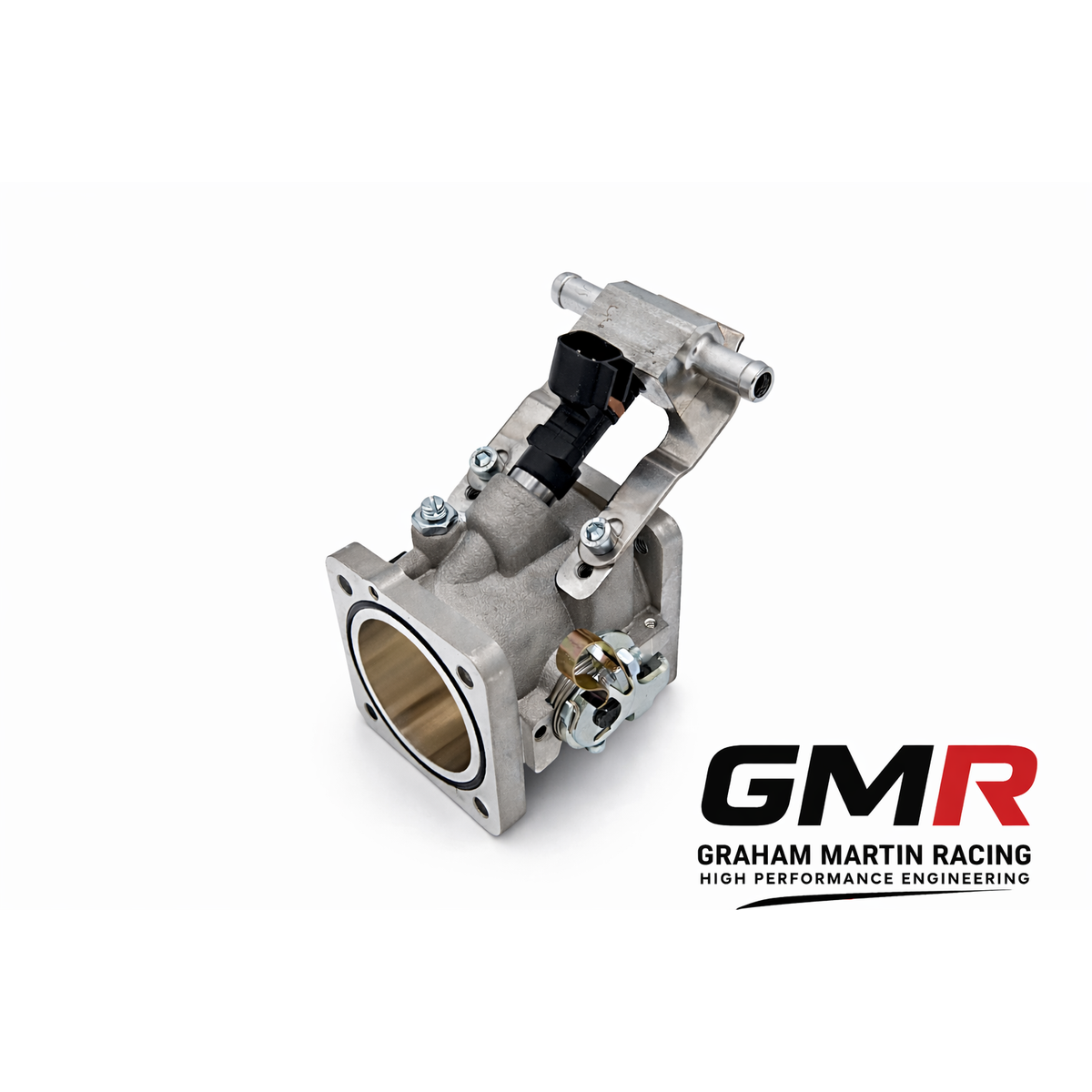
Vauxhall XE Throttle Body Kit: How to Spec, Size and Fit One That Actually Delivers
The single biggest restriction on a standard C20XE “Red Top” is its intake tract. The engine breathes through a plastic

For years, 3D printing for production was treated as a bit of a novelty — a clever way to knock out a quick prototype before the “real” manufacturing began. That’s changed. The technology has matured to the point where printed parts aren’t just stand-ins anymore; they’re the finished article, shipping in products you can buy today. If you’ve only ever used a printer to test a fit or mock up a shape, it’s worth taking a fresh look at what these machines are now capable of — because in my workshop, printed parts now do real jobs, not just sit on a shelf as a curiosity.
The original appeal of 3D printing was simple: you could go from a CAD file to a physical object overnight, without tooling, moulds or minimum order quantities. That made it brilliant for prototyping. You’d print a part, hold it, find the flaws, tweak the model and print again. Fast, cheap and entirely in your own hands.
What’s happened over the last decade is that the same qualities that made printing great for prototypes — no tooling, no minimums, design freedom — turned out to be genuinely useful for production too. The hardware got faster and more reliable, the materials got tougher, and suddenly making the actual end-use part on a printer stopped being a compromise.
I’ve watched this shift happen at the sharp end. Where I’d once have printed a fixture purely to check clearances before sending a drawing off to a machinist, I now print the fixture and put it straight to work. The dividing line between “test piece” and “production piece” has genuinely blurred, and that has real consequences for how you plan a job. Related: read more on The Future of Digital Manufacturing.
It isn’t hype driving this — there are some solid, practical reasons why printed parts now turn up in real products. None of them are about chasing a trend; they’re about measurable advantages on the right job.
Injection moulding is fantastic at volume, but the moulds cost thousands and take weeks to make. If you only need a few hundred parts — or a few thousand of something that changes often — printing skips that entirely. You pay per part, not for a mould you have to amortise over a huge run. For low and medium volumes, that maths often tips decisively in printing’s favour, and it does so without locking you into a design you might want to revise next month.
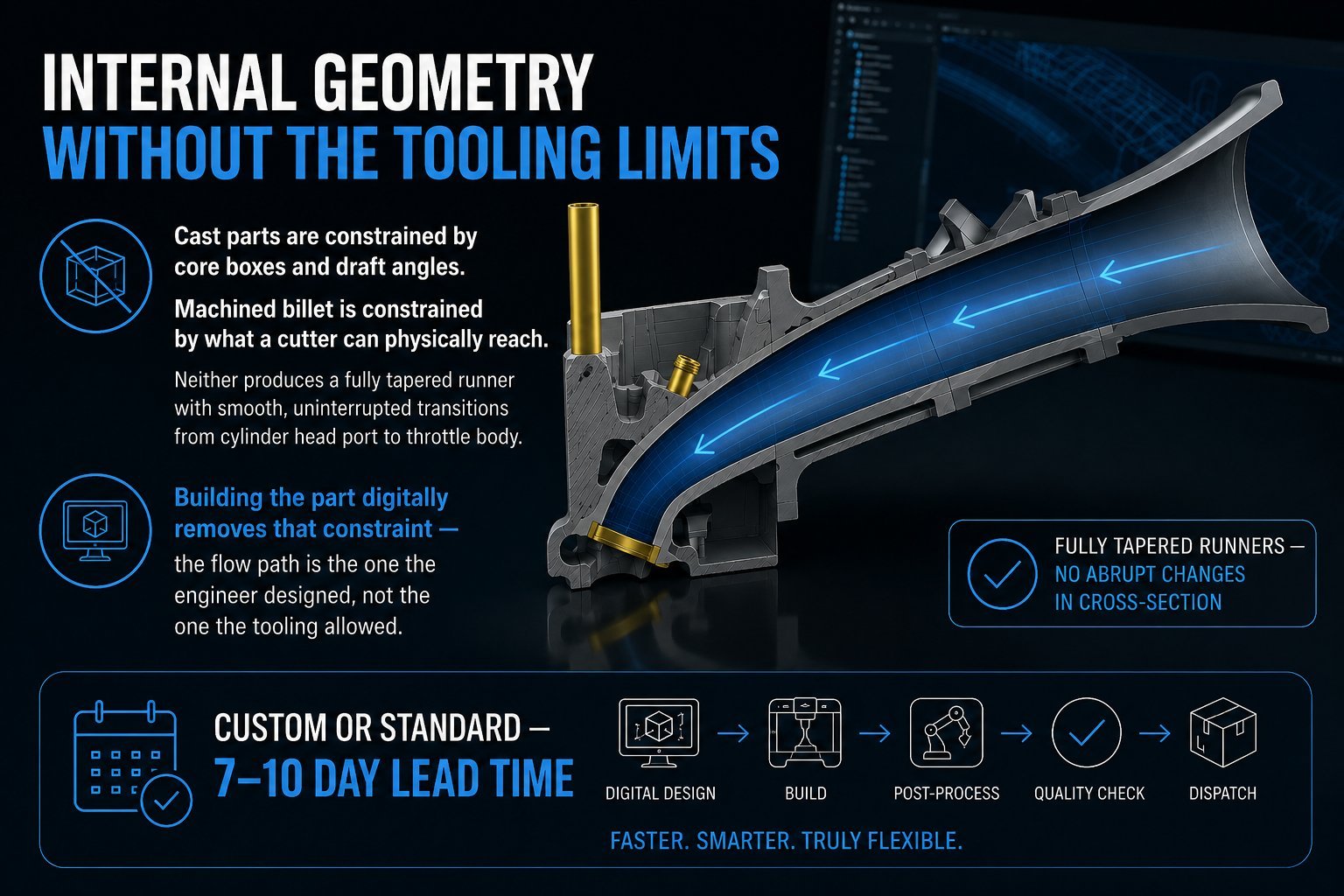
Printing builds up material layer by layer, so internal channels, lattice structures and consolidated assemblies are all on the table. Parts that would once have needed five separate components and a handful of fasteners can be printed as one. Lighter, fewer failure points, less assembly time. A moulded part has to come out of the mould, which rules out a whole class of internal geometry; a printed part has no such constraint, and that opens up cooling channels and weight-saving lattices you simply couldn’t make any other way.
Here’s a part that brings the whole argument together, and it’s one I’ll happily bang on about: a double-walled, hollow, additively manufactured carbon composite airbox. On a naturally aspirated engine especially, intake air temperature (IAT) is everything. Air density falls as temperature rises, so warm intake air simply carries less oxygen per unit volume — less oxygen means less fuel you can usefully burn, which means less power. It’s volumetric efficiency in a nutshell, and it’s exactly why an engine feels stronger on a cold morning. Worse still, when IAT climbs the ECU starts retarding ignition timing to fend off knock, and that costs you power on top of the density loss — on a hot performance engine you can be looking at a meaningful chunk of horsepower disappearing.
The enemy is heat soak. Sat in a hot engine bay, an airbox is surrounded by exhaust manifolds, turbine housings and a baking block, all radiating heat straight into your intake charge. It’s worst at idle and low speed, where there isn’t enough airflow to carry that heat away, so the box soaks it up and hands it straight to the air going into the engine. A solid aluminium box is precisely the wrong tool here — aluminium’s thermal conductivity is high, so it absorbs heat readily and holds onto it. A single-skin plastic box isn’t much better; it’ll happily soak up and store bay heat too.
This is where the double wall earns its keep, and where printing makes it possible in the first place. The trick is the air gap between the two skins. Trapped air is a superb insulator — it’s free, it’s everywhere, and it has a very low thermal conductivity. By splitting the box into an outer wall facing the hot bay and an inner wall in contact with the intake air, you break the conduction path — the thermal bridge — between the two. The outer skin can cook all it likes; the inner skin stays largely decoupled from it, so the air on its way to the engine picks up far less heat. Use a carbon composite rather than metal and you stack the odds further in your favour: a polymer-matrix composite has dramatically lower thermal conductivity than aluminium, so even the walls themselves resist conducting heat into the charge.
A couple of honest caveats, because physics doesn’t give you something for nothing. An air gap only kills conduction — radiation and convection can still ferry heat across it. So the gap wants to be sized to suppress convection currents inside it, and a low-emissivity surface helps knock back the radiant component; get that wrong and the gap underperforms what the textbook promises. The other thing to be straight about is structure: this is short, chopped-fibre printed composite, not autoclaved continuous-fibre prepreg, and it’s nowhere near as strong as a structural laminate. An airbox doesn’t need to be — it carries no real load — but you should never pretend printed CF matches a proper lay-up. What you can do is tailor the fibre orientation and volume fraction to suit the job, which is exactly the kind of design freedom that makes this a sweet spot for printing.
None of this is achievable by moulding. You cannot pull a sealed, hollow, twin-skinned shell with an internal air cavity out of a tool — but you can print it as a single consolidated part, air gap and all. That’s the whole point: the geometry that does the thermal work is only on the table because the part is additively manufactured. Whatever the design, you should still feed it cold air from outside the bay — cold air carries more oxygen — but the double-walled composite box makes sure that cold air stays cold on its way in.
Because each part comes from a file, making every one slightly different costs nothing extra. That’s why printing has taken off in areas like dental aligners, hearing aids and bespoke surgical guides — mass customisation that would be a nightmare with traditional tooling. Every variant would need its own mould; with printing, the only thing that changes is the file you send to the machine.
This isn’t theoretical. Printed end-use parts are quietly everywhere — and once you know what to look for, you start spotting them in products you’d never have suspected:
What ties these together is volume and value: relatively low numbers, high complexity, or a real benefit from customisation. Hit that sweet spot and printing isn’t just viable, it’s the obvious choice. Related: see how this plays out in Custom Race Engine Components in the UK: How 3D Printing Fits the Motorsport Workflow @ Ask The Nozzle.
A bit of honesty is in order. Printing isn’t about to replace injection moulding for a million identical bottle caps — at that scale, traditional methods win on cost and speed every time. Surface finish often needs post-processing, material choice is still more limited than moulding, and part-to-part consistency takes proper process control to nail. I’ve seen plenty of people get burned by assuming a printer will hand them perfect, repeatable parts straight off the bed; it won’t, not without the right discipline behind it. Related: Why 3D Prints Fail: AI Photo Diagnosis Fixes It Fast @ Ask The Nozzle.
The smart approach is to treat printing as another tool in the box — brilliant for the right job, the wrong choice for others.
The trick is knowing where the crossover point sits for your particular part. Low to medium volumes, complex geometry, frequent design changes or a need for customisation all push you towards printing. High volumes of simple parts still belong to the mould. Get that judgement right and you’ll save time and money; get it wrong and you’ll waste both. There’s no universal answer here — only the one that’s measurably correct for your specific part.
If you’re a hobbyist or running a small workshop, this shift is genuinely good news. The same machines that prove out a prototype on your bench can now produce sellable parts. A short run of brackets, a batch of custom enclosures, replacement components for kit that’s long out of production — all viable without commissioning tooling you can’t justify. The gap between “I designed this” and “I’m selling this” has never been smaller.
That’s the part I find most exciting. The barrier to making a real, sellable product used to be the cost of getting set up for manufacture. Now a capable printer, a sound design and a bit of process discipline can take you from idea to finished part on your own bench — no factory, no minimum order, no waiting weeks for a mould. Related: our high-strength GMR PPA-CF filament is built for exactly these end-use parts.
3D printing has grown up. It started as a way to fail fast and cheaply, and it’s still excellent at that — but it’s now earned its place as a legitimate production method in its own right. Treat it with a clear head about its strengths and limits, and you’ll find printed parts solving real problems, not just sitting on a shelf as a proof of concept. Used properly, 3D printing for production isn’t a compromise — it’s the right answer to a growing list of jobs. Related: learn more about what performance engineering involves and why GMR approaches it this way.
The single biggest restriction on a standard C20XE “Red Top” is its intake tract. The engine breathes through a plastic

A Ford Duratec bike throttle body kit replaces the single OEM throttle body and plenum with four individual bike throttle