If you’ve landed here searching for a bespoke intake manifold UK builder, you’ve already worked out the obvious: an off-the-shelf casting designed around someone else’s combination is a compromise. The question isn’t whether a custom manifold is better — it’s whether the one you’re about to commission has been designed around your engine, your power band and your packaging, or whether it’s a pretty part that happens to bolt on. I’m Graham Martin, and at GMR we design and manufacture intake systems around the engine in front of us, not the marketing brochure. Here’s how to spec one properly.
First decision: single-throttle plenum or ITBs?
This is the fork in the road, and it dictates almost everything downstream. The two architectures behave very differently.
A single-throttle plenum uses one large throttle body feeding a common chamber that distributes air to all cylinders. It’s cheaper, simpler, and it plays nicely with a MAF-based load sensor — which is exactly why the OEMs use it. Fewer parts, easier to tune, more forgiving of engine-to-engine variation.
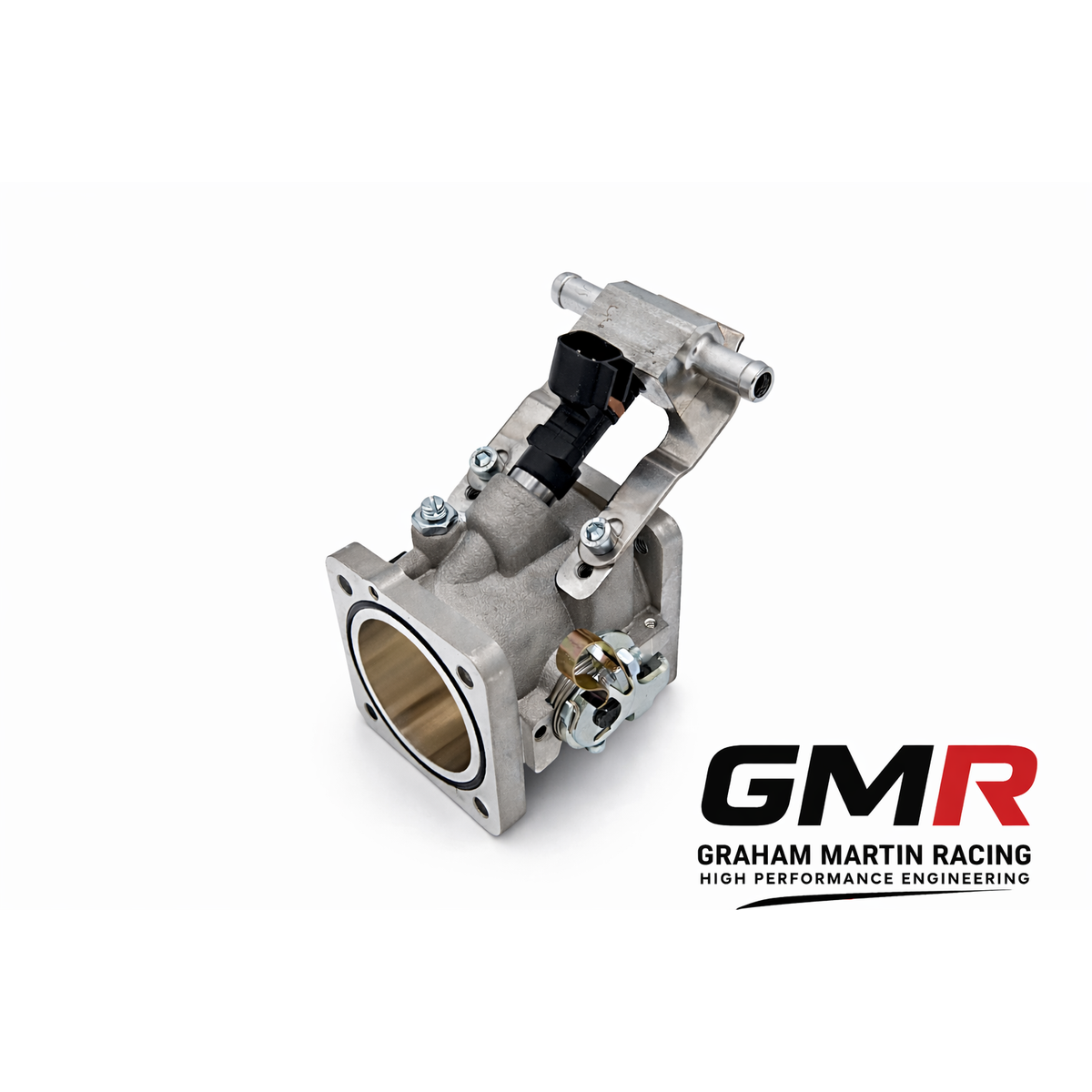
Individual throttle bodies (ITBs) give each cylinder its own throttle plate. That means more even air distribution, sharper throttle response and a larger total inlet area with less pressure drop on the way in. It also means a lot more parts — throttle bodies, manifold, linkages, injectors, wiring and an ECU that can run the lot — plus more setup, balancing and fault-finding. ITBs typically push you toward a TPS-based load model, which is less tolerant of variation than MAP.
You’ll read everywhere that “plenums are for mid-range, ITBs are for top end at the expense of low-end grunt.” Be careful with that. It’s a half-truth. ITBs don’t inherently cost you mid-range torque, and for a serious top-end engine you want as much plenum volume as you can sensibly package — there’s no rule that says you can’t combine a generous plenum with throttles per cylinder. The BMW S-series M3, for context, runs a roughly 14-litre plenum. The two genuine, defensible advantages of multiple throttles are that they tame a wild cam to give a far more usable idle, and they open up the inlet area so there’s less restriction feeding the head.
If you’re running boost, the decision is partly made for you: a forced-induction engine still needs a plenum to feed pressurised air from the turbo, with the throttles sitting between plenum and head, and your boost take-off lives after the throttle plate. For more on getting an ITB conversion right, our guide on how to buy an ITB kit that actually fits and performs is the place to start.
The direct-to-head advantage
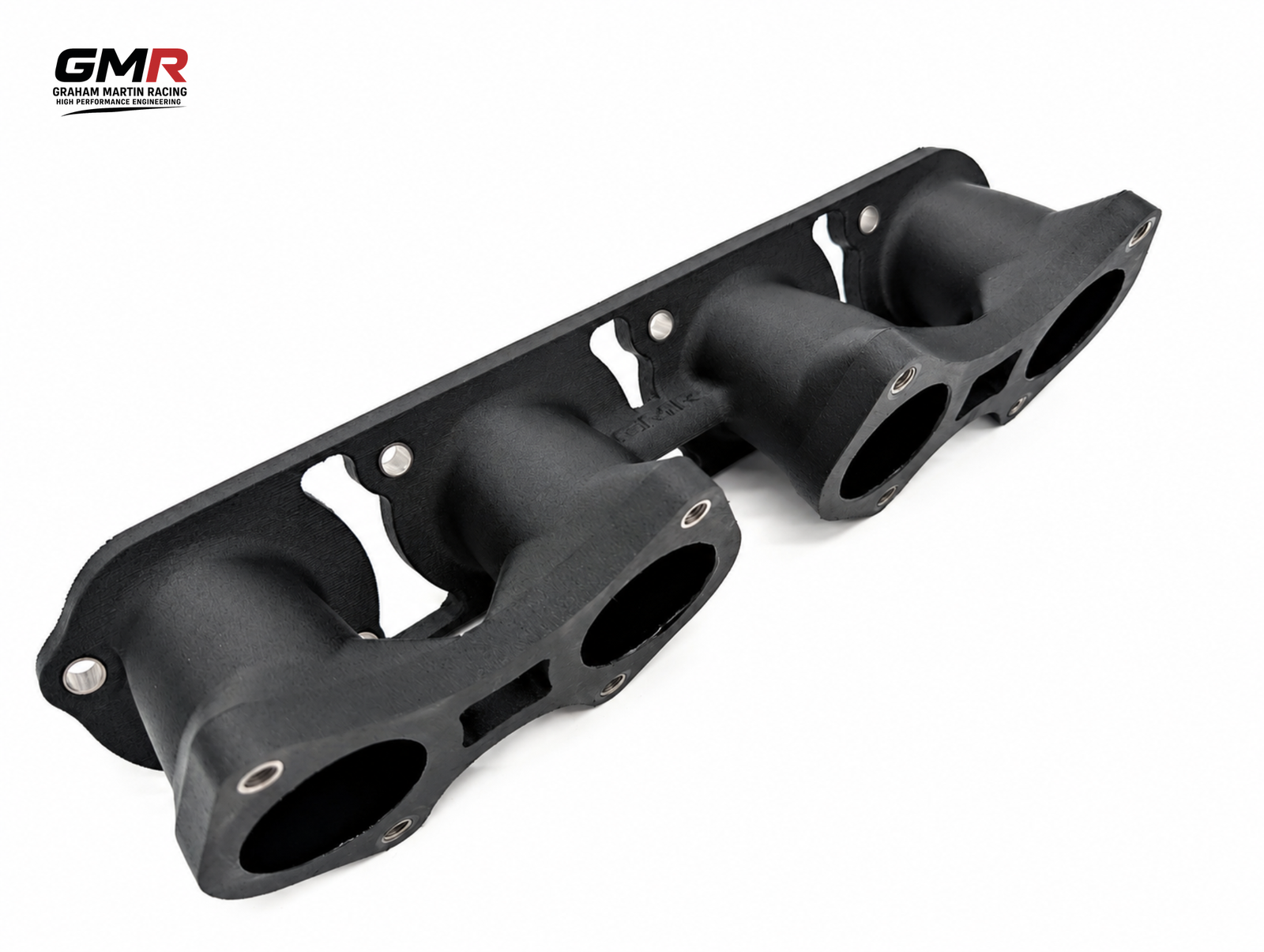
On a properly engineered ITB setup we mount the throttles as close to the head as the packaging allows, often using a detachable mounting plate. That does two things: it moves the throttle plates nearer the inlet ports for crisper response, and it lets us port the head flange to match your cylinder head’s inlet ports exactly — no step, no mismatch, no frictional loss from a sloppy “near enough” transition. A larger-diameter tract close to the head reduces losses where it matters most. This is the kind of detail that separates a made-to-fit part from a universal one.
Runner length and plenum volume: where the engineering lives
The geometry of a bespoke intake manifold isn’t decoration — it’s pressure-wave timing. Get it right and you bank real torque exactly where your engine uses it.
- Runner length: long runners favour low-RPM torque; short runners favour high-RPM power. It’s not magic, it’s the timing of the reflected pressure wave arriving back at the valve. A towing or torque-biased build might run 350–400 mm of runner — which is exactly why truck manifolds look tall and stubby race manifolds look short.
- It targets torque, not peak HP: this is the nuance most people miss. Runner-length tuning decides at what RPM the manifold is most efficient and where the biggest torque gain sits. It has very little to do with your headline peak power figure.
- Runner area: unlike length, which works over a narrow RPM band, runner area affects power across the rev range. The rule of thumb: the larger the port, the weaker the pressure waves become. A gentle taper toward the valve speeds the charge via the Bernoulli effect, but as a workshop rule (not a peer-reviewed constant) a taper steeper than about 2.5% stops helping airflow.
- Plenum volume: think of the plenum as a capacitor smoothing the airflow demand through the throttle. Too small and you starve transient response; too large and you can soften throttle crispness. The three variables that set your peak-torque location are plenum volume, runner length and runner area — and they have to be solved together, around your cam, head and target RPM.
This is the entire reason a bespoke part exists. A generic manifold has picked a compromise on all three for an “average” engine. We design them for the engine you’re actually building. If you want the background on how we approach this, read what performance engineering actually means and our take on high performance engineering.
The MAP sensing trap with ITBs
Here’s a tuning pitfall that catches people out. With a conventional shared plenum, a MAP sensor reads a realistic air-pressure signal as the intake valve opens. With ITBs, the volume between throttle plate and valve is tiny, so a single MAP tap gives you noise, not a usable signal.
The fix: tap each runner between the valve and the throttle plate, then route those taps to a small common balance plenum — a “balance bar” — to average out the individual pulses. You take your MAP reading from that small plenum for background compensation. A MAP sensor is still a good idea on ITBs (not strictly mandatory), but only if it’s plumbed correctly. This is exactly the kind of thing that should be designed into the manifold from the outset, not bodged on afterwards — and it’s where bespoke in-house calibration alongside the hardware earns its keep.
Material and process: carbon composite and DDM
How a manifold is made matters as much as its geometry. We build in carbon composite and via Direct Digital Manufacturing (DDM), and the advantages are concrete:
- Lighter than aluminium or steel — meaningful on the front of an engine, and on rotating/reciprocating-adjacent mass budgets.
- Low thermal conductivity — carbon composite doesn’t soak heat into your intake charge the way alloy castings do. As a rough rule, every 10°C rise in intake air temperature costs roughly 3% power, so keeping the charge cool is real, measurable performance. Double-wall, air-gap insulated designs take this further.
- Corrosion-resistant and dimensionally stable.
- Organic, flow-conducive geometry — DDM and composite layup let us build smooth, curved runners and plenums that a CNC-billet or sand-cast process simply can’t, or can’t without enormous cost.
If you want to understand how digital manufacturing changes what’s possible here, see the future of digital manufacturing and our partner piece on how 3D printing fits the motorsport workflow.
Worked examples: proven platforms
We don’t theorise in a vacuum. We have proven intake systems and bespoke development on platforms including the Honda K20, Subaru EJ, and the Peugeot XU/TU family — including the GTi6 and Mi16. Each of those started as a problem to solve, not a part to copy.
FAQ
How long does a bespoke intake manifold take to design and build?
It depends on whether we’re adapting a proven platform or starting from a clean sheet. A new design involves capturing your head geometry, modelling runner length and plenum volume around your target power band, then manufacturing and validating. We’ll give you a realistic timeline once we understand the combination — we don’t quote fantasy lead times.
Are ITBs road-legal and MOT-friendly in the UK?
A well-engineered, correctly tuned ITB or bespoke plenum setup can absolutely be run on a road car, but emissions and noise requirements apply depending on your vehicle’s age and use. Tuning quality is everything here — a properly calibrated setup idles cleanly and runs predictably. We’re happy to advise on what’s sensible for your specific build. Related: if you’re building for track use, how to find, compare and book the right track day is worth a read.
Will ITBs lose me mid-range torque compared to a plenum?
Not inherently. The “ITBs kill mid-range” claim is overstated. Mid-range torque is governed by runner length, runner area and plenum volume — solve those for your engine and you keep your mid-range while gaining response and top-end breathing.
Do you offer free UK delivery?
Yes — free UK delivery on orders over £100. We’re based in Northampton and ship across the UK. See our returns and refund policy for the detail.
The bottom line
A bespoke intake manifold is only worth the money if it’s engineered around your actual combination — runner length and plenum volume solved for your power band, the throttle architecture chosen for your goals, MAP sensing plumbed correctly, and built in a material that doesn’t cook your charge. That’s the difference between a part that looks fast and one that is. If you’re ready to build it properly, get in touch and tell me what you’re running.
Related: Custom Race Engine Components in the UK: How to Specify Parts That Actually Fit and Last
Related: ECU Calibration for Motorsport in the UK: How It’s Actually Done
Related: Carbon Intake Manifold for a Race Engine: What Actually Works
Related: Bespoke Race Engine Manufacture: How a Properly Built Unit Is Actually Made