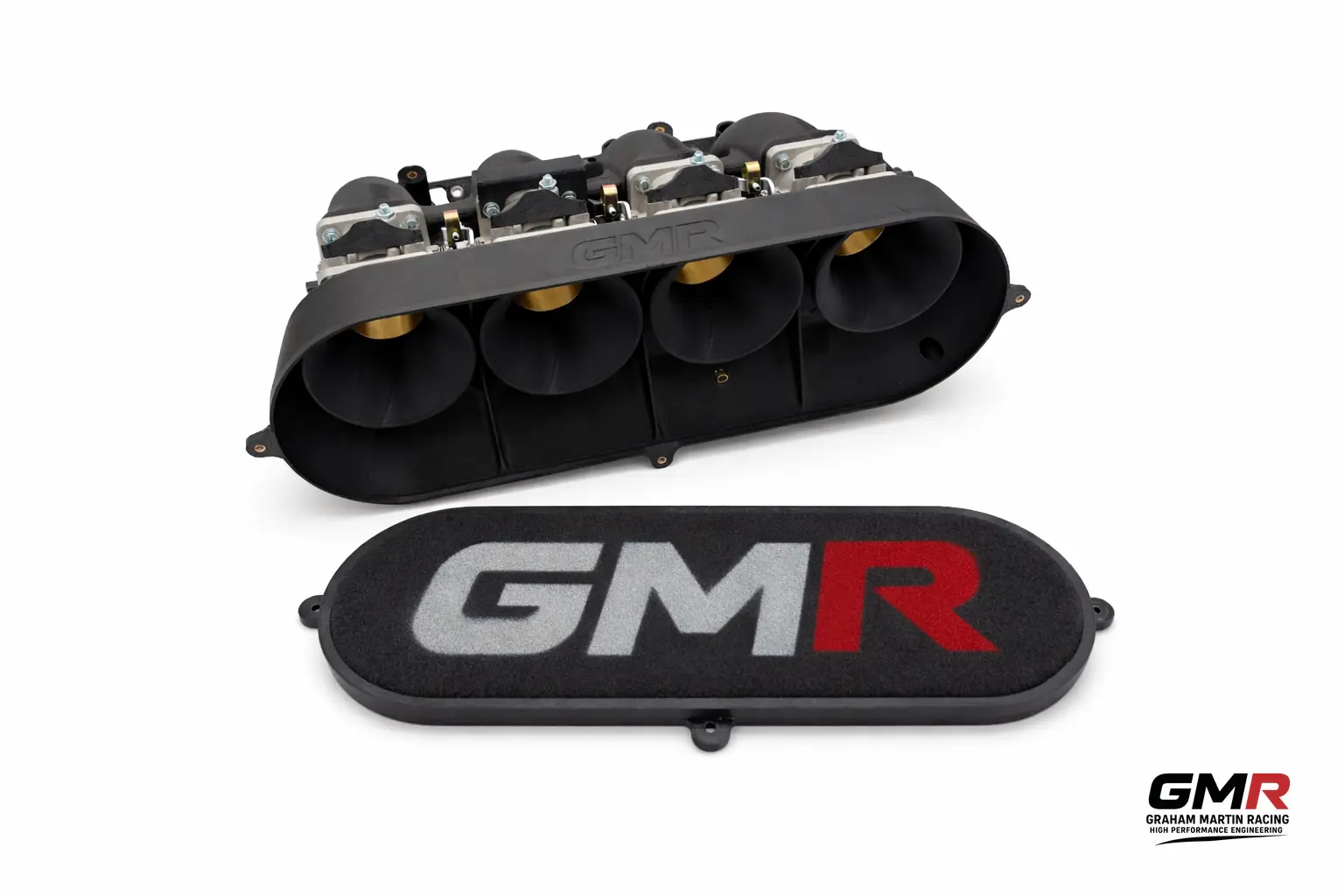
Carbon Composite Airbox for the K20: How to Get One That Actually Feeds the Engine
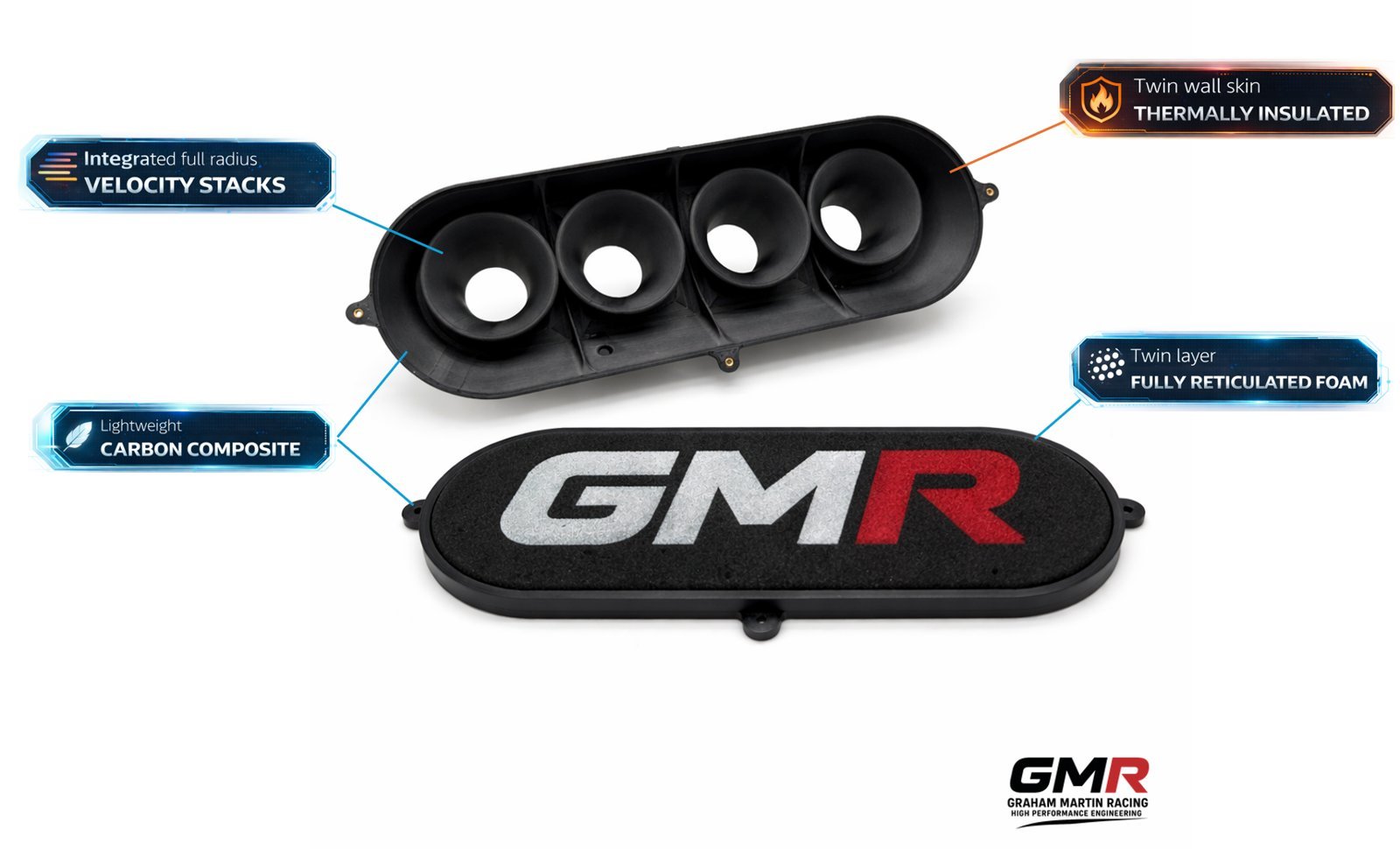
I’ve lost count of the number of K20 builds I’ve seen running individual throttle bodies with four little sock filters poking out into the engine bay, then wondering why the dyno graph doesn’t match the hype. Here’s the blunt truth: on a serious K-series build, the carbon composite airbox isn’t an accessory — it’s part of the induction system, and getting it wrong costs you exactly what you paid the rest of the build to find.
This is a guide to specifying a carbon composite airbox K20 setup that does its job: shields the intake from heat, feeds clean cool air, and works with the trumpets rather than choking them. I’m Graham Martin, and at GMR we design and manufacture these properly, around your actual combination — not a universal-fit lid that “should be close enough”.
Why a carbon composite airbox earns its place on a K20
The primary job of the airbox is simple to state and easy to get wrong: enclose the intake and shield it from engine-bay heat, so the engine draws a cooler, denser charge. Density is power. As a working rule of thumb, roughly every 10°C rise in intake air temperature costs you around 3% power — so a charge that’s been sitting in radiated bay heat is quietly robbing you.
This is where open-cone and sock filters fall down. They often flow better than a restrictive stock box, yes, but in a hot engine bay they suffer badly from heat soak. The filter sits in the hottest air available and feeds it straight to the cylinders. A sealed airbox fed by a decent cold-air intake addresses that directly: it prevents the intake from absorbing excessive engine-bay heat and gives the engine a defined, cool source of air.
On ITB setups in particular, this matters even more. You can run individual sock filters on K20 throttle bodies, but in a dirty, hot engine bay they aren’t really doing much good. The ideal setup is ITBs plus a properly designed airbox — you get precisely metered air and you start exploiting the resonance behaviour between cylinders, because the box becomes a shared plenum that lets the pressure waves interact instead of dumping straight into open air.
Single throttle body or ITBs — and what the airbox has to clear
The K20 platform splits two ways. Plenty of builds run a single large throttle body — aftermarket electronic units are typically sized around 70–72mm, for example the Skunk2 72mm ETB that suits the 06–11 Civic Si. That’s a straightforward route to more airflow with a single sealed airbox over a panel filter.
The other route is individual throttle bodies — four smaller bodies, commonly 48–51mm, in place of one 68–72mm unit. Sizing is application-dependent: the bigger the throttle body, the higher the rpm where it makes power, and that has to be matched to your cam and rpm target. As a guide for a road-race K20, given the port is roughly a 47mm equivalent, you want a sensible minimum to account for flow loss across the plate and shaft — going too small to chase low-end response throttles the top end. If you’re weighing up the platform, our piece on the individual throttle body kit UK buyer’s guide covers the sizing trade-offs in detail.
Whichever way you go, the airbox has a non-negotiable design constraint: it must clear the trumpets and never choke them. Intake tract length is a tuning lever — shorter tracts push power higher up the rev range, longer air horns move it down. The trumpet length you’ve chosen sets the airbox internal volume and the trumpet-to-wall clearance you need. Get that clearance wrong and the box simply strangles the air horns it’s supposed to feed.
What “done correctly” actually looks like
Three things separate a real race airbox from a pretty carbon lid:
- Sufficient internal volume. Within reason, larger is better — a generous plenum settles the air and feeds all four trumpets evenly. Done correctly it should never hurt power and usually helps. But “large” still has to package in the bay and respect bonnet clearance, which is where bespoke design beats off-the-shelf compromise.
- Geometry that respects the trumpets. Even radial clearance around each air horn, no flat wall sitting directly over a trumpet mouth, and an organic, flow-conducive internal shape rather than a square box. The air should be able to turn into each trumpet without separating off a hard edge.
- A real cold-air feed. A sealed box fed from hot bay air is just an insulated heat trap. The inlet needs to draw from a cool, high-pressure zone — ahead of the radiator, a bonnet scoop, or a ducted feed.
For the deeper theory on plenum behaviour and feed design that applies just as much to a K20 box, read our companion guide, Carbon Composite Airbox for Motorsport.
Fitment realities on a K20 ITB build
If you’re building around a Jenvey-style ITB kit — say the EP3 (K20) kits — be aware of the integration details before the airbox even goes on. The standard EP3 kit ships with four 51mm tapered throttle bodies, levers, fuel rail and tapered air horns, but standard Honda injectors won’t fit and the water pump housing needs modification. The curved-manifold variant exists specifically to avoid changes to the pulley, but it won’t clear the standard alternator and belt-tensioner unit. These constraints decide how much room you actually have, and therefore what airbox geometry is even possible.
To run a panel filter against ITBs you’ll typically want a carbon dished backplate (the Jenvey route uses a 50mm dished backplate, part ABF-KIT-MH07; their carbon airbox base plates require machining to suit each application). Throttle actuation can be cable linkage or an electronic actuator — both affect packaging around the box. This is exactly the sort of build where a made-to-fit airbox beats a parts-bin lid. Our take on K-platform induction sits alongside our work on the Subaru EJ20 ITB kit and the Peugeot GTi6 ITB kit — same engineering discipline, different platforms.
What the dyno actually shows — read the numbers carefully
There’s a widely quoted EP3 figure worth understanding properly. A developed Jenvey ITB kit on a K20 produced a peak of 251.1bhp — an additional 13.8bhp over a tune that already had a carbon airbox, exhaust manifold and 70mm catback. Read that correctly: the +13.8bhp is the gain of ITBs over a single-throttle-body car that already had a carbon airbox — it is not the gain from an airbox alone. That ITB spec used four 48mm parallel throttle bodies, a curved manifold to clear the pulley, short 20mm billet air horns and an ITG filter on a backplate.
I flag that because the figures get misquoted constantly. A carbon airbox’s contribution is mostly in protecting charge temperature and stabilising the feed — its real-world value is consistency across a long stint, not a headline peak on a cold first pull. None of these numbers are universal; they’re specific to that engine, that tune and that day.
Why the material and process matter
I specify carbon composite for these boxes for concrete engineering reasons, not for looks. It’s lighter than aluminium or steel, corrosion-resistant, and crucially it has low thermal conductivity — so the box wall itself doesn’t conduct bay heat into the air charge the way a metal lid does. Where the heat load is severe, double-wall air-gap construction adds a further insulating barrier.
How the carbon is laid up is just as important as the fibre. The highest-grade method is prepreg carbon laid up and cured in an autoclave — the aerospace-derived process — where the fibres are pre-impregnated with resin in a controlled ratio and consolidated under heat and pressure. That gives you minimal voids, consistent wall thickness and proper structural integrity, rather than the resin-rich, void-prone results you get from cheap wet-lay parts that look the part and crack in service. If you want to understand how digital manufacturing and composites fit a modern motorsport workflow, our partners cover it well in custom race engine components and 3D printing.
FAQ
Do I really need an airbox on K20 ITBs, or will sock filters do?
You can run sock filters, but on a hot engine bay they don’t achieve much — they sit in radiated heat and offer no resonance benefit. A sealed carbon composite airbox with a cold-air feed gives cooler, denser charge and lets the cylinders share a plenum, which is where the ITB resonance gains actually come from.
How big should the airbox be?
Within packaging limits, larger generally helps — a bigger plenum settles and evens out the feed to all four trumpets. The hard constraint is clearance: it must clear your air horns with even radial spacing and not sit a flat wall over a trumpet mouth. Volume and trumpet length are linked, so they’re designed together, not bolted on after.
Single throttle body or ITBs for a track K20?
A single 70–72mm throttle body with a sealed carbon airbox is simpler and very effective for many builds. ITBs (typically 48–51mm) add throttle response and top-end resonance but bring fitment work — injectors, water pump housing, alternator clearance — so choose based on your rpm target, cam and budget for integration.
Is a carbon airbox worth the money over aluminium?
Yes, for the reasons that matter: it’s lighter, corrosion-resistant and has low thermal conductivity, so it doesn’t pump bay heat into your charge. With autoclaved prepreg construction you also get a structurally sound, repeatable part rather than a flexing wet-lay shell.
Get one built around your engine
A carbon composite airbox for a K20 should be specified around your throttle bodies, your trumpet lengths and your actual bay packaging — not bought off a shelf and trimmed to fit. That’s the whole point of what we do at GMR in Northampton. If you’re speccing a build, talk to us about a made-to-fit box, and read our guide to specifying custom race engine components that actually fit and last. Related: if you build your race engine from the ground up, see our guide to bespoke race engine manufacture.
Related: Bespoke Carbon Parts for Your Engine in the UK: What Actually Survives Under the Bonnet