
2026-09-01
K20 ITB: How to Spec, Fit and Tune Individual Throttle Bodies That Actually Deliver
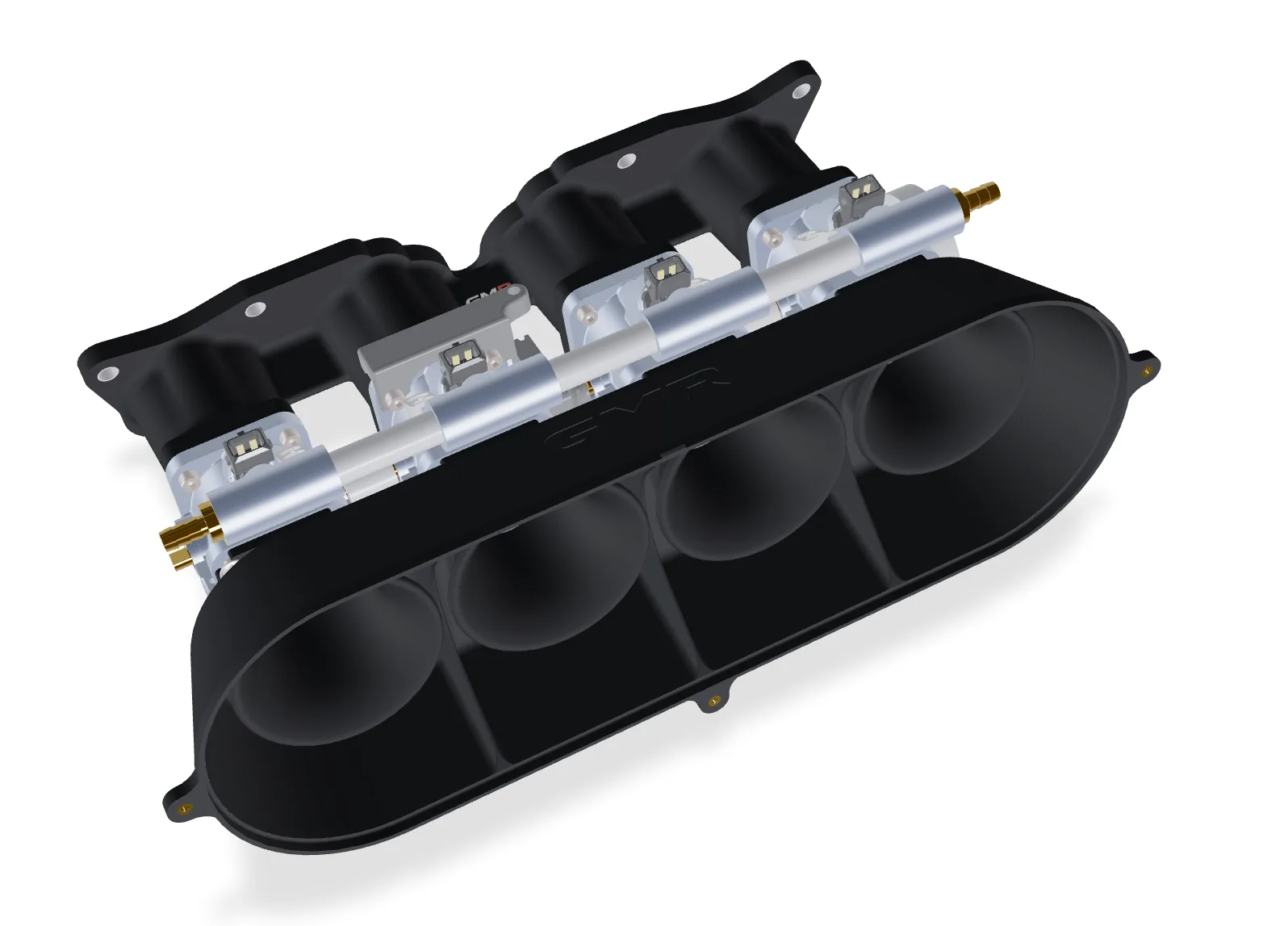
A K20 ITB setup buys you one thing above all else: throttle authority. Fitting four individual throttle bodies — one butterfly per cylinder — in place of the single throttle body and shared plenum sharpens the relationship between your right foot and the engine's response. That's the real prize for circuit, hillclimb and sprint work. What it is not is a bolt-on peak-power win. Runner diameter, runner length and head flow decide your top-end number, and a well-sized single-throttle manifold can match ITBs on peak power. So before you spend, be clear about what you're actually buying and what the engine underneath needs to make it worthwhile.
I'll walk through sizing, runner length, ECU strategy, cooling clearance and the install pitfalls that catch people out — with real kit specs so you can compare like for like.
What a K20 ITB kit actually does for you
With ITBs, each cylinder gets its own butterfly sitting close to the port. There's no shared plenum acting as a buffer, so throttle transients arrive at the valve with far less lag and far less cross-talk between cylinders. On a car where you're modulating throttle mid-corner and metering grip on the exit, that resolution is worth real lap time.
The mistake is assuming that resolution equals horsepower. It doesn't. If your engine is essentially stock, a set of ITBs will make it feel keener without adding a meaningful amount of power — and it can actually cost you drivability. ITBs suit a build with raised compression, uprated cams and, ideally, some head work. They reward an engine that already wants to breathe. Bolt them to a mild long block and you've bought throttle response you can't fully exploit, plus a tuning headache. If you're weighing this against a simpler route, our guide on the individual throttle body kit for the Honda K20 lays out what combinations genuinely justify the move.
Throttle plate sizing: bigger is not automatically better
This is the most contested number in the whole K20 ITB conversation, so treat any single "correct" figure with suspicion. Commercially available bodies cluster around 45, 50, 52 and 55mm, with only a couple of specialist builders (Kinsler) starting at 57mm and climbing to 60mm.
The case for going large rests on flow loss. The K20 intake port is roughly a 47mm equivalent, and one school of thought argues you need a minimum of around 54mm at the plate to offset the flow lost to the butterfly and its shaft, with 60mm reportedly making more power everywhere on a fully built engine. The counter-argument — and the one that catches most club-level builders — is that you can absolutely over-ITB a motor. Put 52mm bodies on a mild 1.8 and you'll only make power up top; the bottom and midrange fall away because charge velocity through an oversized throttle collapses at low RPM.
The honest position: correct plate size is a function of your cams, head porting and target RPM — not a fixed number you can copy off a forum. Here's how the mainstream options stack up.
| Throttle plate size | Typical target | Trade-off |
|---|---|---|
| 45mm | Stock-to-mild K20/K24, OEM ancillary retention | Best low/mid response and drivability; caps top-end on a big build |
| 50–52mm | Cammed, ported street/track engines | Good all-round balance for most fast-road and club builds |
| 55mm | Ported heads, high-RPM circuit engines | Needs the head flow to justify it; narrows usable band otherwise |
| 57–60mm | Full race, big cams, extensive head work | Peak-power biased; poor manners below the power band |
One design detail worth understanding: some billet kits use a shaftless butterfly to remove the central shaft from the airstream, with a claimed airflow gain of up to 10% over a conventional shafted body. That's a manufacturer figure, not an independently verified one — treat it as a design rationale rather than a promise. For the deeper theory on why bore diameter and shaft blockage matter, see our piece on choosing a kit that actually fits and performs.
Runner and trumpet length: your real tuning lever
Once the plate is sized, runner and trumpet length is where you tune the torque curve. This is pressure-wave tuning: a reflected pressure pulse arriving at the valve during the intake event effectively supercharges the cylinder at the RPM where the wave timing lines up. Longer overall length moves that peak down the rev range; shorter length moves it up.
Numbers from real kits give you a feel for the window. The standard Jenvey K20 body is 66mm long with the butterfly in the middle; one builder found 55mm trumpets performed slightly better on the dyno than the supplied length. A straight-port 52mm kit example ships with 50mm air horns for a 220mm total length. None of these are universal — they're starting points to be dyno-optimised for your engine.
This is also where the honest trade-off with a plenum sits. A plenum and single throttle body allow resonance tuning with longer standing waves, so you can target a specific RPM band and reach higher air velocity at higher frequency than open ITBs easily can. If your discipline lives in a narrow, high RPM window, a well-developed manifold can out-tune ITBs there. It's a tool you reach for when the engine calls for it — not a lesser option. Our article on how velocity stack length and radius actually make power goes into the mechanism properly.
Where DDM composite intake parts change the calculation
Trumpets, plenums, airboxes and manifolds are exactly where manufacturing route matters, and it's worth being precise about the options. The laminated composite route — prepreg and autoclave — is genuinely the right call where sustained temperatures are extreme or where load runs through the part in a direction that would otherwise rely on interlayer strength. But for tuned-length intake geometry, GMR's DDM composite parts, printed in PPA-CF (carbon-fibre reinforced polyphthalamide) by Direct Digital Manufacturing, solve problems the other routes can't touch.
First, geometry. DDM lets us produce hollow, closed internal cavities, tuned-length runners and smooth internal transitions in a single piece — shapes that simply cannot be laminated or machined in one go. That means the runner length and radius your dyno data asks for, not the shape the tooling allows.
Second, thermal behaviour. A reinforced polymer wall plus a trapped-air cavity keeps intake-charge heat pickup far lower than an aluminium part. Aluminium has a density of 2.70 g/cm³ and a thermal conductivity of 150–220 W/m·K; PPA-CF's conductivity is orders of magnitude lower (I won't quote a single figure — it isn't published on the datasheet, and I'm not going to invent one). The practical upshot is most valuable at idle and heat-soak, where an aluminium plenum sat over a hot head bakes the charge. At sustained wide-open throttle with cold air already rushing through, the benefit narrows — I'd rather tell you that than oversell it.
Third, weight. PPA-CF is 1.25 g/cm³ — under half aluminium's 2.70 g/cm³ before the hollow section is even counted.
Fourth, fit. Engine-specific geometry with genuine port matching, no "universal fit" compromise, and CAD-to-dyno iteration fast enough that the geometry is optimised on real data rather than guesswork.
On the heat question, the material earns its place under the bonnet. PPA-CF is semi-crystalline and fibre-reinforced, so its 85°C glass transition is emphatically not a service ceiling — load-bearing capability persists well above it. That's why its heat deflection temperature is 196°C at 1.8 MPa (227°C at 0.45 MPa) and its Vicat softening point is 232°C. The one orientation caveat to respect: Z-axis tensile strength is 57±5 MPa versus 168±4 MPa in XY, so part orientation is an engineering decision, not an afterthought.
| Property (PPA-CF datasheet) | Value |
|---|---|
| Tensile strength (XY / Z) | 168±4 MPa / 57±5 MPa |
| Young's modulus (XY) | 11,800±670 MPa |
| Bending strength (XY) | 208±6 MPa |
| Impact strength (XY) | 41.7±2.8 kJ/m² |
| Density | 1.25 g/cm³ |
| Heat deflection temp | 196°C @1.8 MPa / 227°C @0.45 MPa |
| Vicat softening | 232°C |
| Saturated water absorption | 1.30% |
If you're building the whole induction path, our guides on a carbon composite airbox for the K20 and on building an enclosed induction system that actually lowers intake temps cover how the box and the trumpets have to be developed together.
The kits worth comparing
| Kit | Body size | Notes / fitment |
|---|---|---|
| Jenvey CKHA07 (EP3) | 51mm tapered SF | Includes manifold, four bodies, levers, fuel rail, tapered airhorns. Standard Honda injectors won't fit; water pump housing mod needed; aftermarket ECU required |
| AT Power 45mm oval twin-housing | 45mm | Port-matched to OEM ports, packages in standard engine bay, retains OEM water pump, reversible bolt-on. Tune required |
| AT Power 50/55mm (FN2/FD2) | 50 / 55mm | 55mm direct-to-head for ported heads — head ports must be machined to match. Electric water pump required |
| Clockwise Motion straight-port | 52mm | Modular: manifold, bodies, air horns, fuel rail, linkage, TPS, filter, backplate, cable mount |
| Rzcrew Racing billet | 45/48/50/52/55mm | Cable throttle, optional water-passage flange, custom diameters. Standalone ECU required |
One important clarification, because searchers conflate them constantly: a 70mm or 74mm Skunk2 unit is a single large throttle body, not an ITB kit. Fitting a bigger single throttle body (or an FD2 throttle body) to your existing manifold is a cheaper, simpler upgrade path — a tapered entrance and larger bore does raise flow — but it gives you none of the per-cylinder throttle control that defines an ITB setup. Different tool, different job.
ECU and tuning: the part that makes or breaks the build
Every serious K20 ITB kit requires standalone or aftermarket engine management — K-Pro/Hondata, Haltech, MoTeC or Link. This isn't optional, and here's the mechanism why.
Speed-density (MAP-based) load sensing does not work with ITBs. Without a shared plenum to damp the signal, MAP sits very low and very unstable at idle, and any throttle movement produces enormous swings in the reading. The ECU can't resolve fuelling from that, so Alpha-N (TPS-based) load sensing is effectively the only option — the throttle position becomes your primary load axis. Some ECUs support a blended strategy, using MAP at low RPM and small openings and switching to TPS at higher RPM and larger openings, which is the best of both for a road car.
Be realistic about drivability. Alpha-N can take a lot of tuning to get right at part throttle, and on the street that means chasing out flat spots, bucking and surge. It's very achievable — plenty of owners run ITB K20s daily in stop-start traffic with a clean idle you'd never pick as anything unusual until the bonnet's up — but it lives or dies on the calibration. Verify your tuner has genuine Alpha-N experience before you commit. This is exactly the kind of work we do in-house, and getting the throttle linkage actuation right is a prerequisite — a non-linear or notchy pedal makes a clean Alpha-N tune almost impossible.
Idle, vacuum, injectors and cooling — the install pitfalls
Idle air. ITBs pass excess air at idle, so you need an idle control strategy. A remotely mounted IACV fed to the manifold via a hose and adapter helps make a road car useable; with electronic throttle actuation it isn't required.
Vacuum source. With no plenum there's no single vacuum tap, so all four runners are manifolded into a vacuum block or accumulator. A typical setup runs one hose from each runner into the block, then one line to the brake booster and a short line to the MAP sensor for reference and diagnostics.
Overrun stall. Coasting/overrun stalling is a known symptom, usually traced to wiring or TPS/throttle-plate setup rather than the ITBs themselves. In one documented case it was MAP and TPS grounds wired incorrectly; the fix also required adjusting the TPS and throttle plates so injector firing didn't drop to zero on a closed throttle.
Injectors. Budget for new injectors. OEM Honda injectors often won't physically fit the ITB fuel rail — the Jenvey kit states this outright. Some billet kits specify exact hardware, e.g. a Bosch TPS (0280122016) and Bosch EV14 long-style (LS1-style) injectors. Size them to your power target; our injector sizing guide covers how to avoid over- or under-buying.
Cooling clearance. This is the one that surprises people. Larger ITB kits foul the OEM mechanical water pump housing — the whole point is to run the ports where the engine wants them, so no compromise is made around the pump. The standard fix is an electric water pump plus a block-off plate (K-Tuned's plate kit, for example, deletes the OEM pump, tensioner and accessory drive). One caution on sustained circuit use: off-the-shelf electric pumps can under-cool — there's a documented case of a K-Tuned e-pump on a K24 overheating after two laps. Size the pump and rad for your duty cycle; this is a real reliability concern, not a theoretical one.
Realistic power expectations
A naturally aspirated K20 with proper supporting mods — cams, springs, head work — targets roughly 250–300 whp. ITBs contribute to that as part of a matched package, not as a standalone power adder. If someone promises you a big number from ITBs alone on an otherwise stock engine, they're selling, not engineering.
FAQ
Can you daily-drive a K20 with ITBs?
Yes, when the tune is done properly. Owners run ITB K20s daily in stop-start traffic with a clean idle. The catch is that it lives on the calibration — Alpha-N takes real tuning effort to eliminate part-throttle flat spots and stalling, so it's only as drivable as your tuner is good.
Do I need an aftermarket ECU for a K20 ITB kit?
Yes. Every serious kit requires standalone or aftermarket management (K-Pro, Haltech, MoTeC, Link) because ITBs need Alpha-N or blended load sensing — the factory MAP-based ECU can't resolve fuelling from the unstable manifold pressure.
What throttle body size should I run on a K20?
There's no universal answer. 45mm suits stock-to-mild engines and best low-end response; 50–52mm is the sweet spot for most cammed, ported builds; 55mm and above are for high-RPM race engines with the head flow to use them. Oversizing narrows your usable powerband — match the plate to your cams and RPM target.
Do ITBs make more power than a single throttle body?
Not necessarily on peak power — a well-sized manifold and single throttle body can match ITBs, and a plenum can out-tune them in a narrow RPM band. The real ITB advantage is throttle response and per-cylinder control, which is where it earns its money on track.
Related: Rolling Road Tuning in Northampton: What You Actually Get for Your Money