
2026-10-04
Zetec Bike Throttle Body Kit: How to Spec, Size and Fit One That Actually Performs
A Zetec bike throttle body kit uses reconditioned motorcycle throttle bodies — GSXR or ZX-10R units — mounted on a bespoke manifold to replace the standard single throttle and plenum. On a healthy 2.0 Zetec-E it is a credible, lower-cost route to individual-runner induction, and when it is specced and mapped properly a standard 135 bhp 2.0 will typically read 165–170 bhp with a free-flowing exhaust. Get the engine family, body diameter, injector location and manifold spacing right and it is a genuinely good conversion. Get any one of those wrong and you buy yourself a flat spot, a mapping headache, or a part that simply doesn't bolt to your head.
Before you spend a penny, the single most important decision is which "Zetec" you actually have — because the kits are not interchangeable.
First, work out which Zetec engine you've got
"Zetec" is one of the most misused names in Ford tuning. Vendors split the kits by engine family for good reason — the port spacing, head face and injector arrangement differ enough that one kit will not serve another. There are three families you need to tell apart:
| Family | Common names | Capacities | Notes |
|---|---|---|---|
| Zetec-E | "Zetec", Blacktop / Silvertop | 1.6 / 1.8 / 2.0 | Iron block, alloy head. The classic kit-car and track engine. |
| Zetec SE | Sigma (Puma, Fiesta Zetec S, Focus) | 1.4 / 1.6 / 1.7 | Different engine entirely — a Zetec-E kit will not fit. |
| ST170 | Zetec-E derivative with VVT | 2.0 | Has its own specific parts; the standard Zetec-E kit is not suitable. |
The Zetec-E itself is an iron-block DOHC four with an alloy head, offered as 1,597/1,598/1,769/1,988/1,989 cc, bores of 80.0 or 84.8 mm, an 88.0 mm stroke and compression of 9.6:1 or 10.2:1. That iron block is relevant later — it is a heat sink, which changes how much you benefit from insulating the intake charge.
Bike throttle bodies vs purpose-made ITBs
A "bike throttle body kit" is exactly what it sounds like: motorcycle throttle bodies — GSXR600, GSXR750, GSXR1000, ZX-10R and similar — repurposed onto a car manifold. They are the value route into individual-runner induction, offering real performance, reliability and reasonable fuel economy without the price of a dedicated ITB set. They are popular in kit cars, hillclimb and club motorsport for that reason.
Purpose-made Zetec ITB kits from the likes of Jenvey, AT Power or Gradient are the premium alternative: matched bore sizes, car-specific injector bosses, proper trumpets and a clean mapping story out of the box. If you want the honest cost comparison between the two routes, we've laid it out in detail in our piece on bike carbs vs ITB conversion cost. For many builders the bike route wins on budget; for others the fabrication time eats the saving. Be honest with yourself about which you are.
Throttle body diameter: bigger is not automatically better
This is where most bike-body conversions are won or lost. Bike throttle bodies are tapered, so the quoted "size" is normally the butterfly/outlet diameter — the number that actually governs airflow and signal strength at the engine side. Approximate real-world figures from the common donors:
| Donor body | Inlet (approx) | Butterfly / outlet (approx) | Typical application |
|---|---|---|---|
| GSXR600 | ~45 mm | ~38 mm | Zetec SE / Sigma, mild Zetec-E |
| GSXR750 (2000–03) | ~50 mm | ~42 mm | Tuned Zetec-E, ST170 |
| GSXR1000 | ~50 mm | 42 mm | Tuned 2.0 |
| ZX-10R | — | 44 mm | Zetec-E, 240 bhp+ capable |
| GSXR1300 / ZX12R | — | 46 mm | Ultimate top-end builds |
The mechanism is straightforward. A smaller bore keeps port velocity high at low and mid lift, which sharpens throttle response and fattens the mid-range, and it keeps the manifold vacuum signal strong for the ECU to read. A larger bore trades that away for peak flow at high rpm. Those two goals pull in opposite directions, and the right answer depends on where on the rev range you want the engine to work.
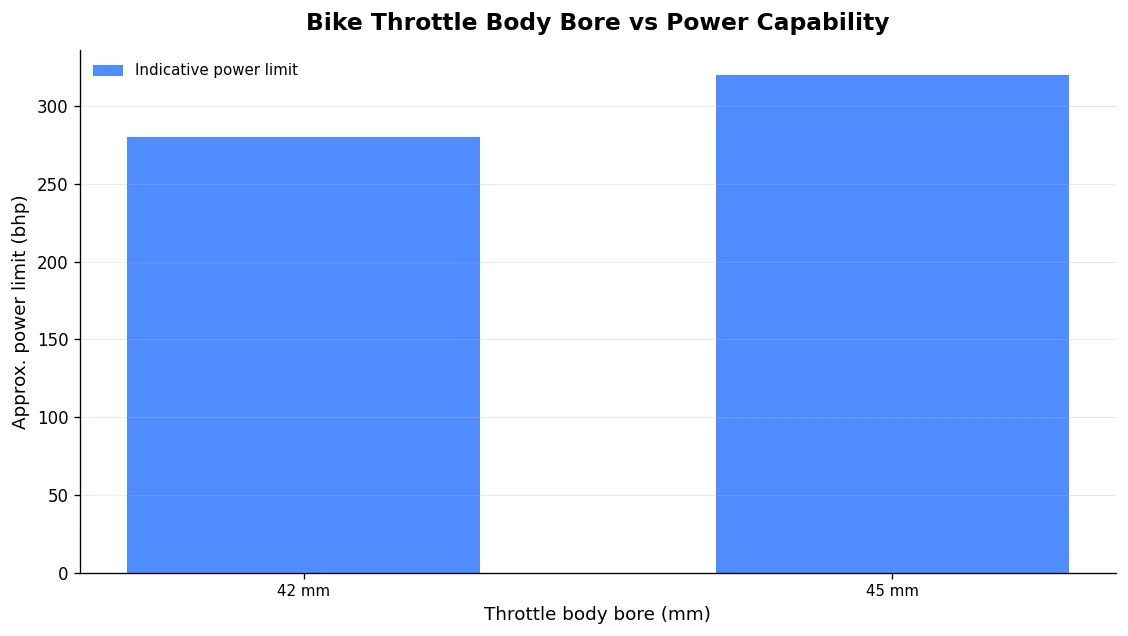
Practically: 38 mm bodies give slightly better torque and throttle response and flow plenty for at least 170 bhp. For a road car, 600-size bodies give better low-mid power and control; 750-plus are better for the top end — and we're talking only a few millimetres between them. For a non-ultimate-power build, 40 mm is fine, and 42 mm is on the small side but snappy on a mild engine and happy making peak torque around 5,500–6,000 rpm. If you're chasing torque at 7,000–7,500 rpm it starts to run out of breath, which is why the heavily tuned 2.0s move to 44–46 mm. The common mistake is fitting 46 mm bodies to a near-standard 2.0 and wondering why it feels lazy below 4,000 rpm — you've killed the velocity that made the engine driveable.
Injectors: location is a fitment decision, not an afterthought
The Zetec-E mounts its standard injectors and fuel rail in the inlet manifold. Once you bin the standard manifold, those injectors have nowhere to live. You have two routes:
- Retain the bike injectors and rail. ZX-10R bodies keep their 330cc injectors; GSXR600 bodies keep ~240cc. This is the standard bike-kit approach and avoids modifying the head. The 330cc flow is ample for a 165–170 bhp 2.0.
- Delete the bike rail and run injectors in the standard head location. Useful if you want to fit larger or matched injectors, or keep a cleaner fuel layout. Most good manifold builders will delete the rail on request.
Either works. The point is to decide deliberately — because the choice drives fuel rail fabrication, injector spacing and how you wire the loom.
Manifold and the spacing problem nobody mentions
Motorcycle cylinder spacing is not Ford cylinder spacing. Bolt a set of bike bodies straight onto a Ford head and the ports won't line up. So the bodies must be re-spaced: the gaps between them opened out to match the head, the fuel rail lengthened to suit, and the tabs on the butterfly levers extended so the linkage still works. On a respaced set the throttle plates may no longer touch each other, so small extenders get TIG-welded onto two of the bodies to keep the linkage synchronised. This is real fabrication, and it is where the "budget" route quietly spends your time.
A properly built manifold is high-quality aluminium with a precision CNC- or water-jet-cut 10 mm flange and TIG-welded runners, 45–48 mm OD with a 3 mm wall, and all internal joints fully ported and ground for smooth flow. That flange thickness matters: it keeps the face flat under clamp load and heat so the bodies seal and stay aligned.
There is a well-known ST170 shortcut worth flagging honestly. Because the ST170 uses a plastic manifold with rubber connectors, builders re-space the bodies, fuel rail and butterfly tabs and connect them straight onto the existing ST170 rubbers. The ST170 inlets are oval and the bodies are round, so a flared, ovalised piece of 14-gauge aluminium tube makes the round-to-oval transition. It works and it's cheap, but it is a bodge in the literal sense — the transitions aren't ideal and you're trusting rubber connectors on a race intake. Fine for a budget hillclimb hack; not what I'd build for repeatable results.
Where a DDM composite intake changes the maths
The spacing, round-to-oval transitions and tuned-length runner geometry that cause all the fabrication grief on a bike kit are exactly the problems that DDM composite (Direct Digital Manufactured carbon-fibre-reinforced PPA-CF) solves in one piece. Rather than welding aluminium tube and grinding transitions, the intake path is printed with the correct port spacing, smooth internal transitions and tuned runner lengths designed around your head — with genuine port matching rather than a universal-fit compromise. Hollow, closed internal cavities and internal transitions that simply cannot be welded or machined in a single part become routine.
There are three concrete advantages worth spelling out. First, thermal. PPA-CF has a thermal conductivity orders of magnitude lower than aluminium (which sits at 150–220 W/m·K), and a printed part can carry a trapped-air cavity around the runner. On a hot iron-block Zetec sitting in traffic or heat-soaking after a run, that keeps intake-charge heat pickup far lower than an aluminium manifold would. Be honest about the caveat: this helps most at idle, low speed and heat-soak; at sustained wide-open throttle with cold air rushing through, the charge spends little time in contact with the wall and the benefit shrinks. Second, weight. PPA-CF is 1.25 g/cm³ against aluminium's 2.70 g/cm³ — under half the density before the hollow section is even counted. Third, geometry and iteration. Because the part goes from CAD to a printed component quickly, runner length and taper can be optimised on real dyno data rather than guessed and welded.
On the material itself: PPA-CF gives 168±4 MPa tensile strength and 11,800±670 MPa Young's modulus in the XY plane, 208±6 MPa bending strength and 41.7±2.8 kJ/m² impact strength. The 85°C glass transition is often misread as a temperature ceiling — it isn't. PPA-CF is semi-crystalline and fibre-reinforced, so it keeps load-bearing capability well above Tg, which is why the heat deflection temperature is 196°C at 1.8 MPa (227°C at 0.45 MPa) and Vicat softening is 232°C. For under-bonnet work that HDT figure is the number that matters. Where a laminated/autoclave part is genuinely the better call is sustained extreme temperature, or a load case governed by the Z axis — PPA-CF Z tensile is 57±5 MPa against 168 MPa in XY, so print orientation matters and we design around it. I reach for the laminated route when the engine calls for it, not by default.
Trumpets, filters and induction tuning
Trumpet length is a tuning variable, not a cosmetic one. The standing pressure wave in the runner reflects and returns; time its arrival to coincide with a still-open inlet valve and you get a supercharging effect at a particular rpm. Longer trumpets (and runners) favour low and mid-range; shorter favour the top end. A typical bike kit ships with a 50 mm aluminium trumpet kit in selectable 25/50/90 mm lengths, and the air filter — a Pipercross PX500/PX600, for example — is sized to suit the chosen trumpet and the space available. Pick the trumpet length to match where you want the torque, then size the filter around it.
What power to realistically expect
Manage expectations, because this is where disappointment lives. A healthy standard 135 bhp 2.0 Zetec-E typically makes 165–170 bhp with a bike throttle body kit and a free-flowing exhaust, correctly mapped. A Zetec SE/Sigma on GSXR600 bodies will see around 150 bhp given a healthy engine, performance manifold and exhaust. Those are bolt-on-and-map numbers.
Gains are highly dependent on supporting work. Throttle bodies complement an engine that already has at least an upgraded exhaust manifold and system; cams and headwork push the curve further. The real-world spread proves the point: an ST170 on GSXR750 bodies with a custom manifold, polished head and standard VVT made 158 bhp / 150 lb-ft — the owner had hoped for ~185 and was let down. At the other end, a heavily built example with GSXR600/750 bodies, VVT removed, headwork, cams and standalone management made the right side of 230 bhp. Same base engine family, wildly different outcomes — because the throttle bodies were never the whole story.
Pricing and what you actually get in the box
Representative UK pricing (ex VAT — always confirm current prices):
| Kit | Price (ex VAT) | Contents |
|---|---|---|
| Zetec-E ZX-10R Starter Pack | £850.00 | TIG-welded alloy manifold, throttle linkage, optional EFI fuel pack. No ECU. |
| Zetec-E ZX-10R Fast Road Pack | £1,750.00 | Respaced ZX-10R bodies + extended linkage and fuel rail, manifold, silicone hose + Mikalor clamp fitting kit, ME221 ECU + plug-and-play loom, air temp and coolant sensors. |
| Zetec SE GSXR Starter Pack | £850.00 | As Zetec-E starter, GSXR600 38 mm bodies. |
For context, a purpose-made Zetec ITB kit runs from around £1,057 ex VAT for bodies and manifold, rising to £2,184 ex VAT complete with ECU and loom. The key buying decision is the Starter vs Fast Road split: a Starter Pack gets you the hardware but you still need an ECU and mapping; the Fast Road Pack is effectively turnkey hardware with a standalone ECU. Either way, note the honest caveat every serious vendor repeats — basemaps get the car running, but road mapping or dyno time is still required. Our in-house guidance on choosing throttle bodies for kit cars covers how to scope that work before you commit.
FAQ
Will a Zetec-E bike throttle body kit fit my ST170 or Sigma?
No. The three families — Zetec-E, Zetec SE/Sigma and ST170 — have different port spacing and head faces, and the kits are not interchangeable. The ST170 in particular has its own parts and a plastic manifold shortcut route. Confirm your exact engine before buying.
GSXR600 or GSXR750/ZX-10R bodies for a 2.0 Zetec?
For a near-standard or mild 2.0 aimed at a smooth, torquey curve up to ~6,000 rpm, 38–42 mm (GSXR600/750) is the better choice and flows plenty for 170 bhp-plus. Only move to 44–46 mm (ZX-10R, GSXR1300) if the engine is heavily tuned and you're chasing peak power at 7,000 rpm and above. Oversizing on a stock engine costs you mid-range.
Do I have to re-space bike throttle bodies?
Almost always, yes. Motorcycle cylinder spacing doesn't match the Ford head, so the bodies, fuel rail and butterfly tabs must be opened out to suit, and linkage extenders welded on to keep the plates synchronised. A one-piece DDM composite intake sidesteps the re-spacing entirely by printing the correct geometry from the start.
Can I run these without a standalone ECU?
Not sensibly. Individual throttle bodies produce a weak, uneven manifold vacuum signal that factory speed-density ECUs struggle with. A standalone such as the ME221 (or ME360 if you want drive-by-wire) with an alpha-N or throttle-position-based strategy is the correct approach, followed by proper mapping.