
2026-10-10
Zetec E Bike Carburettor Kit: How to Spec, Size and Set One Up Properly
A Zetec E bike carburettor kit bolts a bank of four motorcycle CV carburettors onto a bespoke manifold in place of the standard single-throttle intake, giving you four individual intake tracts and a far crisper throttle than the OE setup — at a fraction of the cost of a twin Weber 40/45 DCOE conversion. It fits the 16-valve twin-cam Ford Zetec E (red top, silver top and black top) in 1.6, 1.8 and 2.0 capacities. Get the carb size, mounting angle and fuel pressure right and it will reward you with sharp response, usable torque and decent economy. Get any one of those three wrong and it will never run cleanly, no matter how long you spend on the jets.
This guide covers exactly how to spec one for your engine — the sizing logic, the fitment numbers that actually matter, and the set-up details that separate a conversion that drives properly from one that coughs and backfires off idle.
What fits — and what categorically does not
The first mistake I see is people buying a kit for the wrong family of engine. "Zetec" covers several unrelated designs, and the parts are not interchangeable.
- Zetec E (1.6/1.8/2.0) — the earlier blacktop/silvertop twin-cam. This is what the standard bike carb kit is built for.
- Zetec SE / Sigma (1.4–1.7) — a completely different engine despite the name. It needs its own application-specific manifold.
- ST170 — different head and port layout again; it requires ST170-specific parts.
Measure your head and confirm which engine you actually have before you order anything. The single most useful number is the inlet port centre spacing: the Zetec E head runs port centres of approximately 92–93mm. Bike carbs are spaced far tighter than that, which is precisely why a bespoke, correctly-spaced manifold is non-negotiable.
37mm or 40mm? Sizing the carbs to your build
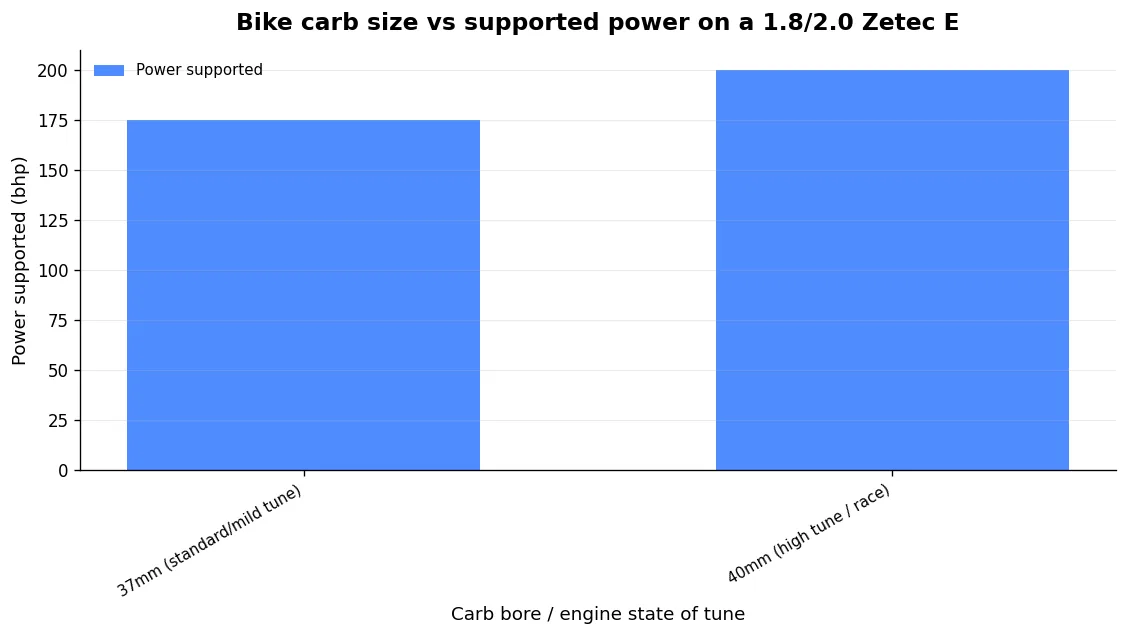
Bike carb kits are typically supplied in two bore sizes, and the right choice is governed by your power target and how the car is used — not by "bigger is better".
| Carb bore | Typical donor carbs | Power supported | Best for |
|---|---|---|---|
| 37mm | ZX6R, CBR600, CBR900, YZF600, ZZR600, R6, GSXR600 SRAD | Up to ~175bhp | 1800/2000cc in standard to mild tune; road and occasional track |
| 40mm | Larger-bore CV banks | Over ~200bhp | 1800/2000cc in high tune; high-revving race/track engine |
For the vast majority of road and fast-road 1.8/2.0 Zetecs, 37mm is the better all-round choice. It has been proven to give better torque characteristics than 40mm carbs on this engine, because the smaller tract keeps port velocity up where you actually drive. The 40mm kit only makes sense on a seriously built, high-revving engine chasing 200bhp-plus.
A point that confuses people: bike carbs are measured at their narrowest point, so a nominally "small" CV carb flows more than its number suggests. A 38mm CV bike carb is 38mm at its narrowest, whereas a set of 45 DCOEs typically runs 36 or 38mm chokes — so it is only 36/38mm at its tightest restriction. That is why 37mm bike carbs comfortably feed engines people assume need 45s. The rough rule that CV carbs need to be ~15% bigger than a slide carb to flow the same is a guideline only, not a figure to design around.
And do not oversize. 42mm is too big even for a 200bhp 2.0-litre — all you buy is lost velocity, soft throttle and a jetting headache.
The fitment detail that trips people up: carb spacing
Because the Zetec head sits at ~92–93mm port centres and bike carbs are far closer together, the manifold has to bridge that gap. Manifolds are commonly cut for a specific carb bank — for example, ZX6R/CBR600-type banks spaced 75–75–75mm. Buy a manifold for that spacing and fit carbs from a different bike and nothing lines up.
Spacing varies by donor model, and forum-quoted figures are enthusiast-measured — treat them as a starting point, not gospel:
- ZZR600 — roughly 75–95–75mm
- ZZR1100 — roughly 75–86–75mm
Always physically measure your actual carbs centre-to-centre before buying a manifold. This is exactly the kind of place where "close enough" ends the project.
Mounting angle: get the float bowls level or it will never run
This is the detail most home conversions get wrong, and it is the one that makes a set of carbs un-tuneable. Bike carbs must be mounted in the same orientation they sit in on the bike, with the float chamber roughly horizontal. A good manifold is designed to present the carbs at the correct angle for precisely this reason.
Mount them at 90° — flat, as if they were throttle bodies — and the float chambers end up on their side. With the chokes horizontal the floats cannot do their job, and you will never set a stable mixture however much you fiddle.
There is a usable range of angles rather than a single correct value. As reference points: CBR600 carbs sit about 10° off vertical in the bike's own manual; the float-bowl split line on a 1998 ZX6R is at 24–25°. One builder deliberately chose 30° to keep the float chamber line sensible. The failure mode to watch for is fuel draining out of the bowls and into the runners when the car is parked — one builder found this happening at around 27° from horizontal and cured it by changing the mounting angle (to roughly 50°) so the carb gasket face sat flat. If your engine floods after sitting, suspect the angle before you suspect the needles.
Fuel supply: low pressure, properly regulated
Motorcycle carburettors are gravity/low-pressure devices. They need a supply pressure of just 2–3 psi — and the principle is "as low as will reliably fill the bowls". Some builders aim lower still, around 1.5 psi, on the basis that any more and the float needles struggle to seat and the carbs flood.
The critical warning: do not plumb an OE fuel-injection pump straight to bike carbs. A factory EFI pump runs 45 psi or more — around twenty times what the carbs can tolerate. It will blow straight past the needle valves. Your options are:
- A dedicated low-pressure bike fuel pump, or
- An aftermarket electric pump with a regulator — a Malpassi "Filter King"-type unit is the common, proven choice — set to carb pressure.
Ignition: carbs fuel it, something still has to spark it
Bike carbs deal only with fuelling. You still need spark management for the Zetec. If your engine kept its distributor, that will happily run the ignition alongside the carbs. The OE manifold vacuum-advance line is usually just left disconnected on a performance build to keep things simple; if you want to retain vacuum advance you need a vacuum balance bar on the new manifold to give the distributor a stable signal.
Deluxe kits sidestep the distributor question entirely by including a programmable ignition ECU (a NODIZ Pro / ME100-core variant) with a plug-and-play Zetec loom, so you get a proper mappable spark curve. If you are building a high-tune engine, a mappable ignition is worth it — fixed mechanical advance leaves power and part-throttle refinement on the table.
Jetting and set-up: the part you cannot skip
Carbs ship with base settings only. Those are an approximate starting point to get the engine running — they are not a tune, and running a lean base jet under load is how you hurt pistons. Final jetting must be done under load with a wideband AFR meter, ideally on a rolling road.
For a 1.8/2.0 Zetec, main jets land around 1.5–1.6mm depending on capacity and spec; deluxe kits are supplied with a main jet set already fitted in that range. Independent builders report much the same — mains opened out to 1.6mm with the slow-running (idle) jets swapped to 50s. Your tuning levers, in roughly the order you reach for them:
- Main jets — full-throttle, higher-rpm mixture
- Pilot/idle jets — idle and low-speed running
- Air correctors — leaning the mixture as rpm climbs
- Needle clip position — mid-range/part-throttle
- Float height — affects full-throttle/low-rpm richness and cruise mixture; a typical bike spec is around 7mm ±2mm, but verify against the donor carb's own service data
Finally, the carbs must be balanced/synced so all four butterflies open evenly. Unbalanced carbs give a lumpy idle and uneven cylinder fuelling that no amount of jetting fixes.
What power should you actually expect?
Be realistic. As a rule of thumb, expect around 10–20bhp on a healthy engine with a good ignition set-up — and bike carbs reward supporting work. They complement an engine that already has at least a decent exhaust manifold and system; add cams and headwork and both power and torque climb further. The carbs are not a magic induction system bolted to a stock engine.
Indicative dyno numbers from real builds (specs vary, so read them as ballpark):
- Bike carbs running a 2.0-litre Zetec at 165–170bhp.
- A built 1800 made 177bhp on 45mm carbs with 36mm chokes, and 187bhp on fuel injection — a useful illustration of the carb-vs-EFI gap on a developed engine.
Bike carbs vs throttle bodies: the honest version
The recurring question. On a properly set-up comparison, throttle bodies tend to show around 10bhp more than bike carbs — fairly consistently on the rollers. But the counterpoint is equally consistent: on a near-stock engine, plenty of Zetecs on TBs don't go any quicker than one on bike carbs. The pattern is clear — on a stock-ish engine the difference is marginal; EFI and ITBs pull steadily ahead as the engine is built. For genuine 200bhp-plus naturally aspirated Zetecs the serious route is high compression, cams, headwork and EFI/ITBs, not carbs.
If you already know you're heading for a high-output, mappable build, it's worth reading our breakdown of the Zetec ITB kit and the Zetec bike throttle body kit before you commit to carbs — and the honest cost comparison between bike carbs and ITBs lays out the budget trade-off. If you'd rather stay on carbs but want the jetting walked through in detail, our Zetec bike carburettor conversion kit guide goes deeper on set-up.
Where a DDM composite part earns its place
If you do move onto throttle bodies later, the induction tract itself is worth engineering properly. For a plenum or airbox feeding a bank of bodies, a laminated/autoclave composite part is one route — but it struggles to form the tuned-length, hollow internal geometry an intake really wants in a single piece. Our bespoke DDM composite airbox is printed in PPA-CF (carbon-fibre reinforced polyphthalamide) with closed internal cavities and tuned transitions that simply cannot be laminated or machined in one go.
The material matters under the bonnet. PPA-CF has a heat deflection temperature of 196°C at 1.8 MPa (227°C at 0.45 MPa) and a Vicat softening point of 232°C — so although its glass transition is 85°C, it is semi-crystalline and fibre-reinforced, meaning load-bearing capability persists well above that Tg. It is also a far better thermal barrier than aluminium: a reinforced polymer plus a trapped-air cavity keeps intake-charge heat pickup orders of magnitude lower than an aluminium part (aluminium sits at 2.70 g/cm³ and 150–220 W/m·K thermal conductivity), which helps most at idle and heat-soak. At 1.25 g/cm³ it is under half the density of aluminium before the hollow section is even counted. Where very high sustained temperatures or Z-axis loads govern, a laminate can still be the right call — PPA-CF's Z tensile strength (57 MPa) is far below its XY value (168 MPa), so build orientation matters. None of this applies to the carb kit itself, but it's worth knowing for the next stage of the build.
FAQ
Will a Zetec E bike carburettor kit fit my Zetec SE / Sigma?
No. The Zetec E and the Zetec SE/Sigma (1.4–1.7) are different engines with different heads. The SE/Sigma needs its own application-specific manifold, as does the ST170. Confirm which engine you have — measuring the inlet port spacing (~92–93mm on a Zetec E) is a good check.
Why can't I run my standard fuel pump?
An OE fuel-injection pump runs at 45 psi or more, while bike carbs want just 2–3 psi. That much pressure forces fuel past the float needles and floods the engine. Use a low-pressure bike pump, or an aftermarket pump with a regulator such as a Malpassi Filter King set to carb pressure.
My engine idles fine but coughs and backfires off idle — what's wrong?
Classic symptom of incorrect low-speed jetting, wrong emulsion tubes, or unbalanced carbs. One 2.0-litre Zetec did exactly this; swapping the wrong jets and emulsion tubes and balancing the airflows fixed it completely. Check the mounting angle and float bowl level too before you chase jets.
How much power will I gain?
As a rule of thumb, 10–20bhp on a healthy engine with good ignition. Bike carbs reward supporting mods — an uprated exhaust manifold and system, then cams and headwork. They won't transform a stock engine on their own.
The bottom line
A Zetec E bike carburettor kit is a genuinely good-value route to a sharp, responsive induction system — but only if you treat the three fundamentals as engineering, not guesswork: size the carbs to your build (37mm for most 1.8/2.0 road engines, 40mm only for serious 200bhp-plus tune), present them at the correct angle with level float bowls, and feed them clean low-pressure fuel. Do that, jet it on a rolling road with a wideband, and it will drive beautifully. Cut corners on any of the three and it never will.