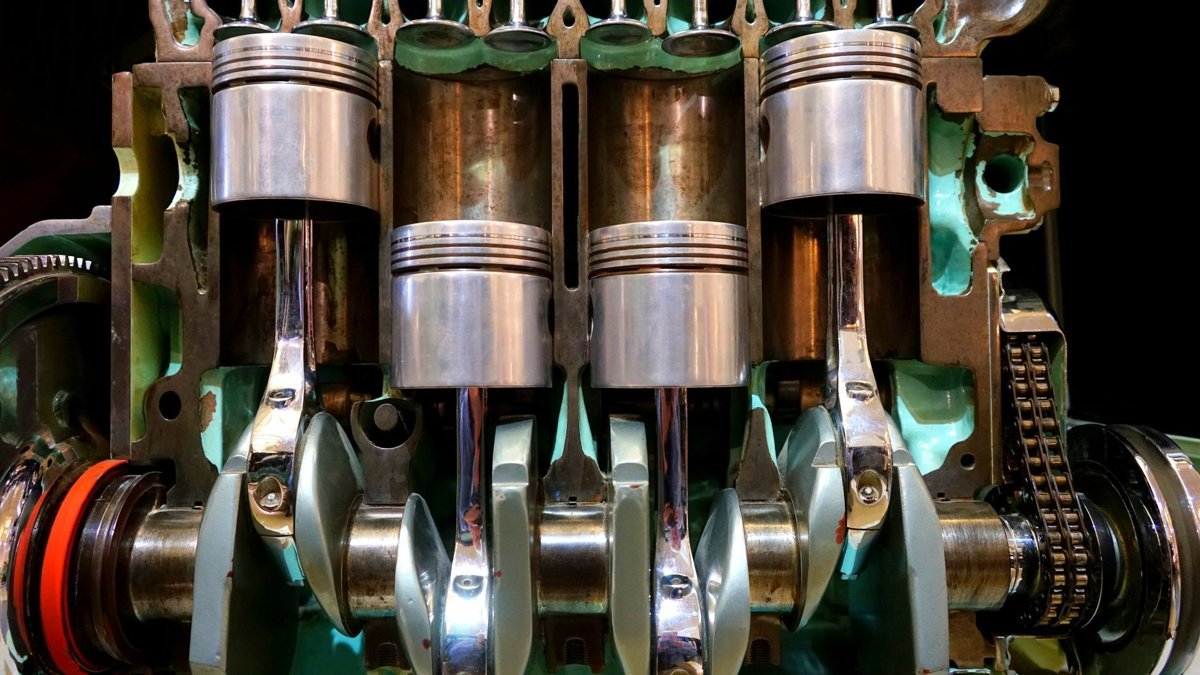
If you’re sourcing high performance engine components in the UK, the hard part isn’t finding parts — it’s finding the right parts for your combination, then having them fit and behave the way the spec sheet promised. I’ve spent enough years at the sharp end of motorsport to know that most failures aren’t down to a “weak” part. They’re down to the wrong part, fitted to the wrong clearance, in an engine that wasn’t diagnosed properly in the first place.
This guide walks through the components that actually carry the load — pistons, connecting rods and crankshafts — with the real materials, alloys and tolerances that matter. No marketing fluff. Just what I’d tell a customer specifying a build on the phone.
Pistons: cast vs forged, and why grain flow matters
The headline difference is in how they’re made. A cast piston is poured — molten aluminium into a mould. A forged piston starts as a single solid billet of aluminium, heated, then formed under enormous compressive force in a press. That process aligns the grain flow of the material directionally, which is exactly why forged is stronger. A cast piston, made from a molten mix, has no such directional grain structure, so it can’t match it.
For anything facing real stress — racing, forced induction, high-revving engines — forged is the only sensible answer. Cast pistons are fine for a daily driver running standard outputs. They’re not fine behind a turbo at 8,000 rpm.
4032 vs 2618: the alloy decision
Forged pistons come in two main alloy families, and choosing between them is one of the more consequential decisions in a build:
- 4032 — contains roughly 10–12% silicon. That silicon gives a lower expansion rate, so you can run tighter piston-to-wall clearances. The result is longer engine life, less noise on warm-up, and a slightly lighter piston. Tensile strength sits around 54–55,000 psi.
- 2618 — lower silicon, higher tensile strength at around 64–65,000 psi. It grows more with heat, so it needs greater cold clearance. That can mean piston slap noise when cold and a small efficiency penalty, but it takes abuse that 4032 won’t.
The strength gap is smaller than people assume — it’s not double, it’s roughly 20%. So don’t reach for 2618 by default. A high-revving naturally aspirated engine that lives at part-load on the road often runs better on 4032. A high-boost, high-thermal-load build wants 2618.
Clearance is everything. Forged alloys expand more than cast, so they need more piston-to-wall clearance when cold — set precisely by an experienced builder for that exact piston and use case. Get it too tight and the piston seizes once it reaches operating temperature: catastrophic, expensive, and entirely avoidable.
What good forging buys you
On a properly made forged piston, surface finish can be as fine as 0.5 microinches and tolerances as tight as ±0.0001 inch. You can also specify genuine performance features: contact-reduction grooves, dual pin oilers, lateral and vertical gas ports (which feed combustion pressure behind the top ring to increase sealing load), accumulator grooves and internal milling to shed weight.
The most important consideration is not the piston itself. It’s the bore size, bore condition, plating wear, hone pattern and general engine condition. A piston is only a fuse. If you don’t diagnose why the last one failed, you’ll just blow the next one.
Connecting rods: I-beam, H-beam and the materials that actually decide it
Rods come in three categories: cast, forged and billet. For the vast majority of serious builds, 4340 and 300M forged steel remain the most versatile and widely adopted — strong, reliable and sensibly priced.
Beam geometry, honestly
The internet loves to argue I-beam vs H-beam. Here’s the engineering: an I-beam handles high compression loads well because the “I” section can’t expand — under heavy compression the sides of an H-beam can actually bow outward. H-beam rods are typically used for naturally aspirated applications under 1,000 hp.
But the honest truth is that materials and overall design matter far more than beam shape. Both styles appear in every kind of street and race engine — even F1 uses both. Treat beam shape as builder preference informed by the application, not as a magic decider. There’s also the newer X-beam: a hybrid with a large cross-section distributing tension across the rod, giving high rigidity, crack resistance and low weight for racing use.
Billet, and where the real money goes
Billet rods are the pinnacle — machined from a single piece of steel or aluminium, reserved for custom and extreme race engines, and the most expensive option. What you’re paying for is the manufacturing and QC: AMPCO 18 bushings, shot peening for fatigue life, Magnaflux crack inspection, multi-stage heat treatment, CNC machining to tolerances as tight as 0.0002″, centre-to-centre held to .001″, FEA stress analysis and weight-matched sets to ±1 gram.
Bolts are part of the spec, not an afterthought. As a real-world reference, H-beam rods are commonly built with 3/8″ ARP 2000 bolts, while higher-spec sets step up to ARP 625+ — a meaningful upgrade for forced-induction and high-load duty. Indicative power figures circulate (standard H-beam sets quoted around 600–900 hp, higher-spec forced-induction sets around 1,000–1,200+ hp), but treat those as manufacturer marketing, not a guarantee for your specific combination.
Crankshafts: steel grades and heat treatment
For the crank, material and heat treatment do the heavy lifting. 4340 is the workhorse. Beyond it, the EN-grade steels are worth understanding:
- EN26 (2.5% nickel) — a Nickel-Chromium-Molybdenum alloy, closest in character to 4340, and capable of being through-hardened to a higher hardness. Whether that extra hardness is desirable depends on the application — harder isn’t automatically better in a crank.
- EN40B (722M24) — a chromium-molybdenum nitriding steel with around 3.25% chromium. Nitrided, it gives a tough core with a very hard, thin surface layer. This is the kind of steel used for some F1 and Indycar crankshafts.
The principle to take away: a nitrided surface delivers a hard, fatigue-resistant journal face over a tougher, more ductile core. That combination — hard where it slides, tough where it flexes — is what keeps a crank alive at sustained high rpm.
How GMR specifies components around your engine
This is where I differ from the “universal fit” crowd. I don’t sell a part and wish you luck. We design and manufacture race and performance components here in the UK, around your actual combination — bore, stroke, target rpm, fuel and intended use. That extends from valvetrain to our carbon composite intake work: see our approach to a Honda K20 individual throttle body kit and how we spec a bespoke intake manifold that actually works.
None of the rotating assembly matters if the air and fuel side isn’t right, either. The same engineering discipline applies to velocity stack length and radius and to the calibration that ties it all together — our motorsport ECU calibration is what turns good hardware into repeatable power. If you want the wider philosophy, read what high performance engineering actually means.
Building toward track use? It’s worth planning the car as a whole — a first track day guide is a sensible read before you commit to a spec. Related: if you’re eyeing a specific circuit, see this guide to Brands Hatch track days.
FAQ
Are forged pistons always better than cast?
For high-stress use — racing, turbocharged or high-revving engines — yes, because forging aligns the grain flow and produces a stronger piston. For a standard daily driver at stock outputs, cast pistons are perfectly adequate. The real risk with forged is clearance: they expand more, so cold piston-to-wall clearance must be set correctly or you’ll seize.
Should I choose 4032 or 2618 forged pistons?
4032 (10–12% silicon) runs tighter clearances, lasts longer and is quieter cold — good for high-revving naturally aspirated and road-biased builds. 2618 is stronger (around 64–65,000 psi vs 54–55,000 psi) and tolerates more thermal abuse, which suits high-boost forced induction, at the cost of more cold noise and a slight efficiency penalty.
Does H-beam vs I-beam really matter?
Less than people think. I-beams resist high compression loads well; H-beams suit most naturally aspirated builds under 1,000 hp. But material grade (4340, 300M, billet), heat treatment, bolt spec and overall design matter far more than beam shape. Both styles run in everything up to F1.
Why does crankshaft steel grade matter?
Because heat treatment and material define fatigue life. 4340 is the versatile standard; nitriding steels like EN40B give a hard journal surface over a tough core, which is why they appear in top-tier motorsport cranks. The right choice depends on rpm, load and how the crank is finished.
Related: Motorsport Engine Builder UK: What Actually Separates a Built Engine From a Bodged One
Related: Performance Engine Pistons: How to Choose 4032 vs 2618, Clearances and Ring Packs That Survive