
2026-08-26
TU5 Intake Manifold Upgrade: The Real Power Ceiling (And Why 1500 HP Is a Myth)
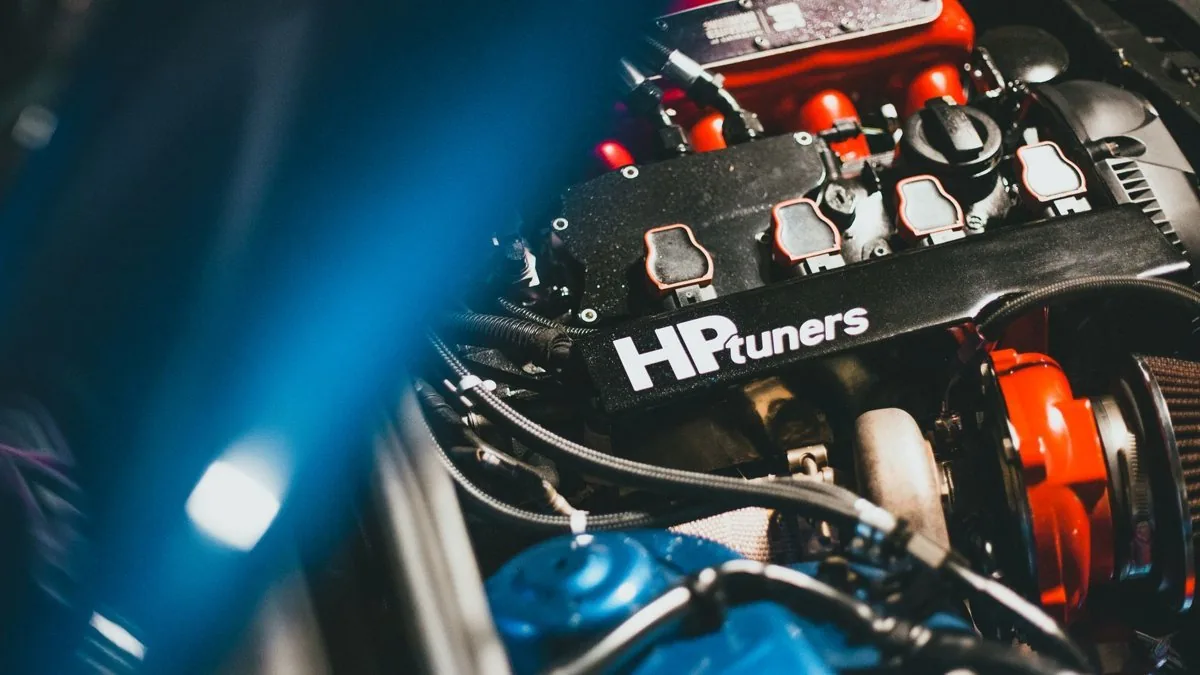
Let’s deal with the number in the search box first, because it changes the whole conversation. A TU5 is a 1.6-litre four-cylinder. Asking it for 1,500 hp is asking for roughly 940 hp per litre — territory occupied by purpose-built F1 and top-tier drag powerplants with billet blocks, dry-decked closed-deck architecture and fuelling systems that cost more than most people’s cars. There is no credible, verifiable dyno record of a TU5 anywhere near that figure, and if someone is selling you a manifold on the promise of it, you’re being sold marketing, not engineering.
What a TU5 intake manifold upgrade genuinely does is unlock the airflow, throttle response and top-end breathing the factory plastic plenum was never designed to deliver — and, on a properly built forced-induction engine, act as one enabler among several toward the real power ceiling of the platform. So let’s set out what that ceiling actually is, what the manifold contributes to reaching it, and how to spec one that fits your head instead of “a TU5, roughly”.
The honest TU5 power ceiling
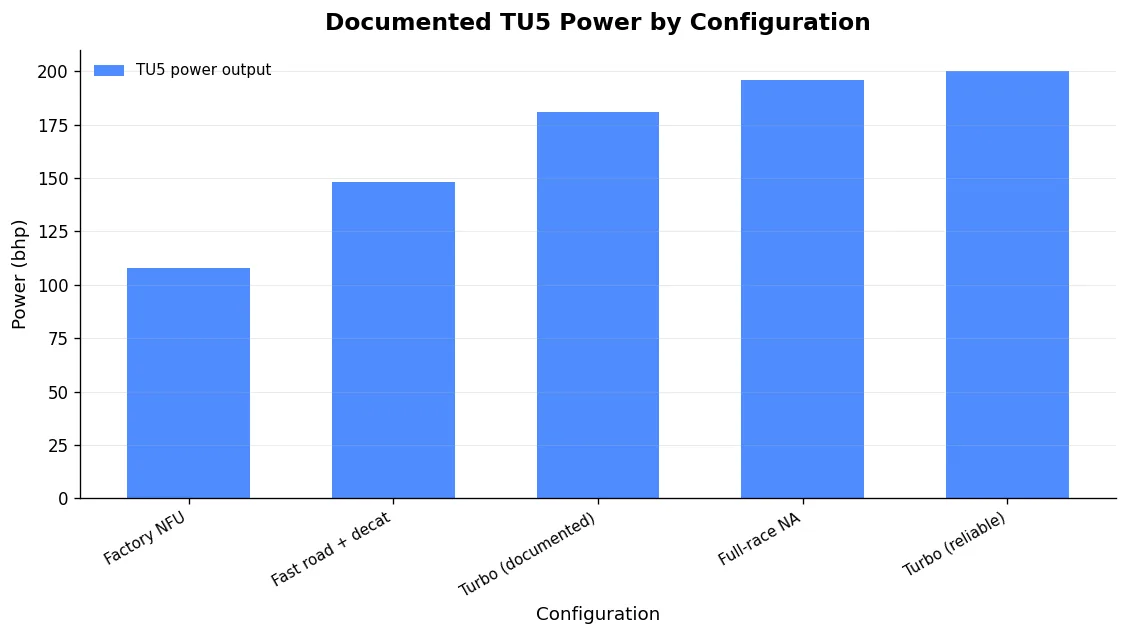
Here are the documented figures, so you can calibrate your expectations against reality rather than a forum boast:
| Configuration | Power | Notes |
|---|---|---|
| TU5JP4 (NFU) factory | 110 PS (108 bhp) @ 5,800 rpm | 147 Nm @ 4,000 rpm, 1,587 cc DOHC 16v |
| Fast road, breathing mods + decat | ~145–150 bhp | Gains largely from higher CR and larger valves on the sporting head |
| Full-race NA (documented) | 196 bhp @ 7,700 rpm | Full ITB race build (Pug1off TU5JP4) |
| Turbo, reliable | ~200 hp | Forum consensus; the TU is a strong bottom end when built for it |
| Turbo, documented example | 181 bhp @ 8 psi | Saxo VTS 16v, decomp plate, GT17 — described as the safe limit of some components |
| Big-power drag builds (400 hp+) | Unverified | Claims exist; no reputable dyno data found — treat with scepticism |
The pattern is clear. A well-sorted naturally aspirated TU5 lives around 145–200 bhp. A sensibly built turbo car makes ~200 hp reliably, with the frontier of credible figures sitting well below any four-figure fantasy. The 1.6 TU is a genuinely strong unit — several builders note the 1.6 uses a cast-iron block rather than the alloy casting of the smaller TUs, which is part of why it tolerates boost better (verify the exact variant of your block before you commit to a boost target; sources aren’t unanimous on every casting). But strong is not the same as indestructible.
What the factory manifold actually costs you
The standard TU5 intake manifold is an equal-length plastic moulding. It’s a perfectly sensible OEM part: cheap to make, quiet, and tuned for low- and mid-range driveability on a road car that revs to around 6,500 rpm. What it is not is a high-rpm breathing part. Its runner geometry and plenum volume are compromises struck for emissions, packaging and cost — none of which are your priorities on a track or dyno.
Two things limit it once you start chasing power. First, the fixed runner length and plenum volume place the pressure-wave tuning peak at a modest engine speed; push past it and volumetric efficiency falls away exactly where you want it climbing. Second, the single throttle body upstream of a shared plenum throttles all four cylinders through one restriction and gives sluggish transient response. For a serious NA build, that’s the wall you hit.
The NA route: individual throttle bodies
For a naturally aspirated TU5, individual throttle bodies (ITBs) are the dominant and correct upgrade. Each cylinder gets its own throttle and its own tuned runner, so throttle response becomes near-instant and each cylinder can be fed on its own terms. If you want the full reasoning on choosing a kit that actually fits and makes power, we’ve written it up specifically for this engine family in our Peugeot TU individual throttle bodies guide.
The main options on the market for the 16v head:
| Kit | Throttle | Notes |
|---|---|---|
| Jenvey ST45 taper kit | ST45, 42 mm butterfly | Includes manifold, fuel rail and four 40 mm airhorns; Saxo/106 GTi fitment |
| danST bike-TB kit | GSXR600 bodies | TIG-welded alloy manifold, retains 240 cc injectors, suits >200 bhp |
| danST DCOE kit | DCOE-pattern, various bores | 106 GTi / Saxo / C2 VTS TU5 16v |
| AT Power direct-to-head | 38 mm twin-oval, shaftless | Knife-edged blades, no central shaft — claimed up to 10% more flow vs shafted |
The AT Power detail is worth dwelling on because it illustrates the mechanism: removing the central butterfly shaft eliminates the turbulence and blockage it causes at full throttle, which is where a shaft sits directly in the airstream. That’s a real airflow gain from geometry, not from marketing. Bore sizing matters too — bigger isn’t automatically better. Oversize throttles kill air velocity at part-throttle and mid-range, hurting driveability and low-end torque for a top-end number you may never use. Match the bore to your rev ceiling and camshaft, not to the biggest figure on the shelf.
The forced-induction route: plenum manifolds
Boost changes the priority. Under positive pressure you want a plenum that distributes charge evenly to all four runners and can house the throttle body, MAP sensor and any additional fuelling. Billet plenum designs for the TU5 — such as the Kakarakis 106/Saxo unit with individual runners, a high-flow venturi design and provision for 4-port meth or nitrous, plus 70–80 mm throttle options — exist precisely for this. On a boosted engine the manifold’s job is to stop being a restriction and to distribute evenly; get cylinder-to-cylinder distribution wrong and you’ll lean out a cylinder and hurt something expensive.
One honest caveat: 3D-printable TU5 plenum designs circulate in the enthusiast scene, some with genuinely useful features like integrated MAP mounting and OEM throttle adapter flanges. A hobbyist FDM print in a general-purpose plastic is not a boost part — it will creep, distort and eventually fail under pressure and heat. That is a completely different thing from a properly engineered DDM composite part, which I’ll come to below, because the manufacturing route and material determine everything.
Where DDM composite earns its place
At GMR we manufacture intake parts by two routes: laminated/autoclave composite, and Direct Digital Manufacturing (DDM) in PPA-CF — a carbon-fibre-reinforced polyphthalamide. Both are genuine carbon composites; the difference is how they’re made and what geometry each route can achieve. For a lot of TU5 intake work, DDM composite is the stronger engineering answer, and here’s specifically why.
First, geometry. DDM lets us build hollow, closed internal cavities, tuned-length runners and internal transitions in a single part that simply cannot be laminated by hand or machined from billet in one piece. On a small four where runner length and plenum volume set your torque curve, being able to iterate that geometry freely is the whole game.
Second, thermal. A reinforced polymer wall plus a trapped-air cavity picks up intake-charge heat far more slowly than an aluminium part. Aluminium has a thermal conductivity of 150–220 W/m·K; PPA-CF is orders of magnitude lower. That matters most at idle and under heat-soak in the pit lane or on the grid — less so at sustained wide-open throttle, where charge dwell time is short. I’ll always tell you honestly which case applies to your car rather than sell insulation as a universal win.
Third, weight. PPA-CF has a density of 1.25 g/cm³ — under half aluminium’s 2.70 g/cm³ before you even count the hollow section. On the intake side of the engine, that’s mass off the top of the motor for nothing.
Fourth, fit. Every part is built around your head, your throttle bodies and your packaging — genuine port matching, no “universal fit” compromise. And because CAD-to-dyno iteration is fast, we optimise geometry against real numbers, not a catalogue guess.
PPA-CF and the temperature question
The figure people misquote is the glass transition temperature (Tg) of 85°C. Read on its own it sounds like a service ceiling — it isn’t. PPA-CF is semi-crystalline and fibre-reinforced, so load-bearing capability persists well above Tg. The numbers that actually govern under-bonnet suitability are the heat deflection temperatures of 196°C at 1.8 MPa and 227°C at 0.45 MPa, and a Vicat softening point of 232°C. Here’s the material summary:
| Property | Value |
|---|---|
| Tensile strength (XY / Z) | 168±4 MPa / 57±5 MPa |
| Young’s modulus (XY) | 11,800±670 MPa |
| Bending strength (XY) | 208±6 MPa |
| Impact strength (XY) | 41.7±2.8 kJ/m² |
| Density | 1.25 g/cm³ |
| Heat deflection (ISO 75) | 196°C @1.8 MPa / 227°C @0.45 MPa |
| Vicat softening | 232°C |
| Saturated water absorption | 1.30% |
Note the anisotropy: XY tensile strength is 168 MPa but Z-axis is 57 MPa, so build orientation is a design decision, not an afterthought. Where the loading is severe and aligned against the build direction, or where sustained temperatures are genuinely extreme, a laminated/autoclave part can be the right call — and I’ll say so rather than force DDM onto a job it isn’t suited to. It’s a tool reached for when the engine calls for it. For the deeper trade-offs, our piece on a carbon intake manifold for a race engine and our bespoke intake manifold spec guide both go further.
The manifold is one enabler — not the whole build
A manifold alone typically adds modest gains on an NA engine — think single figures to mid-teens of horsepower, mostly from better airflow and throttle response. In boost, if the previous setup was badly restricted, a good manifold can unlock far more. But it will never make big power in isolation. For any serious TU5 number you need the supporting cast: fuelling to suit (a MAP sensor is essential on boost — TPS load-sensing is an NA convenience only), a standalone ECU such as an ME221 or Omex 600, and on forced induction, low-compression pistons once you exceed ~9–10 psi, along with forged rods, intercooling and proper calibration.
Two known TU5 weak points deserve attention on any build: the coils are the weakest link in the ignition system, and the timing belt drive is not forgiving — when it lets go, valves bend. Sort both before you chase power. If you want the discipline behind a build that actually finishes races, our club racing engine parts guide lays out the approach. And if you’re building the car to actually drive it, find a local track day and get real data.
FAQ
Can a TU5 really make 1500 hp?
No. That figure is not credible for a 1.6-litre TU5 and there’s no verifiable dyno record anywhere near it. Realistic ceilings are roughly 145–200 bhp naturally aspirated and around 200 hp on a reliable turbo build; extreme drag claims above ~400 hp remain unverified. Anyone promising four figures from this engine is selling a story.
ITBs or a plenum manifold for my TU5?
ITBs for naturally aspirated — individual runners and throttles give the best top-end breathing and throttle response. A plenum-style manifold for forced induction, where even charge distribution and housing the throttle, MAP and any extra fuelling matter more than individual runners.
Is a DDM composite manifold strong enough for boost?
A properly engineered PPA-CF part is a serious component, not a hobby print — HDT of 196–227°C and high XY strength suit it to real intake duty, and build orientation is designed around the load path. That’s entirely different from a general-purpose FDM print, which has no place on a boosted engine.
How much power does a manifold upgrade add on its own?
On an NA TU5, expect modest gains — single figures to the mid-teens in horsepower, mostly airflow and response. On boost the gain depends on how restricted you were before. The manifold is an enabler; fuelling, internals and calibration make the actual power.
If you’re building a TU5 and want a manifold engineered around your exact head and target — not a universal-fit compromise — talk to us. We’ll tell you honestly where the power really is, and which manufacturing route your engine calls for.