
Made to Fit Throttle Body Kit: Why Engine-Specific Beats Universal Every Time
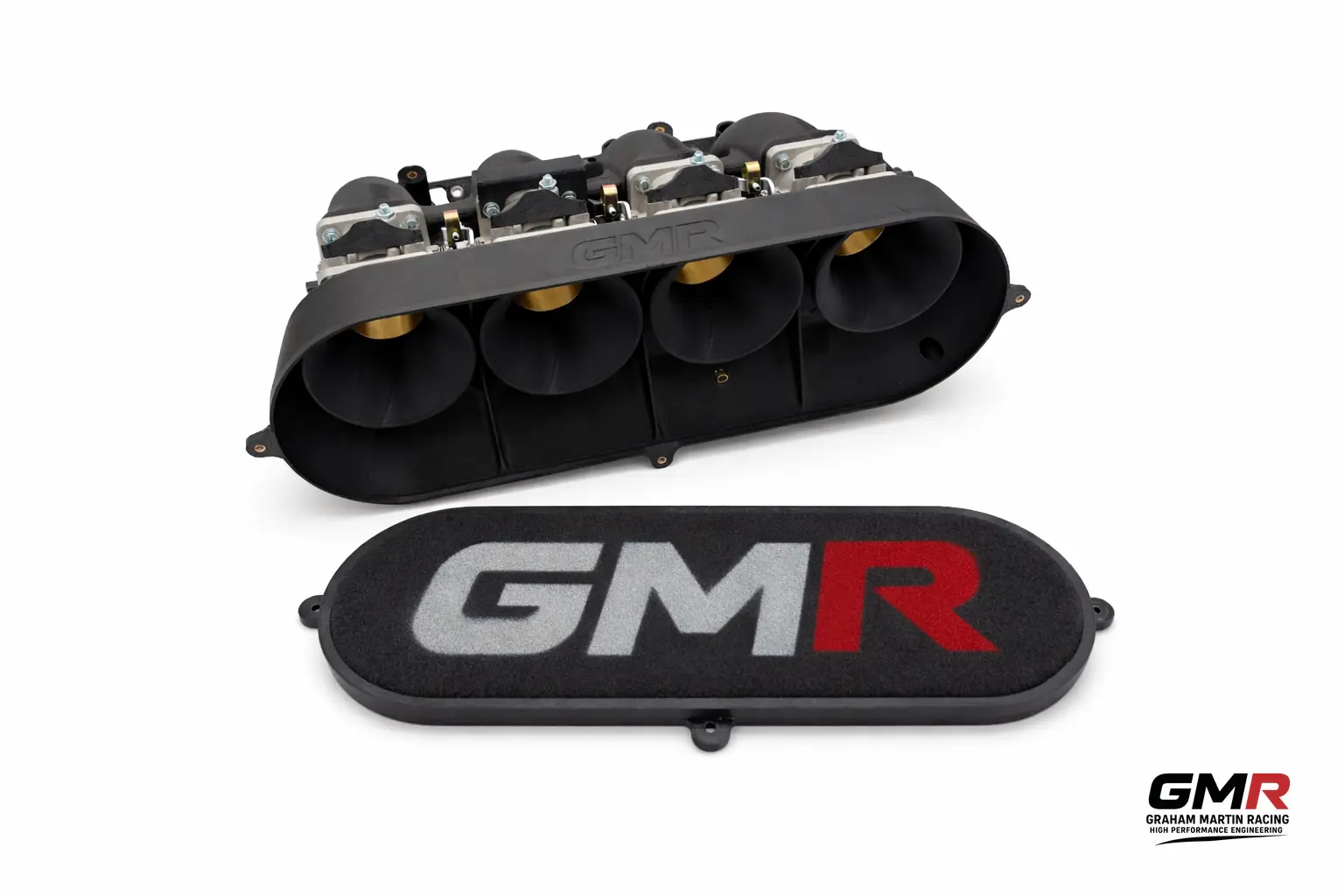
I’ll say it plainly, because someone needs to: a “universal fit” set of individual throttle bodies is a compromise dressed up as a product. If you want the response, the driveability and the peak power your engine is actually capable of, you need a made to fit throttle body kit — one engineered around your cylinder head, your port geometry and your target rev range, not a generic part that bolts to “most things” and serves none of them properly.
I’m Graham Martin. I design and manufacture ITB kits, intake manifolds and airboxes here in Northampton, and I calibrate the engines they go on. So this isn’t theory off a forum — it’s what I see on the bench and the dyno. Let me walk you through what “made to fit” actually means, why it matters, and how to spec a kit that performs.
What “made to fit” actually means on an ITB kit
An individual throttle body kit gives each cylinder its own throttle — a four-cylinder gets four bodies, a six gets six. That’s the opposite of the single throttle and common plenum you’ll find on the vast majority of road cars, and it’s why ITBs respond the way they do: each cylinder breathes on its own, with no shared restriction.
“Made to fit” goes a step further than “ITB kit”. It means the kit is engine specific — designed around a particular cylinder head — rather than vehicle specific or, worse, universal. That distinction is the whole game. Bore size, runner length, trumpet shape and the mounting flange all have to suit your combination. Get them right and the engine drives cleanly from idle to redline. Get them generic and you’ll fight poor idle, soft mid-range and a peak number that flatters nobody.
Direct-to-head fitment: the difference you can feel
The cleanest execution of a made-to-fit kit is direct-to-head fitment. There’s no intermediate carburettor-style manifold — the engine end of the throttle body is machined to match the inlet face of the head and bolts straight to it.
Why does that matter? A traditional manifold typically sits the bodies at 90 degrees to the head. Direct-to-head lets me tailor the angle the body presents to the port, so the airflow runs as straight as possible into the chamber. The more direct the path, the better the efficiency. It also lets me move the throttle plates closer to the head — which sharpens throttle response — and carry the larger-diameter inlet tract nearer the valves, reducing frictional losses along the way.
A properly made direct-to-head kit uses a detachable mounting plate. The head flange bolts to the cylinder head without the bodies attached, so it can be ported and matched to your inlet ports precisely. That’s not a detail you skip. Misalignment between flange and port — even with perfect bore sizing — creates a step, and a step creates turbulence and flow loss. Bore matching is wasted effort if the flange doesn’t line up. This is exactly the kind of work we handle as part of our custom race engine components service.
Bore size: smaller is usually smarter
The single most common mistake I see is people fitting bores that are too big. Bigger bores look fast on paper — lower flow resistance at full chat — but they give very poor control of airflow at small throttle openings. That makes torque hard to meter, idle messy and the car genuinely difficult to drive. A smaller bore gives better throttle response and a more precise air/fuel mix.
As a working guide (assuming a rev ceiling around 9,000 rpm), size against power per cylinder:
- 35 BHP/cylinder → 40mm
- 45 BHP/cylinder → 42mm
- 55 BHP/cylinder → 45mm
- 65 BHP/cylinder → 48mm
- 75 BHP/cylinder → 50mm
Oversizing by even 2mm per cylinder increases the airflow inertia, blunts low-end response and worsens idle quality. There are exceptions — a big, low-revving V8 can carry a large bore happily — but for most four- and six-cylinder builds, resist the urge to go large.
One more thing that trips people up: butterfly placement changes the effective size. A BMW M3 engine runs 50mm ITBs, but the head has long, narrow ports with roughly a 37mm equivalent high-velocity section, which effectively puts the butterfly out near the bell-mouth. That’s why bolting M3 bodies onto an engine with conventional ports so often disappoints — the geometry was never yours to begin with. It’s a perfect illustration of why universal-fit thinking falls down, and why I design around the head in front of me. If you’re choosing a kit for a specific platform, our guides on the K20 ITB kits and GTi6 / XU10J4RS bodies go deeper.
Runner and trumpet length: tune the powerband, don’t guess it
Induction length is one of the most important aspects of fuelling a performance engine, and an under-length system is the single greatest cause of disappointment — you can lose up to a third of your power potential to it. That’s not a rounding error. That’s the whole reason you bought the kit.
The mechanism is pressure-wave behaviour: each intake event sends a wave back up the tract, and if the runner length is right for your rpm, that wave returns to help pack the cylinder. As a guide, measuring from the face of the trumpet to the centre of the valve head, 350mm suits a 9,000 rpm engine. Scale it proportionally with rpm — an 18,000 rpm engine wants roughly 175mm.
Longer trumpets and runners build torque and mid-range; shorter ones suit higher-revving engines. If you can change the inlet length, you can shift the powerband almost wherever you want it — in one back-to-back test, longer parallel trumpets kept the same peak power (just 400 rpm lower) while adding nearly 13 lb ft of peak torque. That’s a real, measurable result from getting one dimension right.
There’s also a packaging minimum: higher rpm wants a larger butterfly-to-valve distance, and for a 7,000–9,000 rpm engine I’d treat 200mm as a practical floor. Where space is tight, fully tapered-bore bodies are a clever fix — they effectively extend the trumpet’s behaviour past the butterfly and into the manifold.
Tapered versus parallel trumpets
The atmosphere end of a trumpet needs to be as large as possible to give air the biggest area to enter; the engine end must match the throttle body bore exactly, with no step to trip the flow into turbulence. Tapered bodies have a smaller engine-side diameter than the trumpet side, effectively turning the entire inlet into one long trumpet for a constant increase in air speed — which suits higher-revving applications well.
Airbox and trumpet clearance
If you’re enclosing the trumpets in an airbox — and you should, for clean, controlled, cooler air — give them room to breathe. A sound guideline is a minimum clearance above each trumpet of three-quarters of the throat diameter. Crowd the bell-mouths and you choke the very flow you’ve spent money chasing. Our carbon composite airboxes are built to hold that clearance while staying light and dimensionally stable; carbon composite’s low thermal conductivity also keeps intake air cooler than an aluminium box soaking up engine bay heat — and as a rule of thumb, a 10°C rise in intake temperature costs you roughly 3% power.
Frequently asked questions
Are GMR throttle body kits engine-specific or universal?
Engine-specific, by design. I build around your cylinder head and target rev range — bore, runner length, trumpet profile and flange all matched to your combination. That’s the difference between a made to fit throttle body kit and a parts-bin set that “should be close enough”. Close enough costs you power and driveability.
Do my cylinder head ports need machining?
Often, yes — and that’s a good thing. A true direct-to-head kit has a detachable flange so the head face can be port-matched precisely before the bodies go on. Even perfect bore sizing won’t save you from a misaligned flange, which causes turbulence and flow loss. Plan for port matching as part of the install.
What bore size should I choose?
Size for power-per-cylinder, not ego. Around 45mm suits roughly 45 BHP/cylinder up to ~9,000 rpm. Going larger than you need ruins low-throttle control and idle quality. When in doubt, go a size down — you’ll thank yourself in traffic and out of slow corners.
Will ITBs idle and behave on the road?
With the right bore, runner length and a proper calibration, absolutely. The driveability problems people associate with ITBs nearly always come from oversized bores or generic fitment, then a map that never corrected for it. Get the hardware right and the calibration follows.
The bottom line
A made to fit throttle body kit isn’t a luxury — it’s the only version of the idea that actually works. The bore, the runner length, the trumpet shape and the flange all have to suit your engine, because the physics doesn’t care what fits “most” cars. If you’re building something serious and want a kit engineered around your head rather than a catalogue, that’s exactly what we do — see how a properly built engine comes together. Have a look at our ITB buyer’s guide, or get in touch and we’ll spec it properly — and once it’s running, point it at a track day and see what it really does.
Related: Race Engine Calibration Service in the UK: How Proper Mapping Actually Works
Related: Throttle Bodies for Kit Cars: How to Choose a Set That Actually Fits and Performs