
2026-11-21
What Does a Velocity Stack Do? The Flow and Pressure-Wave Physics That Actually Make Power
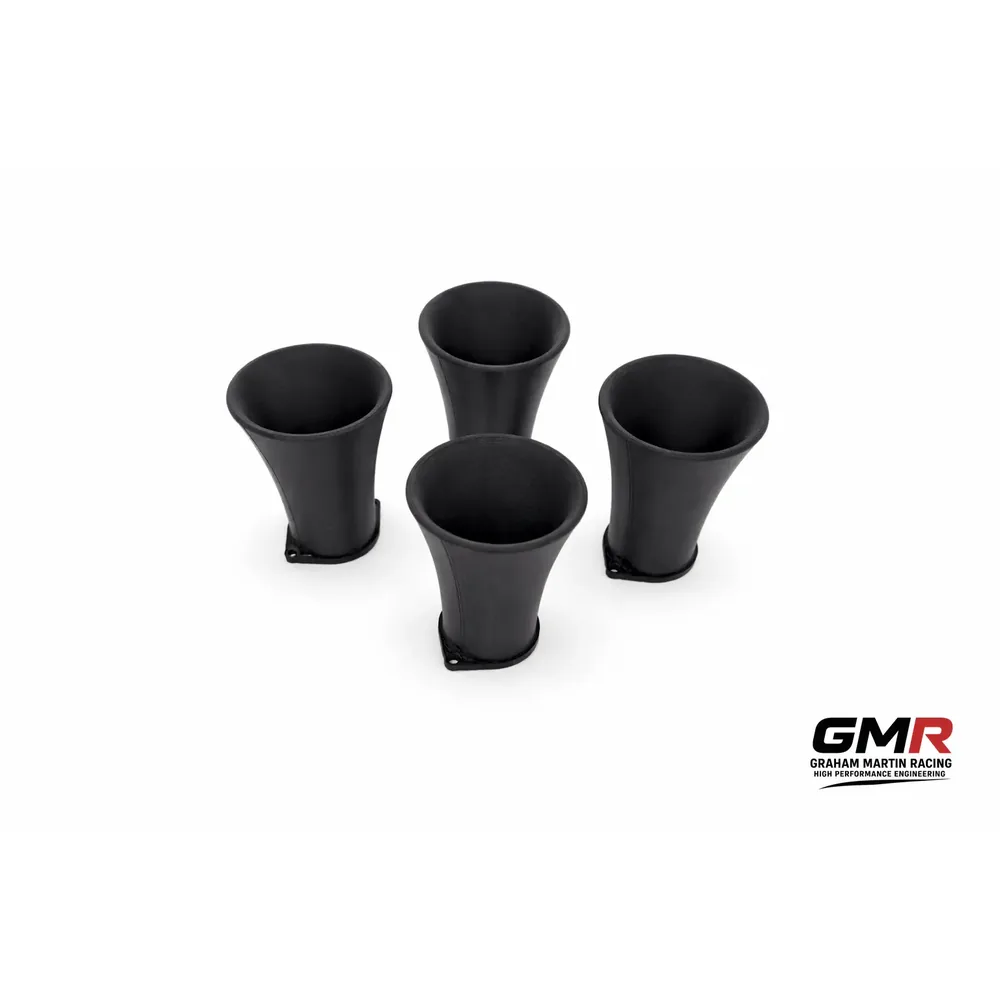
A velocity stack does two distinct jobs, and only one of them is the famous bell mouth. First, the radiused entry lets air turn into the intake tract without separating from the wall — it kills the pinch, or vena contracta, that a sharp-edged inlet creates. Second, and this is the bigger effect, the stack sets part of the total intake tract length, which tunes the pressure wave that reflects off the closing intake valve. Get that length right and a positive pressure pulse arrives back at the valve just as it opens, cramming extra charge into the cylinder. That's the real answer to "what does a velocity stack do": it smooths the air in, and it decides at what RPM the engine inhales hardest.
Everything else — the shape of the trumpet, the radius, whether you run open or boxed — is detail hanging off those two mechanisms. Let's take them in order, with the numbers.
Function one: smooth, attached air entry
Air has mass and inertia. When it has to turn a sharp corner into a pipe, it overshoots the edge and separates, forming a contracted, turbulent core surrounded by dead, low-velocity air. That contraction — the vena contracta — effectively shrinks the usable bore. A radius on the inlet lets the flow stay attached to the wall (laminar entry), so the whole cross-section carries air rather than just the middle of it.
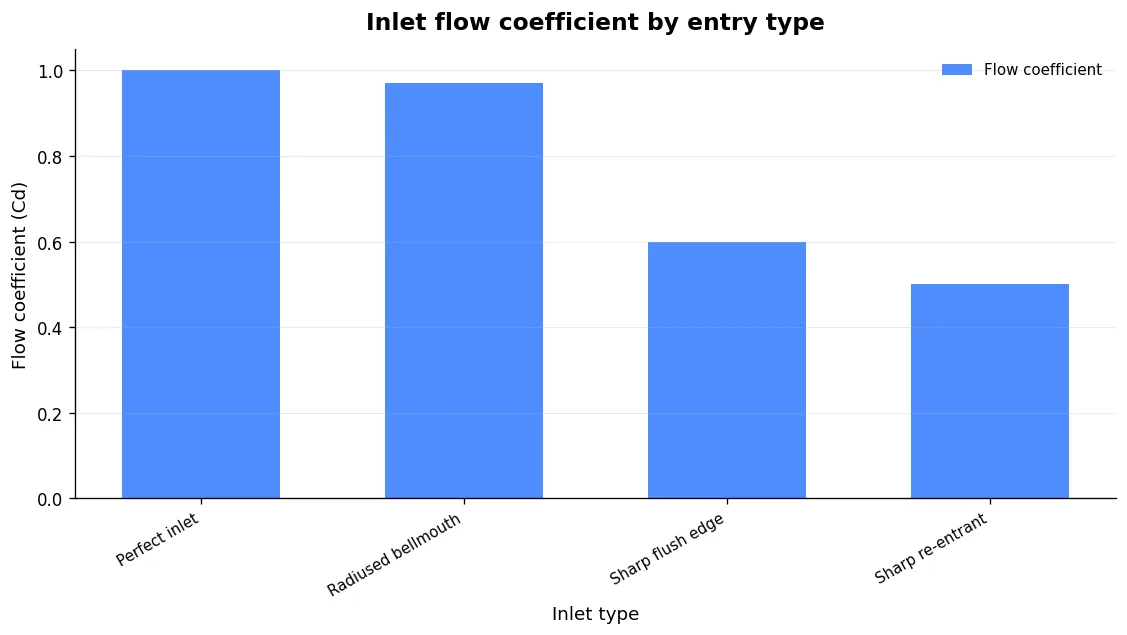
The flow data makes the size of the effect concrete. The inlet's coefficient of discharge tells you how close you are to the ideal:
| Inlet type | Flow coefficient (Cd) | Loss coefficient (K) |
|---|---|---|
| Perfect inlet (ideal) | 1.00 | — |
| Well-radiused bellmouth (r/D ≥ 0.2) | 0.96–0.98 | 0.04–0.06 |
| Sharp-edged flush entry | ~0.60 | ~0.5 |
| Sharp-edged re-entrant entry | ~0.50 | 1.0–1.5 |
Going from a sharp-edged re-entrant hole (Cd ≈ 0.5) to a proper bellmouth (Cd ≈ 0.98) is nearly doubling the entry's flow coefficient. CFD work by Blair confirms the shape matters: even a simple radius beats a plain pipe, and an elliptical profile does best — raising discharge coefficient by up to 27% over a plain pipe. But there are hard diminishing returns. Once you've optimised from a plain pipe to a good radius, moving from a simple radius to a perfect elliptical profile buys you only marginal extra. The rule of thumb I use is that the bellmouth radius should be at least 0.2× the bore diameter, and a common workshop version is that the edge radius should be about half the radius of the opening. Beyond that you're chasing single-digit percentages.
There's a trade-off hiding in that radius, though, and it's one most people never hear about. A bigger radius — say 3/4" on a small bore — broadens the RPM band over which the pressure wave helps, but it also smears and weakens the pulse so much that the engine barely feels the resonance boost. A minimal, tight radius gives a sharper, stronger wave. So radius isn't a "bigger is better" dial; it's a flow-quality-versus-pulse-strength compromise. I cover the profile geometry in more depth in how length and radius actually make power.
Function two: pressure-wave tuning — where the power really lives
This is the part that moves the dyno graph. As the intake valve slams shut, the column of air still rushing toward the cylinder stops dead and piles up, creating a positive pressure wave that travels back up the runner, reflects off the open end, and comes back down. Tune the length of the tract so that reflected wave arrives at the valve just as it reopens, and you get a free supercharging effect — denser charge, more torque at that RPM.
The critical detail almost everyone misses: it's the total intake tract length that tunes, not just the trumpet. The length that matters runs from the back of the intake valve all the way to the radiused mouth of the stack. The trumpet is simply the adjustable end of that pipe. Change its length and you shift the RPM where the boost lands — that is the whole trick. Short stacks move the boost up the rev range; long stacks move it down.
| Approx. stack length | Effect on power band |
|---|---|
| Short (~50–75 mm) | Favours high-RPM power |
| Long (~100–150 mm) | Enhances low-end and mid-range torque via pulse resonance |
Those figures are indicative — they come from motorcycle-scale intakes and are a starting point, not gospel. To actually size a tract, start from a tuned-RPM formula. The simple one I use is:
84,000 ÷ tuned RPM = runner length in inches.
Most road engines run 2nd-harmonic tuning because it gives strong torque gains without absurd runner lengths. Be aware the "magic constant" varies by source and derivation method — you'll see 132,000 quoted for a "2nd harmonic" elsewhere, with 97,000 for 3rd and 74,000 for 4th, plus Helmholtz and Blair methods that disagree again. Don't treat any single number as the truth. Treat it as a first guess, then validate on the dyno.
The practical method to size the stack itself: measure your existing runner length, subtract it from the length the calculator advises, and the remainder is the length of velocity stack you need. Two variables will shift the ideal:
- Cam timing. Camshaft selection strongly affects when the intake valve opens, which directly shifts the pressure-wave timing. Change the cam and you change the ideal length.
- Air temperature. Hotter intake air raises the speed of sound, which moves the ideal runner length. This is one more reason to control intake temperature, not just chase geometry.
The short version I give customers: the radius stops the air tripping at the door; the length decides how hard the engine inhales.
"Stand-off" and reversion: what's really happening
You'll hear that a longer stack "captures" the air–fuel mist that puffs back out of the intake at full throttle, low RPM — the so-called stand-off. That explanation is backwards. What's actually happening is the intake valve is closing too late, the chamber overfills, and the charge blows back out the port before the valve shuts. A longer inlet pipe creates a later-arriving pressure wave that helps hold the charge in the chamber until the valve closes. It's wave timing, not a net.
This is exactly why non-plenum carburettors — Weber DCOE, Dellorto — need stacks so badly. At certain RPM the return shock wave off the valve literally forces air and fuel out of the top of the carb, and the stack is just an extension of the carb to contain that reversion. A plenum design gives that shock wave somewhere to dissipate, which is why plenum systems are far easier to tune. If you're running DCOE-pattern bodies, our 205/306 airbox for Jenvey & DCOE throttle bodies gives that enclosed volume rather than leaving the mouths open to the bonnet.
How much power does a velocity stack actually make?
Be realistic. When inlet radii and stack lengths are optimised for a specific engine, gains are in the order of 2% to 4% — and that's on a high-revving engine with individual intake runners. The inlet end is never the smallest or most restrictive part of the system, so total airflow does not rise by the headline figures that apply only to the entry. If your engine has a single standard throttle body and a factory manifold, open stacks give essentially no benefit. The real gains appear when you already have individual throttle bodies or performance carbs, where each runner can be tuned as its own pipe. That's the whole premise of a properly engineered ITB and airbox package.
Open trumpets or an airbox? Plan for the box
Open trumpets look the part, but on a running car they tend to draw warm under-bonnet air, which pulls ignition timing and quietly erases the gain you paid for — often with poor running on top. The fix isn't to run open; it's to enclose the stacks in an airbox that feeds cool air and stabilises the tuning.
Two things matter here, and people conflate them. A large airbox behaves acoustically much like open trumpets, so it doesn't spoil the resonance — and it simultaneously supplies cooler, denser air. Back-to-back testing of identical trumpets open versus inside a large airbox shows the box winning on charge density alone. A double-wall, air-gap box takes that further by insulating the intake from radiated engine heat and protecting the resonance length you tuned.
And here's the misconception worth correcting: removing the airbox to "cure" stand-off makes it worse, not better. The containment benefit only exists when the stacks sit inside an enclosed volume that can absorb and redirect the pressure pulses. Run them open and you lose that volume entirely. This is one reason we build our carbon composite airboxes — such as the airbox for Jenvey OBX/SF throttle bodies — around the actual trumpet geometry rather than as a lid that happens to clear them.
Why we print the airbox and manifold in carbon composite
Our airboxes and manifolds are printed in PPA-CF — carbon-fibre-reinforced polyphthalamide — by direct digital manufacturing (DDM): printed carbon composite, no moulds. That route does three things an aluminium or hand-laminated part struggles with. First, hollow geometry: closed internal cavities, tuned-length runners and smooth internal transitions that can't be laminated or machined in one piece. Second, thermal insulation: a reinforced polymer plus a trapped-air cavity picks up far less heat than aluminium, whose thermal conductivity sits at 150–220 W/m·K — orders of magnitude higher than the polymer. That protects intake temperature, which, as above, directly protects your tuned length. Third, mass: PPA-CF is 1.25 g/cm³, under half aluminium's 2.70 g/cm³ before you even count the hollow section.
On heat: don't be alarmed by the 85°C glass transition quoted for PPA-CF. It's semi-crystalline and fibre-reinforced, so load-bearing capability persists well above Tg — which is exactly why its heat deflection temperature is 196°C at 1.8 MPa (227°C at 0.45 MPa) and Vicat softening is 232°C. For under-bonnet induction, HDT is the number that matters, and it's comfortably in range. Where a job runs very high sustained temperatures, or where Z-axis strength governs (PPA-CF Z tensile is 57 MPa against 168 MPa in-plane, so orientation is designed around the load path), a laminated/autoclave part can be the right call — and we'll say so. The printed route wins here because the engineering supports it, and because we can go CAD-to-dyno quickly and tune the geometry on real data. Boxes and manifolds are coated internally for sealing and inspection. There's more on the material thinking in our piece on a carbon composite airbox for the K20.
Fitment and filtration: the bits that bite
A velocity stack only works if it's made and fitted properly:
- Match the bore exactly. A stack that doesn't sit flush at the throttle-body face creates a step, and a step trips the very flow you paid to smooth.
- Buy a true profile, not a chamfer. A parabolic or elliptical curve, not a pressed cone with a token lip. Our straight bolt-on velocity stacks are machined to a real profile.
- Decide your tuned RPM first, then size the total tract — stack included — around it.
- Re-tune after any change. Change the cam, the exhaust or the stack length and you've changed the ideal, so the map changes too.
On filtration, be honest with yourself. Open stacks have no filtration at all, and for road use that means debris straight past the valve — worn bores and rings, especially in dusty or sandy conditions. Mesh or foam debris screens are a compromise, not true filtration: a honeycomb screen with 60 PPI foam flows over 315 CFM and will stop pebbles, but it won't stop the fine stuff that actually wears an engine. If the car sees road miles, filter it properly inside a box; keep bare screens for controlled race environments.
FAQ
Do velocity stacks increase horsepower?
On an engine with individual throttle bodies or performance carbs, yes — typically 2–4% when the inlet radius and length are optimised for that specific engine. On a car with a single standard throttle body and factory manifold, there's little to no gain. The benefit is a combination of smoother entry flow and tuned pressure-wave timing, not raw extra airflow.
Does a longer velocity stack give more power?
Not universally — it moves the power. Longer total tract length tunes the pressure-wave boost to lower RPM (more mid-range torque); shorter favours high RPM. Remember it's the whole tract from valve to mouth that tunes, so the stack is just the adjustable end.
Do I need an airbox, or can I run open stacks?
Plan for a box. Open stacks draw warm under-bonnet air, pull timing and often net no gain, and running open actually makes stand-off worse. A large, well-sealed airbox keeps the acoustic behaviour while feeding cooler, denser air.
Can I fit velocity stacks to any engine?
Only usefully to individual-runner setups (ITBs or performance carbs). For other engines we make custom ITB kits, manifolds and airboxes to order — engineered around your combination rather than adapted from a shelf.