
2026-11-18
MX5 Rolling Road Tuning: What It Actually Gains, and What It Can't
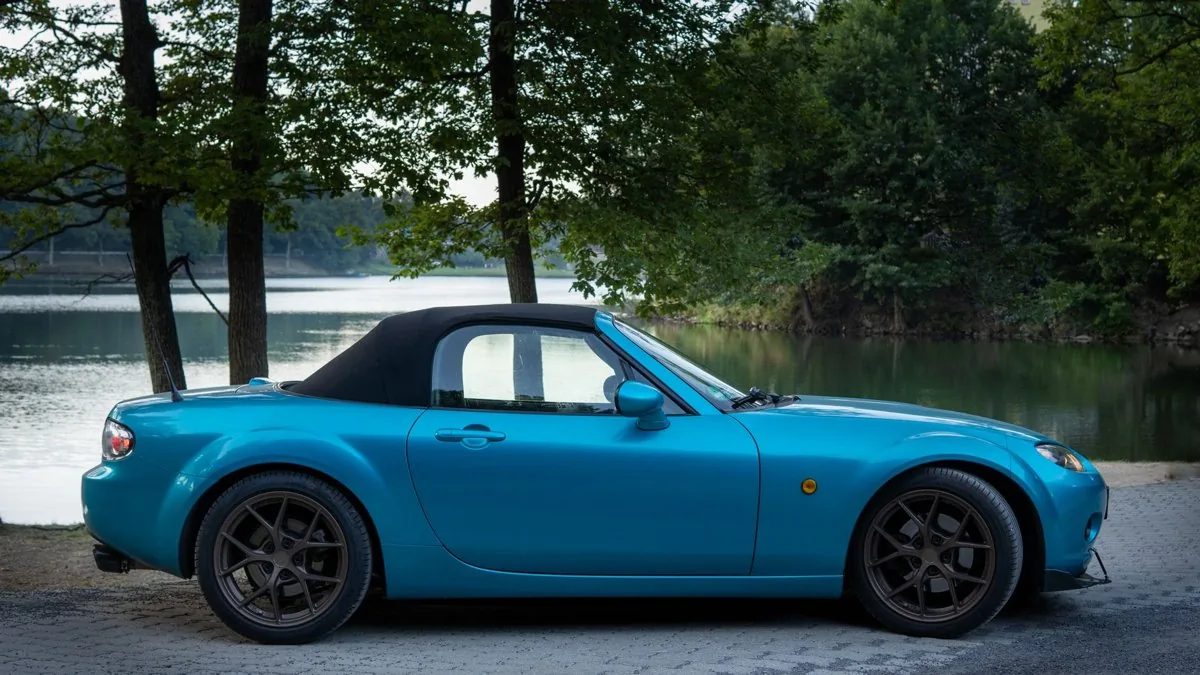
On a naturally aspirated Mazda MX-5, rolling road tuning is worth doing for the driveability — the low- and mid-range torque, the throttle response, the way the car picks up out of a corner — far more than for a headline peak-power figure. If you turn up to a dyno expecting a remap to add 30bhp to a standard NA, NB or stock NC/ND, you'll leave disappointed. Dial in a de-restricted exhaust, a proper induction path and a corrected fuel and ignition map, and you'll feel the difference everywhere in the rev range, even though the peak number moves modestly. That's the honest starting point, and everything below explains why.
MX5 rolling road tuning covers two very different jobs: optimising a lightly modified naturally aspirated car, and calibrating a forced-induction conversion where the gains are genuinely large. The physics, the AFR targets and the value for money are different in each case, so I'll keep them separate.
What a rolling road actually measures (and why the number isn't the point)
A "rolling road" is a dyno where the driven wheels turn a drum. How that drum behaves defines what the session can and can't do.
- Inertia dyno: a large, heavy drum. You accelerate it, apply basic physics, and back-calculate engine power. No power absorber, so it's cheaper — but it only does full-throttle ramp pulls. Fine for a drag car; limited for a road car because it can't hold the engine at a fixed RPM under load.
- Load-bearing (eddy-current) dyno: adds an electromagnetic retarder that applies load. A Dyno Dynamics machine, for example, uses light rollers plus a retarder to hold the car at steady speed, simulate uphill load, or decelerate it. That unlocks steady-state tuning — sitting the engine at a specific RPM and throttle opening while you trim fuel and ignition. This is where a road car actually gets mapped properly.
- Hub dyno: wheels off, adapters bolted to the hubs, car locked into the pod. No wheelspin, better run-to-run repeatability, and fine enough brake control to spot a single-cylinder misfire.
Two numbers matter when you read any dyno sheet. First, power at the wheels is roughly 15–20% lower than at the flywheel because of drivetrain losses — so wheel figures and the factory crank figure aren't the same currency. Second, a hub dyno usually reads higher than a roller because it isn't dragging the wheel and tyre mass around. Dyno figures are not interchangeable across machines. If you're comparing before and after, use the same dyno.
Correction factors: what they fix, and what they don't
Air density changes with temperature and pressure, so most rolling roads correct the measured figure to a reference condition. SAE J1349 references 25°C and 99 kPa; DIN and STD use different baselines. SAE is widely used because it's the more conservative of the common standards. The catch is simple: SAE, STD and DIN are not interchangeable. A graph quoting one standard will not match a graph quoting another even on the identical car, so always state and display which was used.
Correction fixes the air entering the cell. It cannot fix procedure. No formula rewinds a heat-soaked intercooler, a slipping tyre strap, inadequate cooling airflow or a gearbox that wasn't warm. On a Dyno Dynamics machine the transmission drag is estimated, not measured, which is why a proper road warm-up before you strap down genuinely changes the number. If you want an honest before/after comparison, the checklist is short:
- Same dyno, every time.
- Same correction factor, shown on the graph.
- A repeatable warm-up and cooldown — not a cold pull against a heat-soaked one.
- Tyres at recommended pressure, a big fan on the engine, oil temp and ambient logged.
Run the car repeatedly in short succession and heat soak will drop the figure on its own. An operator can move results up or down just by procedure, so a trustworthy tuner documents theirs. If you want a plain-English breakdown of what a session should include before you book, our guide to rolling road tuning in Northampton covers it.
AFR and lambda targets for an MX-5
Lambda is the right metric because it's fuel-independent — it's actual AFR divided by stoichiometric AFR, so lambda 1.00 is correct whatever you're burning. For petrol, stoichiometric is 14.7:1. The targets a mapper works to:
| Condition | Lambda | Approx AFR (petrol) | Why |
|---|---|---|---|
| Idle / cruise | 1.00 | 14.7:1 | Catalyst function, driveability |
| Best economy (light cruise) | 1.03–1.05 | ~15.1–15.4:1 | Slightly lean for fuel economy |
| NA, wide-open throttle | 0.85–0.90 | ~12.5–13.2:1 | Best power window for NA |
| Boosted, WOT (low boost) | 0.78–0.82 | ~11.5–12.1:1 | Charge cooling, detonation margin |
| Boosted, high boost | 0.75–0.78 | ~11.0–11.5:1 | More fuel to resist knock |
A critical point for older cars: the factory upstream sensor is often a narrowband. It flips around 14.7:1 and tells you nothing useful at full throttle — the narrowband limit is the stoichiometric point. Full-load tuning without a wideband is guesswork, and on an engine you care about, guesswork is how pistons die. Any competent MX5 rolling road tuning session runs a wideband.
Realistic gains on a naturally aspirated MX-5
Here's where honesty earns its keep. The NA, NB and standard NC/ND engines don't make big power from a remap alone unless they're already heavily modified. Where the gains actually come from:
- Induction kit alone: marginal — typically no more than 3–5bhp at the crank, and less on NA/NB. It buys throttle response and noise, not power.
- Exhaust: the factory manifold is the main restriction on NA/NB cars — restrictive cast iron that strangles scavenging. A tubular stainless header improves scavenging and cuts backpressure; realistic header-back gain is 8–12hp at the wheels, most of it above 5,000rpm.
- Combined package (induction + full exhaust + retune): on NC and ND cars this nets roughly 10–15bhp. A reasonable split is 2–4hp from the intake, 8–14hp from the exhaust, and 5–10hp from the calibration that ties it together.
The "any header adds 30hp" claim is nonsense on a naturally aspirated MX-5 without supporting mods. Even reaching 180bhp NA is uncommon, and getting near 200bhp costs far more than a turbo or supercharger would. On the ND, Mazda's own jump to 184PS came from hardware — a larger intake manifold, new camshafts, higher injection pressure, a revised induction system, a new exhaust and a raised rev limit (7,500rpm) — not a software flash. That tells you exactly how NA power is unlocked: through flow, not through optimism.
So why tune an NA at all? Because the real win is torque and driveability, not peak. Hit a clean 12.7:1 at peak and the number might barely move, while the low and mid-range fill out noticeably — and in a car this light, small torque gains are genuinely felt. For many owners that's the best money in the whole project. If you're weighing a map against going deeper into the engine, our piece on what separates a properly built engine from a bodged one is worth reading first.
Standard power figures by generation
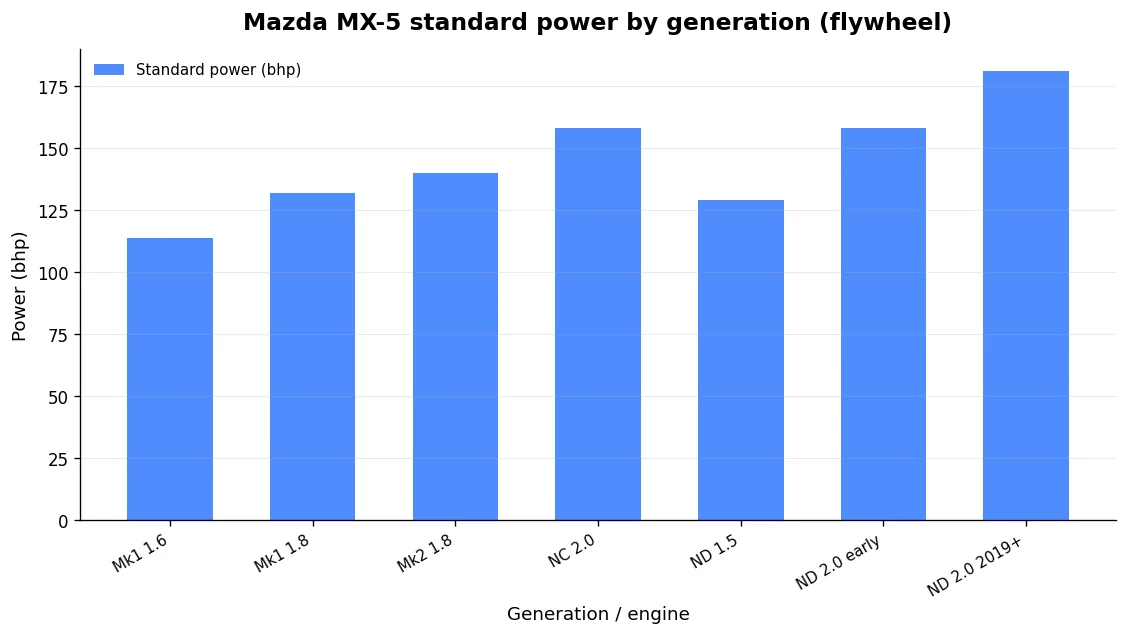
Know your baseline before you book, because a corrected wheel figure only means something against the right flywheel number — and these vary by market and year.
| Generation | Engine | Power (flywheel) |
|---|---|---|
| Mk1 (NA) | 1.6 early | 114bhp (later detuned 1.6: 90bhp) |
| Mk1 (NA) | 1.8 (from 1993, UK) | 132bhp |
| Mk2 (NB) | 1.8 | 140bhp / 157N·m (facelift 1.8: 154bhp) |
| Mk3 (NC) | 2.0 (market-dependent) | 158–167bhp* |
| Mk4 (ND) | 1.5 | 129bhp (131PS) |
| Mk4 (ND) | 2.0 early | 158bhp (160PS) |
| Mk4 (ND) | 2.0 (2019 on) | 184PS / 205N·m, 7,500rpm redline |
*NC 2.0 figures are genuinely contested across sources and markets — Australian-spec is quoted at 158bhp and 188N·m, other sources cite 167hp. State generation, market and year to avoid comparing apples with oranges.
The induction path is where the tune lives or dies
A map can only optimise the air the engine is actually given. Two things degrade that air before the throttle: a poor induction geometry, and heat. Both are worth engineering out, and this is where the intake hardware matters as much as the calibration.
First, geometry. Intake tuning is pressure-wave behaviour — runner length and taper set where the ram effect lands in the rev range. A "universal fit" filter bolted into whatever space exists doesn't tune anything; it just flows. Engine-specific runners and a properly matched plenum let you place the torque where you want it. GMR builds printed carbon composite intake parts — individual throttle body kits, airboxes, manifolds and velocity stacks — using direct digital manufacturing (DDM), which prints geometry that can't be laminated or machined in one piece: hollow closed cavities, tuned-length runners and internal transitions. That's the point of the process — the geometry is designed around your combination and then iterated on real dyno data, not a catalogue.
Second, heat. Intake-charge temperature directly costs you density and detonation margin. The material we print in is PPA-CF (carbon-fibre reinforced polyphthalamide). Its thermal conductivity is orders of magnitude lower than aluminium (aluminium is 150–220 W/m·K), and a printed hollow section traps an insulating air cavity on top of that. Against an aluminium manifold, charge heat pickup is far lower — which matters most at idle and under heat soak in traffic, and less under sustained wide-open throttle where fresh air is moving fast. I'll always tell you which case applies to your car rather than pretend the benefit is universal. It's also light: PPA-CF is 1.25 g/cm³ against aluminium's 2.70 g/cm³, under half the density before the hollow section is counted. Our manifolds and airboxes are coated internally for sealing and inspection.
On the heat question, don't ignore where PPA-CF sits thermally. Its heat deflection temperature is 196°C at 1.8 MPa and 227°C at 0.45 MPa, with a Vicat softening point of 232°C — that's the number that matters under the bonnet, not the 85°C glass transition, because this is a semi-crystalline, fibre-reinforced polymer that keeps its load-bearing capability well above Tg. Where a laminated/autoclave composite part is genuinely the better call is sustained very high temperature, or where load runs through the weak axis — printed PPA-CF is 168 MPa tensile in-plane (XY) but only 57 MPa in the Z direction, so build orientation is a design decision, not an afterthought. I reach for the laminated route when the engine calls for it, and the printed part when the geometry and packaging win — which, on intakes, is most of the time.
Forced induction: where the big numbers live
If you want substantially more than standard, the honest route is boost. A turbo or supercharger delivers the gains naturally aspirated tuning simply cannot, and here the calibration work is both more valuable and less forgiving. WOT targets drop into the lambda 0.78–0.82 range at modest boost and richer still as boost climbs, because the extra fuel cools the charge and buys detonation margin. On a boosted car the quality of the mapping is the difference between a reliable engine and an expensive noise — which is exactly why steady-state load control on an eddy-current or hub dyno matters so much more here than on an NA.
FAQ
How much power will a remap add to my MX-5?
On a standard naturally aspirated car, little peak power from software alone — these engines respond to airflow hardware, not flashes. With a de-restricted exhaust and matched induction plus a retune, expect roughly 10–15bhp on NC/ND cars, and crucially better mid-range and throttle response everywhere. For large gains you need forced induction.
Inertia or load-bearing dyno for MX-5 rolling road tuning?
For a road car, a load-bearing (eddy-current) or hub dyno, because it can hold the engine at steady RPM under load for proper fuel and ignition mapping. An inertia dyno only does full-throttle ramp pulls, which limits calibration precision.
Why does my dyno figure differ from another rolling road?
Different machine, different correction factor (SAE, DIN and STD are not interchangeable), and hub-versus-roller reading differences. Wheel power is also 15–20% below flywheel. Always compare like-for-like: same dyno, same correction, same warm-up procedure.
Do I need a wideband to tune an older MX-5?
Yes. The factory narrowband sensor only reads accurately around 14.7:1 and tells you nothing at full load. Safe wide-open-throttle tuning needs a wideband to hit the 0.85–0.90 lambda power window.
The bottom line
MX5 rolling road tuning is about matching a calibration to real hardware and reading the results honestly. Get the induction geometry and intake temperature right, map it on a dyno that can hold load, and document the conditions so the before/after means something. On an NA you're buying driveability and torque; on a boosted car you're buying big power and engine survival. Either way, the gains come from engineering the air — not from the sticker on the graph.
Related: What Does a Velocity Stack Do? The Flow and Pressure-Wave Physics That Actually Make Power