
2026-10-19
DCOE Throttle Bodies: How to Spec the Bore, Choke and Tract Length Properly
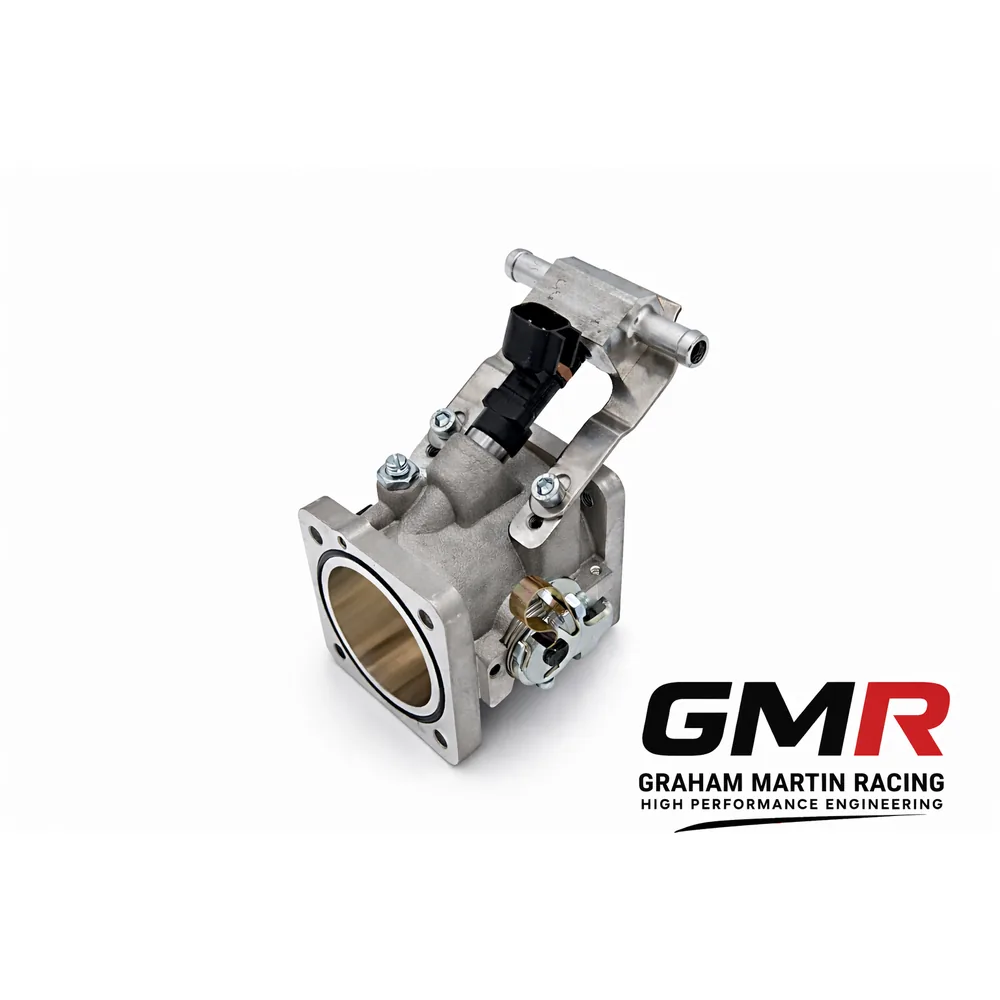
The number in front of every "DCOE" throttle body — 40, 45, 48, 50, 55 — is the throttle bore diameter in millimetres, and it is the single figure most people get wrong. The letters come straight off the Weber carburettor the standard is named after: DC for doppio corpo (double throat), O for orizzontale (horizontal/sidedraft), E for the die-cast body. Today "DCOE" has outgrown the carb and become a flange standard. A modern DCOE throttle body is an EFI unit built to drop onto the same bolt pattern as a Weber DCO/DCOE, a Dellorto DHLA, a Mikuni PHH or a Solex ADDHE, so you can convert a carburetted sidedraft manifold to injection without re-machining the flange.
That compatibility is the whole appeal — and the whole trap. Picking "bigger" because it sounds faster is the quickest route to an engine that's lazy everywhere you actually drive it. Below is how I spec DCOE-pattern bodies properly: bore versus venturi, the fitment dimensions that matter, tract-length tuning, and where a printed DDM composite intake earns its place over billet aluminium.
Bore size vs venturi: the number that actually sets airflow
It is not the barrel size that determines airflow and horsepower — it is the main venturi (the choke) sitting inside it. The throttle bore is just the maximum the body can accommodate; the venturi is where the air accelerates and signal is generated. Get the venturi right first, then pick the smallest bore that carries it comfortably.
The working rule of thumb is simple: venturi × 1.25 = ideal barrel size. Run it the other way and you get a sanity check on any body someone's trying to sell you.
Worked example: a 2.0-litre engine peaking at 6,000rpm wants roughly a 36mm venturi. 36 × 1.25 = 45, so a 45 DCOE is ideal. A 40 DCOE will physically take a 36mm choke too, but it's at its ceiling — the 45 gives you headroom without going soft. Fit a 50 or 55 to that same engine and you've killed air speed through the venturi at the rpm you actually use, blunting throttle response and the quality of the air/fuel mix for a peak-power number you'll rarely see.
| DCOE bore | Typical venturi (choke) range | Choke notes |
|---|---|---|
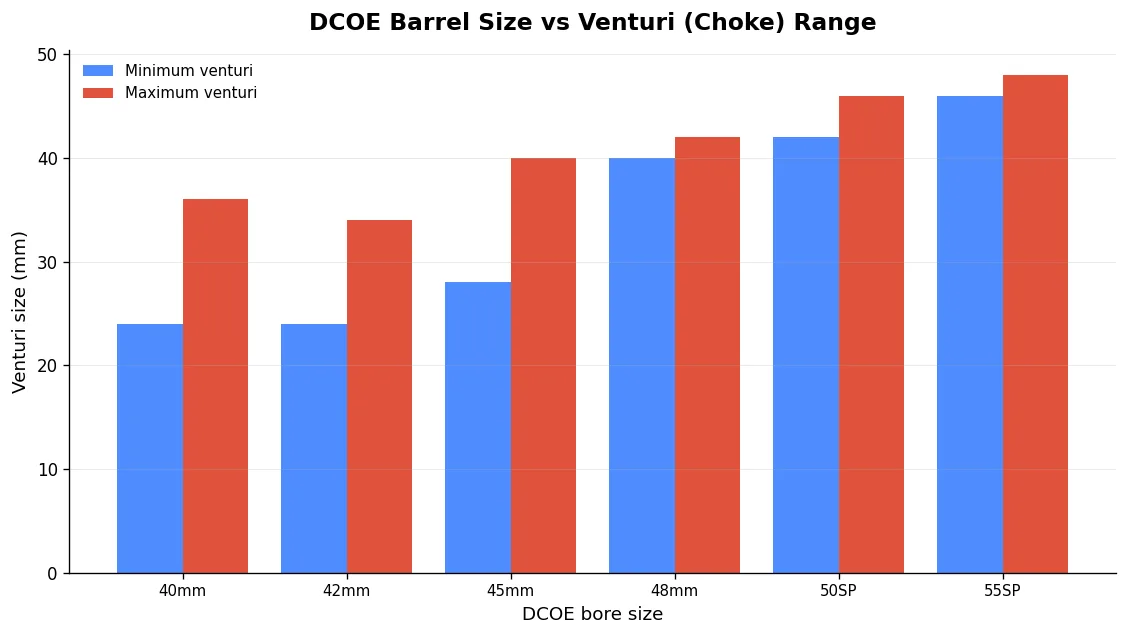
| 40mm | 24–36mm | Shares construction/jets with 42/45/48 |
| 42mm | 24–34mm | Effectively obsolete — chokes/shafts long out of production |
| 45mm | 28–40mm | Shares choke design with 48 |
| 48mm | 40–42mm | Same choke as 45, larger outer diameter |
| 48/50 SP | 42–46mm | — |
| 55 SP | 46–48mm | Needs an airhorn with 72mm centres, not standard PCD |
Treat those venturi limits as approximate — practical figures vary slightly between manufacturers and depend on head, cam and compression. Note too that 40, 42, 45 and 48 DCOE share the same basic construction and take the same jets, brass fittings and gasket sets; the 48/50/55 are a different animal with different chokes, so "they're all the same body" is only half true.
The fitment dimensions that actually matter
If you're converting a carb manifold or fabricating one, these are the numbers to design around. The DCOE pattern is well defined, which is exactly why it's survived as a standard.
| Dimension | Standard figure |
|---|---|
| Throttle bore centres | 90mm (stock DCOE spacing) |
| Body thickness (repro ITB) | 24mm |
| Throttle shaft diameter | 8mm (industry default, usually brass) |
| Ram-tube mounting PCD | 67.5mm (72mm on 52/55mm bores) |
| Manifold studs | M8 × 1.25 |
| Closed-throttle plate angle | ~6–7° |
| Manifold flange thickness | 10mm (6060-T5 aluminium, pilot-drilled to tap M8) |
Premium bodies seal with O-rings on both the manifold and ram-tube faces rather than paper gaskets — you get an instant seal with no torque creep as a gasket relaxes, and lip seals behind the shaft bearings add sealing under high vacuum. If you're fabricating a flange, CNC it from 6060-T5, drill the stud holes as pilots and tap M8 after welding so heat distortion doesn't walk your pattern out of true.
Body length and shaft design
Body lengths vary — commonly around 118mm for standard bodies, with 91mm "short" and 30mm versions for tight engine bays. The move at the premium end is away from a fat shaft blocking the bore. Narrowing the throttle shaft while keeping it stiff reduces the obstruction in the airstream and keeps the plate indexed to the bore, so it returns to exactly the same closed position every cycle without scraping. Some manufacturers run a knife-edged, so-called "shaftless" butterfly and claim up to 10% more airflow over a conventional plate — that's a manufacturer figure, so weigh it against your own data, but the principle is sound: less shaft frontal area, cleaner flow.
Tapered bores take it further. Measured at three points — ram-tube flange, across the butterfly, manifold flange (e.g. 50/48/45 or 48/45/43) — a taper adds a scavenging effect worth a few percent of torque and power over a parallel bore. Construction at this level is billet 6061 aluminium with centreless-ground steel or brass shafts on sealed ball bearings and precision ~7° brass plates.
Intake tract length: where most of the power is won or lost
This is the part people skip, and it's the one that costs them the most. It is the total intake tract length that tunes the engine, not the trumpet on its own. The tuned length runs from the back of the intake valve to the radiused entry of the velocity stack — the stack is simply the adjustable end of that pipe.
The mechanism is a pressure wave. As the intake valve shuts, the moving air column slams to a stop and sends a positive pressure wave back up the runner. It reflects off the open end (the trumpet mouth, where the wave changes sign) and travels back down. Size the length so that reflected pressure wave arrives at the valve just as it opens again, and you ram-charge the cylinder for free — a genuine volumetric efficiency gain with no boost and no extra fuel.
Length sets the rpm it works at:
- Longer tract → wave returns later in the rev range → mid-range torque.
- Shorter tract → wave returns sooner → top-end peak power.
A rough starting point is 84,000 ÷ tuned rpm = runner length in inches. It's only a starting point. As a real-world anchor, a credible manufacturer guide figure from the face of the trumpet to the centre of the valve head is around 350mm for a 9,000rpm engine. The warning that goes with it is the important bit: an under-length system is the single biggest cause of disappointment, capable of throwing away up to a third of the engine's power potential. If you're going to compromise, compromise long, not short.
Two variables shift the ideal length and catch people out. Cam timing changes when the intake valve opens, which changes when you want the wave to arrive — change the cam, re-check the length. And hotter intake air raises the speed of sound, which moves the ideal length too, which is one more reason to keep charge temperature down. Modern ITB systems let you dial this in with bolt-on extensions (typically 70, 100 or 130mm) plus a 40 or 60mm ram pipe, so you can tune length on the dyno instead of guessing once and welding it in.
Billet aluminium or DDM composite ram tubes and plenums?
Round, naturally aspirated ram pipes are usually fine in aluminium. Where DDM composite — Direct Digital Manufacturing, printed carbon composite in PPA-CF (carbon-fibre reinforced polyphthalamide) with no moulds — pulls ahead is on everything downstream of the simple round trumpet: airboxes, plenums, oval entries and any geometry with internal transitions you cannot machine or laminate in one piece.
There are three concrete reasons I reach for it:
- Geometry you can't get any other way. Hollow, closed internal cavities, tuned-length runners and smooth internal transitions come straight out of CAD as a single part. No core-pulls, no bonded halves, no layup seam in the airstream.
- Thermal insulation where it counts. Aluminium has a thermal conductivity of 150–220 W/m·K; a reinforced polymer is orders of magnitude lower, and when you add a trapped-air cavity in the part wall the intake charge picks up far less heat than it would off a hot alloy casting. That matters most at idle and heat-soak in traffic — remember hotter air moves your tuned length — and less at sustained wide-open throttle, so I'll tell you honestly which case is yours before recommending it.
- Weight. PPA-CF is 1.25 g/cm³ against aluminium's 2.70 g/cm³ — under half, before the hollow section is even counted.
On heat: don't read the 85°C glass transition as a ceiling. PPA-CF is semi-crystalline and fibre-reinforced, so load-bearing capability persists well above Tg — which is why its heat deflection temperature is 196°C at 1.8 MPa (227°C at 0.45 MPa) and Vicat softening is 232°C. For under-bonnet intake duty that's the figure that matters.
| Property (PPA-CF, GMR datasheet) | Value |
|---|---|
| Tensile strength (XY / Z) | 168±4 MPa / 57±5 MPa |
| Young's modulus (XY) | 11,800±670 MPa |
| Bending strength (XY) | 208±6 MPa |
| Heat deflection (1.8 / 0.45 MPa) | 196°C / 227°C |
| Vicat softening | 232°C |
| Density | 1.25 g/cm³ |
Where is laminated/autoclave the right call instead? Very high sustained temperature, or any part where Z-axis strength governs the load path — PPA-CF Z tensile is 57 MPa against 168 MPa in XY, so print orientation has to be engineered around the loads, and for some bracketry or structural inlet work a prepreg laminate is still the honest answer. I pick the route the part demands, not the one that's easiest to sell.
Common DCOE mistakes I see on the bench
- Over-boring. 50s and 55s bolted to a 1.6–2.0 that wanted 40s or 45s. Response and driveability gone for a peak figure the engine can't use.
- Trumpet-only thinking. Measuring the stack and ignoring the runner behind it. It's total tract length that tunes — the trumpet is just the end of the pipe.
- Running it short. Packaging to the shortest tract that fits, then wondering where the mid-range went. Up to a third of your power potential can walk out the door.
- Ignoring the cam. Spec a tract for one cam, swap the cam, never re-check. The ideal length moved with the valve timing.
- Chasing bore when you mean venturi. The horsepower is set by the choke. Size that, then pick the bore.
FAQ
What does DCOE actually stand for?
It's Weber's carburettor code: DC for doppio corpo (double throat), O for orizzontale (horizontal sidedraft), E for the die-cast body. The number in front — 40, 45, 48 and so on — is the throttle bore diameter in millimetres. Modern DCOE throttle bodies borrow the bolt pattern, not the fuel system.
Will DCOE throttle bodies fit my Weber or Dellorto manifold?
Generally yes — DCOE-pattern bodies are built as direct replacements for Weber DCO/DCOE, Dellorto DHLA, Mikuni PHH and Solex ADDHE sidedraft carbs, sharing the 90mm throttle centres and M8 × 1.25 stud pattern. Confirm bore centres and stud thread before ordering, and note that 52/55mm bores need a 72mm airhorn PCD.
What size DCOE do I need for a 2.0-litre engine?
For a road/fast-road 2.0 peaking around 6,000rpm, a 45 DCOE with roughly a 36mm venturi is the classic answer (venturi × 1.25 = barrel). Go bigger only when the engine genuinely spins higher and flows more — oversizing costs you response and mixture quality where you actually drive.
Are billet or DDM composite throttle bodies better?
For the throttle bodies themselves, billet aluminium is the standard at the sharp end. DDM composite comes into its own for the ram tubes, plenums and airboxes around them — hollow geometry you can't machine, far lower intake-charge heat pickup than alloy, and under half the weight. Choose by what the part has to do.
If you're moving a sidedraft platform to injection and want the tract tuned on real dyno data rather than a catalogue guess, that's exactly the kind of made-to-fit work we do. For related reading on getting throttle-body geometry right on other platforms, see our guides on K20 individual throttle bodies and sizing a Zetec ITB kit. And if you want to understand how we iterate DDM composite intake parts from CAD to dyno, there's a good overview of 3D printing in the motorsport workflow.