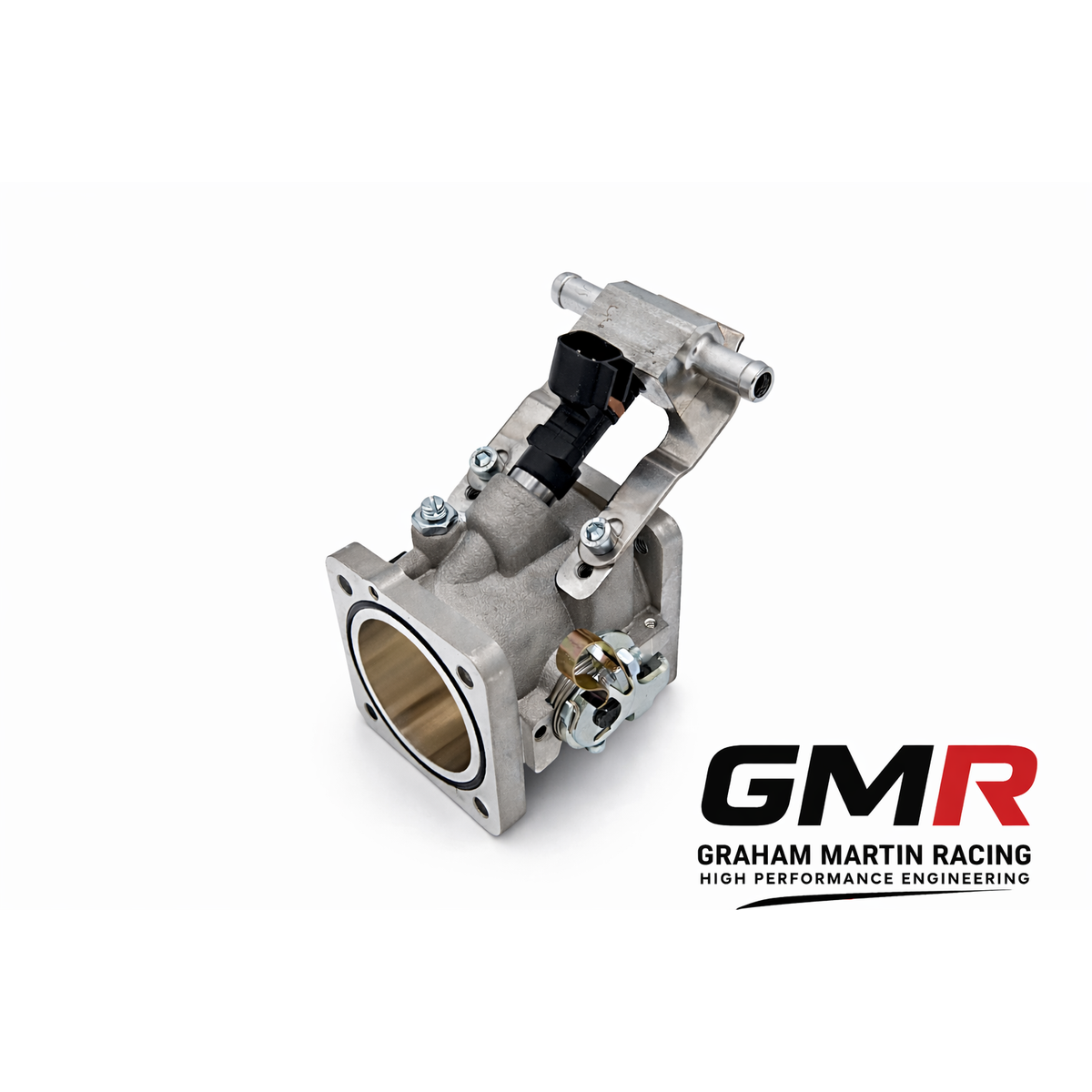
Vauxhall XE Throttle Body Kit: How to Spec, Size and Fit One That Actually Delivers
The single biggest restriction on a standard C20XE “Red Top” is its intake tract. The engine breathes through a plastic


A Ford Duratec bike throttle body kit replaces the single OEM throttle body and plenum with four individual bike throttle bodies on a bespoke inlet manifold — and on a healthy 2.0-litre Duratec HE, that alone will put you in the region of 180 bhp with the right manifold, trumpets and exhaust. It’s the budget route into individual throttle bodies: cheaper than a set of billet ITBs, mechanically simple, and genuinely effective when it’s built and balanced properly. The catch is that “budget” and “close enough” are not the same thing. The manifold geometry, the trumpet lengths, the injector strategy and the balancing all decide whether you get that 180 bhp or a lumpy, surging engine that never quite settles.
Here’s what actually matters when you spec one — the engine variants that will and won’t take a conventional Duratec inlet, the real bore figures of the common donor bodies, how to size them to your target power, and where a bike-TB kit is the right tool versus where you should reach for something else.
The Duratec HE is a Ford/Mazda co-development sharing its architecture with the Mazda L / MZR engine. It’s an all-aluminium DOHC 16-valve unit with cast-iron liners, fracture-split forged powder-metal con-rods and a one-piece cast crankshaft. The head runs directly-actuated bucket lifters with no hydraulic lash adjusters, so mechanical valve-clearance checks are part of the service schedule — worth confirming before you convert, because ITBs will happily expose a tired top end.
Displacements you’ll encounter:
| Variant | Capacity | Notes |
|---|---|---|
| 1.8 HE | 1,798 cc | Common kit-car base |
| 2.0 HE | 1,999 cc | The default conversion, ~180 bhp on ITBs |
| 2.3 HE | 2,261 cc | More torque, benefits from larger bodies |
| 2.5 HE | 2,488 cc | Larger-capacity builds |
Unlike the belt-driven Zetec it replaced, the Duratec runs chain-driven cams, and the induction and exhaust sit on the opposite sides of the head. That matters for packaging in a kit car, where the unit also needs turning round for rear-wheel drive and doesn’t share the classic Ford bolt pattern — so adaptor water manifolds, sumps and bellhousings come into the equation to mate it to a Ford-type RWD gearbox.
The ST170 is the single most misunderstood donor. It’s a tuned 2.0 producing 170 PS at 7,000 rpm and 195 Nm from 2,500 rpm — attractive on paper — but it is not the same head as the alloy “Mazda” Duratec HE. It’s a Zetec-derived “Duratec ST” head with a different inlet port layout. Bolt a standard Duratec inlet manifold onto an ST170 and the throttle bodies end up in the opposite corner of the bay. You’d be looking at an adaptor plate or drilling and tapping the head for the Duratec inlet bolt holes — assuming the water jacket isn’t fouled and the port spacings even line up, which is a long shot. If you’re on an ST170, spec the manifold for the ST170, not the HE. This is exactly the kind of “universal fit” assumption that turns a weekend job into a fabrication project.
The whole conversion hinges on which bike throttle bodies you use, and there’s a lot of loose quoting of bore sizes out there. Here are the figures worth trusting, with the caveats:
| Donor | Bore (ID) | Notes |
|---|---|---|
| Kawasaki ZX10R (Gen1–3) | 43 mm | Secondary blades on all years; often marketed as “44 mm” |
| Kawasaki ZX14 | 44 mm | Gen1–2 |
| Kawasaki ZX12R | 46 mm | Secondary blades only on 04/05 |
| Yamaha R1 (2004) | 45 mm | Primary and secondary butterflies |
| Honda CBR1000 (2006) | 44 mm | — |
| Suzuki GSXR1000 (2003) | 42 mm | — |
| Suzuki GSXR1300 | 46 mm | For larger-capacity/higher-output builds |
| Suzuki GSXR600 | ~38 mm | Small — smaller-capacity engines only |
One thing to be honest about: a popular UK kit is marketed as a “44 mm ZX10R” set, but careful forum measurement puts the actual ZX10R bore nearer 43 mm. The “44 mm” label is approximate. It doesn’t change much in practice, but if you’re specifying to a target power figure, work off measured bore, not the marketing sticker.
Because bike cylinder spacing differs from the Duratec’s bore centres, the bodies have to be re-spaced — cut and re-jigged onto the correct spacing with extended linkages and a fuel rail. The early GSXR bodies are widely regarded as the easiest to re-space cleanly, which is one reason they turn up so often on higher-spec builds.
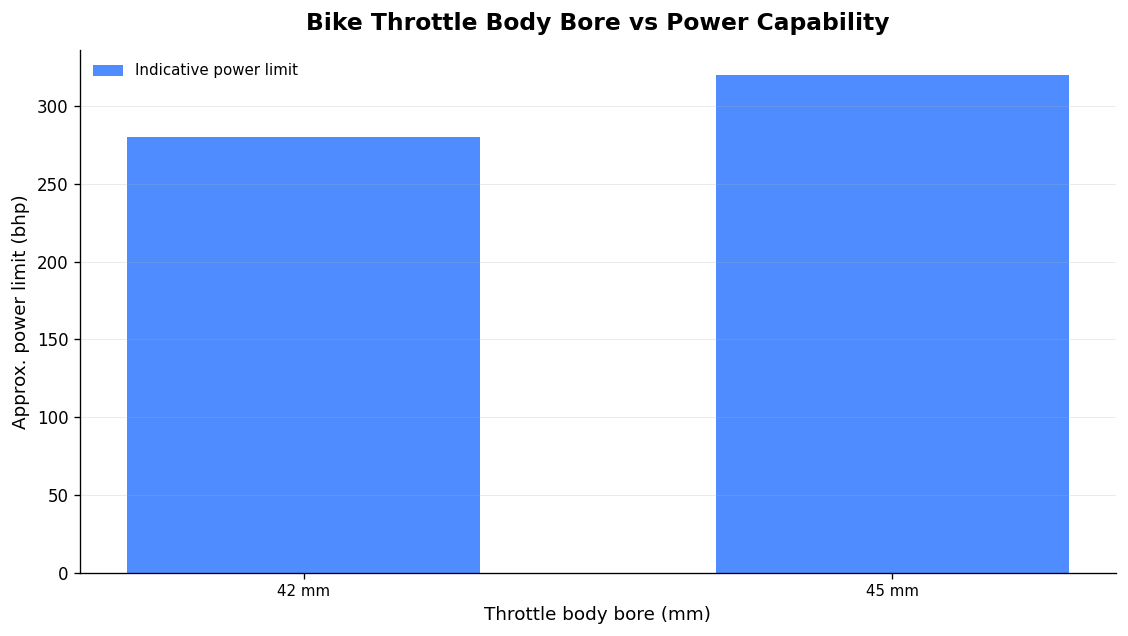
Oversizing throttle bodies is the classic mistake — bigger bores kill air speed at part throttle, which blunts response and mid-range torque for a peak-power number you’ll rarely use. Use these builder rules of thumb as a starting point (indicative, not lab-verified):
For a fast-road or club 2.0 HE targeting ~180 bhp, 42–44 mm bodies are comfortably sized with margin to spare — and the smaller bore keeps air velocity up where you actually drive. Reach for 46 mm GSXR1300 or ZX12R bodies only when the engine spec — big cams, headwork, 2.3+ capacity — genuinely calls for the extra flow. A real worked example at the sharper end: a MEV Rocket running a 42 mm GSXR kit with headwork and custom-profile cams made 213 bhp at the flywheel. Note that’s still 42 mm bodies — velocity, not just bore, makes the power.
The same principle underpins any ITB build, whether bike-bodied or billet. If you want the full sizing methodology, our guides on choosing and sizing a Ford Duratec ITB kit and throttle bodies for kit cars go deeper on the airflow trade-offs.
Do not run a bike throttle body kit without trumpets. Bike breakers routinely strip the trumpets and airbox before selling the bodies, and a huge number of conversions run bare-mouthed as a result — leaving power on the table for nothing.
The numbers back this up. In back-to-back testing — an 1,800 Zetec on R1 carbs and a 2.3 Duratec on ZX9R carbs — fitting 50 mm trumpets over no trumpets gave typical gains of 5–9 bhp between 3,500 and 6,000 rpm, with a noticeably smoother torque curve. That’s a free-flowing radiused entry conditioning the airflow and tuning the intake pressure-wave — a bell-mouth reduces entry losses and the added length shifts where the ram effect lands in the rev range.
Trumpet length is a genuine tuning variable, typically offered in 25/50/90 mm. Longer trumpets bias filling to lower rpm (more mid-range); shorter ones favour top-end. It’s worth mapping length to where you want the torque to sit rather than fitting whatever came in the box.
The trumpets and, increasingly, the manifold itself are where our Direct Digital Manufacturing (DDM) composite parts genuinely out-engineer a fabricated aluminium equivalent — not as a generic claim, but for specific mechanical reasons:
First, geometry. DDM composite lets us print hollow, closed internal cavities, tuned-length runners and smooth internal transitions in a single piece — shapes you simply cannot laminate by hand or machine as one part. The runner and bell-mouth profile can be optimised as a continuous curve rather than approximated with welded tube.
Second, thermal. We print in PPA-CF (carbon-fibre reinforced polyphthalamide). Its thermal conductivity is orders of magnitude lower than aluminium’s 150–220 W/m·K, and a printed part can carry a trapped-air cavity on top of that — so intake-charge heat pickup from a hot engine bay is far lower than with an aluminium manifold. That benefit is real at idle and under heat-soak; it’s less significant at sustained wide-open throttle where fresh air is moving through fast. I’ll always tell you which case applies to your build.
Third, weight. PPA-CF is 1.25 g/cm³ against aluminium’s 2.70 g/cm³ — under half the density before you even count the hollow section.
Fourth, heat resistance where it counts. The material’s heat deflection temperature is 196°C at 1.8 MPa and 227°C at 0.45 MPa (ISO 75), with a Vicat softening point of 232°C. People fixate on the 85°C glass transition, but PPA-CF is semi-crystalline and fibre-reinforced, so load-bearing capability persists well above Tg — which is exactly why the HDT and Vicat figures are where they are. For an intake tract, those are the numbers that matter.
Where I’ll be straight with you: PPA-CF’s Z-axis tensile strength (57±5 MPa) is far below its in-plane XY strength (168±4 MPa), so print orientation matters, and for a part seeing very high sustained temperature or where Z-axis loading governs, a prepreg/autoclave laminate can still be the right call. It’s a tool you reach for when the engine calls for it — not dogma. There’s more on how these parts are really made in our piece on DDM carbon composite parts for motorsport, and on the wider 3D-printing workflow over at Ask The Nozzle.
The Duratec has a genuine convenience here: its injectors are mounted in the cylinder head, not in the throttle bodies. So the cleanest install retains the original 330cc head-mounted injectors and the standard regulator — those are rated for outputs in excess of 240 bhp, comfortably clear of a typical build — and the bike-injector bosses in the throttle bodies simply get blanked during manufacture.
If you do use a bike-TB fuel rail instead, keep the plumbing in mind: a DCOE-type rail typically has standard 8 mm push-on hose fittings at each end and no other connections. And a word of caution echoed by every tuner who’s been burned — be wary of the quality of cheap supplied bike injectors. If in doubt, machine the body to take a known conventional injector rather than trust an unbranded one.
Bike throttle bodies use a simple cable pull with no complicated linkage — usually a case of adapting the inner and outer of the existing throttle cable to interface, with kits supplying the basic parts or a universal cable kit doing the job. One hard rule, though: any car with a fly-by-wire electronic throttle must be converted to a traditional cable arrangement. There’s no bodging around it.
Management is typically a Motorsport Electronics ECU — the ME221 is designed for fully sequential control of a four-cylinder — with an upgrade path to something like the ME442 with a built-in wideband controller and SD-card logging. Two loom caveats: the supplied loom is often Ford Zetec-based, so the crank sensor plug may need changing and a Focus-type coilpack (oval plug) fitted.
Whatever ECU you run, the base map is supplied “as-is”. It exists to get the engine started and driven onto a rolling road — nothing more. Proper calibration under real-world load with AFR equipment is mandatory, both to make the power and to keep the engine off the edge of lean detonation. Bespoke calibration is core to what we do at GMR precisely because a good set of hardware with a rushed map is a slow, fragile engine. If you’re building something more involved, our notes on specifying custom race engine components are worth a read.
Balancing means getting all four bodies flowing the same air at a given rpm. It’s a smoothness and driveability matter, not a wear one — and it matters in a very specific place. Balance has essentially no effect at wide-open throttle, where all the blades are fully open. Where it transforms the car is at idle, cracking the throttle from closed, and small openings. Get it wrong and you’ll feel lumpy surges on a light overrun and sometimes backfiring.
It’s done with a manometer or carb-balancer — traditional mercury “carb stix” or the electronic equivalent — set at two points: idle and an operating speed around 2,500–4,000 rpm. Good suppliers pre-balance the bodies before dispatch and, ideally, strip, ultrasonically clean and rebuild the reconditioned units first. But pre-balancing is a starting point; final balance happens on the car.
The bike-TB route is the budget option, and it’s a good one. Suppliers claim back-to-back rolling-road tests where bike bodies matched or exceeded the peak power of billet ITB kits on the same engine, with the tapered bike-body design often giving more torque and mid-range — though that’s a vendor claim, so treat the “exceeded” part with healthy scepticism. What’s fair to say is that a well-built, well-mapped bike-TB kit gives up very little to billet on a road or club engine.
Where purpose-built billet ITBs (Jenvey, AT Power) earn their premium is repeatability at scale, consistent bore matching across the set, and the flexibility to spec exact bore, spacing and trumpet geometry for a serious motorsport engine. If you’re chasing every last horsepower on a highly-strung race unit, or you want a set that’s guaranteed identical body-to-body, that’s the route. For most 1.8–2.3 Duratec builds targeting 180–220 bhp, the bike kit is the sensible engineering choice.
On a healthy 2.0 HE with an appropriate performance manifold, trumpets and exhaust, expect around 180 bhp — typical of a well-set-up modern 2.0 16V. Headwork, cams and larger capacity push that higher; a 2.0 with cams and porting on 42 mm GSXR bodies has made 213 bhp at the flywheel.
Not straightforwardly. The ST170 uses a Zetec-derived head with a different inlet layout to the alloy Duratec HE, so a standard HE manifold puts the bodies in the wrong corner of the bay and may need an adaptor plate or the head drilling and tapping — and only if port spacings line up. Spec the manifold specifically for the ST170.
Yes — running without them costs 5–9 bhp across 3,500–6,000 rpm in back-to-back tests, plus a rougher torque curve. Length is a tuning variable: longer trumpets (up to 90 mm) favour mid-range, shorter (25 mm) favour top-end. Choose length to suit where you want the torque, not what came with the bodies.
Yes. The Duratec’s injectors live in the cylinder head, so you can retain the standard 330cc units and regulator — rated well beyond 240 bhp — and blank the bike-injector holes in the throttle bodies. It’s the simplest, most reliable route for most builds.
The single biggest restriction on a standard C20XE “Red Top” is its intake tract. The engine breathes through a plastic
The single most important decision when you specify a Ford Duratec ITB kit isn’t the brand on the throttle bodies