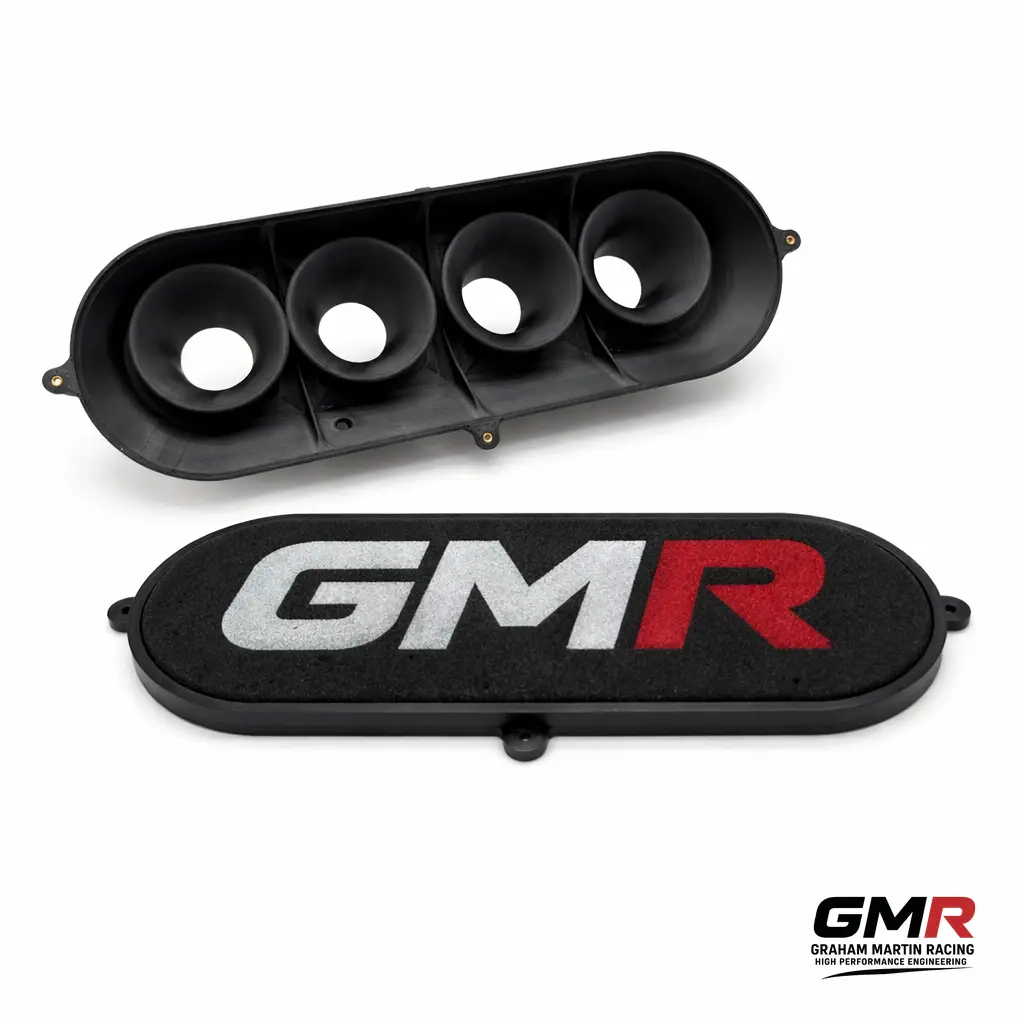
A carbon airbox and a carbon intake manifold are not the same part, and confusing the two is the first mistake most people make when they type “k20 airbox carbon” into a search bar. The airbox is the enclosure around the filter on the induction side, before the throttle body. The intake manifold sits after the throttle body and distributes charge to the ports. This article is about the first one: the sealed box that shields your filter, feeds it cold air, and — done properly — keeps intake air temperatures down so the ECU stops pulling timing. If you’re actually after the manifold side, read our piece on the carbon composite airbox for the K20 and the ITB kit that works alongside it.
The reason a K20 airbox in carbon is worth the money isn’t the badge or the weave. It’s air density. Everything else — the noise, the weight saving, the engine-bay tidiness — is secondary to whether the box delivers cold, clean air to the filter consistently, at idle, in traffic, and on the third lap when the engine bay is heat-soaked.
Why an enclosed box beats an open cone on a K20
Cold air is denser than hot air. Within the same volume you get more oxygen molecules in cold air than in hot, so a cooler charge means the engine can burn more fuel per stroke and make more power for the same displacement. That’s the whole game.
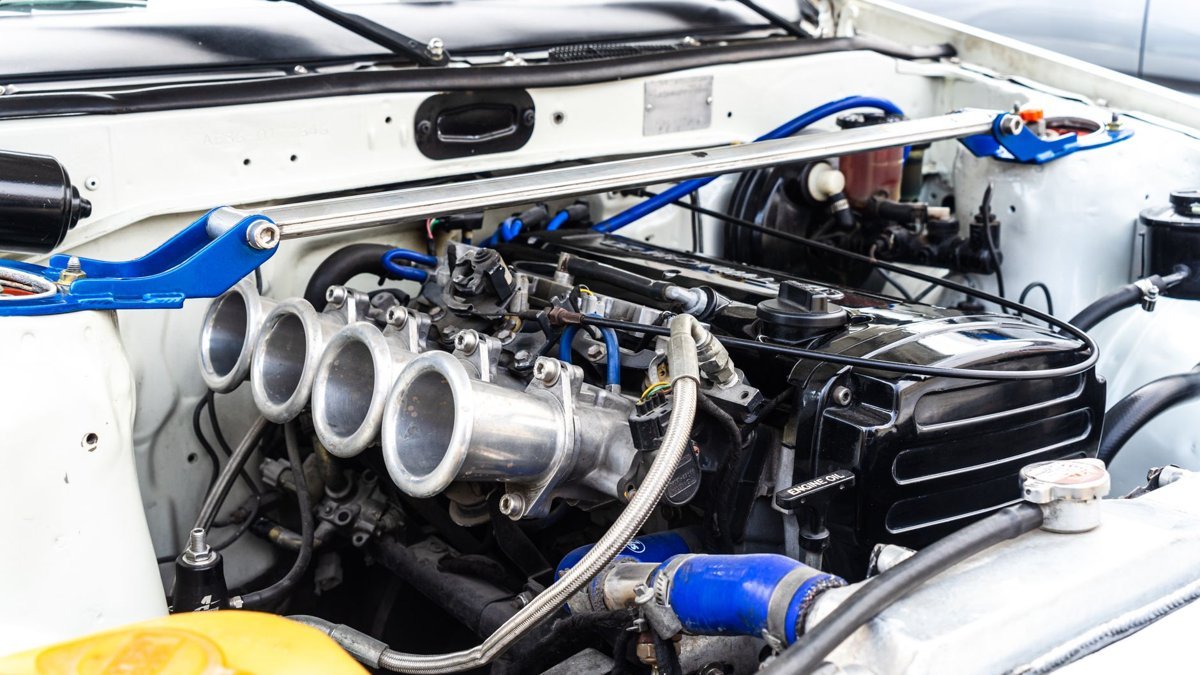
Strip the airbox off and bolt on a cone filter and you break that. The filter is no longer pulling fresh air from the wing or the scuttle — it’s breathing the stagnant, superheated air radiating off the exhaust manifold, radiator and block. The intake air temperature (IAT) sensor sees the higher number, and on a modern K-series the ECU responds by pulling ignition timing to keep detonation away. The result is a car that sounds louder and feels slower: softer throttle response, measurably less power, and the loudest induction roar in the car park. An open cone can easily sit 11–22°C (20–40°F) hotter than a properly ducted box at the same operating point. That is the opposite of what you paid for.
A single-car heat-shield study makes the point cleanly: the best configuration — a fully enclosed filter drawing air from behind the headlight — added 4.5% power (6.8 hp on a 150 hp engine) and dropped inlet air temperatures by 14°C versus the worst arrangement. Those figures aren’t K20-specific, so treat them as directional rather than a promise, but the direction is exactly right: seal the filter, feed it cold air, and IAT falls.
The scuttle scoop is the part that does the work
On the EP3 Civic Type R and DC5 Integra, the carbon airbox itself is only half the system. The other half is the scuttle-mounted scoop. Rather than gulping engine-bay air, a well-designed box takes its feed from a carbon scoop that sits on a modified scuttle panel and directs cool air from the base of the windscreen straight into the chamber. That cold feed is why the box works — and it’s also the part that people botch.
Fitting the scoop is bodywork, not a bolt-on. The scoop panel replaces the OEM scuttle panel, and you should expect some cutting, trimming, filling and sanding to get it to sit. Get the feed wrong and you can make things worse: a cold-air feed routed too close to the exhaust or engine will heat-soak, and then it warms the charge on the way through instead of cooling it. If your feed pipe is hot to the touch after a run, it’s part of the problem, not the solution.
Rule of thumb from the bench: if you can’t route the feed to genuinely cooler air than the engine bay, a well-sealed box drawing from a shielded corner beats an ambitious duct that runs past the manifold.
What the market actually offers — and what it costs
The UK carbon airbox market for the EP3/DC5 is dominated by a handful of options. Here’s how they compare on the points that matter, with 2024 pricing that will drift, so verify before you buy.
| Option |
Approx price |
Feed |
Notes |
| Tegiwa carbon airbox (EP3, T-4077089) |
~£425 |
Scuttle scoop |
Cotton mesh filter, drain hole, RHD-designed. Matt version (T-4077089-MATT-BK) is 240 g lighter than gloss. |
| Gruppe M Ram Air (EP3/DC5) |
~£830 |
Ram-air carbon |
Japanese-made, serial-numbered plate per unit; premium tier. |
| HP-Performances High-Volume V2 (EP3) |
Varies |
Factory location |
Based on the Mugen box, widened and smoothed; largest usable volume, uses OEM or 70 mm throttle body. |
| Injen cold-air intake |
~£300 |
Open-ish CAI |
Cheapest route; less thermal isolation than a sealed box. |
Vendor power claims — “5–10 bhp without mapping, up to 15 bhp with mapping and much improved mid-range” — are marketing, not independently verified. Real gains depend almost entirely on your state of tune and how well you manage IAT. The honest advice is to prove any induction change with a back-to-back dyno test: same dyno, same day, one variable changed. Anything else is a feeling, not a number.
Fitment details that trip people up
- Drive side: these boxes are designed for right-hand-drive cars. LHD fitment is possible but needs work — typically relocating the fuse box slightly, extending the brake-fluid-reservoir hoses and bracket and moving the reservoir forward, and trimming a corner off the scoop to clear the left wiper.
- Water: a properly designed box won’t hydrolock in normal use because it has a drain hole in the base so water drains out freely. Don’t blank it off.
- Filter: a cotton mesh element flows well and re-oils, but keep on top of maintenance — an over-oiled element can contaminate a hot-film MAF if your setup uses one.
Don’t oversize the throttle body to “match” the box
People fitting a carbon airbox often talk themselves into a bigger throttle body at the same time. On a near-stock K20, that’s usually money for nothing. Stock K20 throttle bodies are typically 60 or 62 mm (cable OEM commonly 62.5 mm), and the community consensus — backed by repeated dyno testing — is that jumping to 68, 70 or 72 mm gives little or no gain on a stock-internal engine. One tested K20A2 with an RBC manifold saw no real change going from a 62 mm to a 72 mm throttle body; AFR stayed put and timing/cam angle changes never picked anything up.
The physics explains why. A larger throttle body only helps by reducing pressure drop, and that pressure drop is only significant when airflow is high. On a 500 hp engine an 82 mm throttle body might drop 0.75 psi at 8000 rpm; going to 93 mm cuts that to 0.25 psi and can find 10–20 hp. On a 220 hp K20A2, the pressure drop across a stock 62 mm body is already trivial — there’s nothing to recover. Match the throttle body to the actual power level, not to the marketing. If you’re building toward a serious induction package, our guide to choosing a K20 ITB kit that fits and performs covers where the airflow gains genuinely are.
Laminated carbon vs DDM composite: the manufacturing choice
Almost every off-the-shelf K20 carbon airbox is a laminated part — hand-laid or prepreg carbon in an autoclave, then trimmed and bonded. That route is proven and, for a large single-skin enclosure that mainly needs stiffness and heat tolerance, it’s a sensible way to make the part. Where sustained temperatures are very high, or where the geometry is a simple shell, laminate remains the right call.
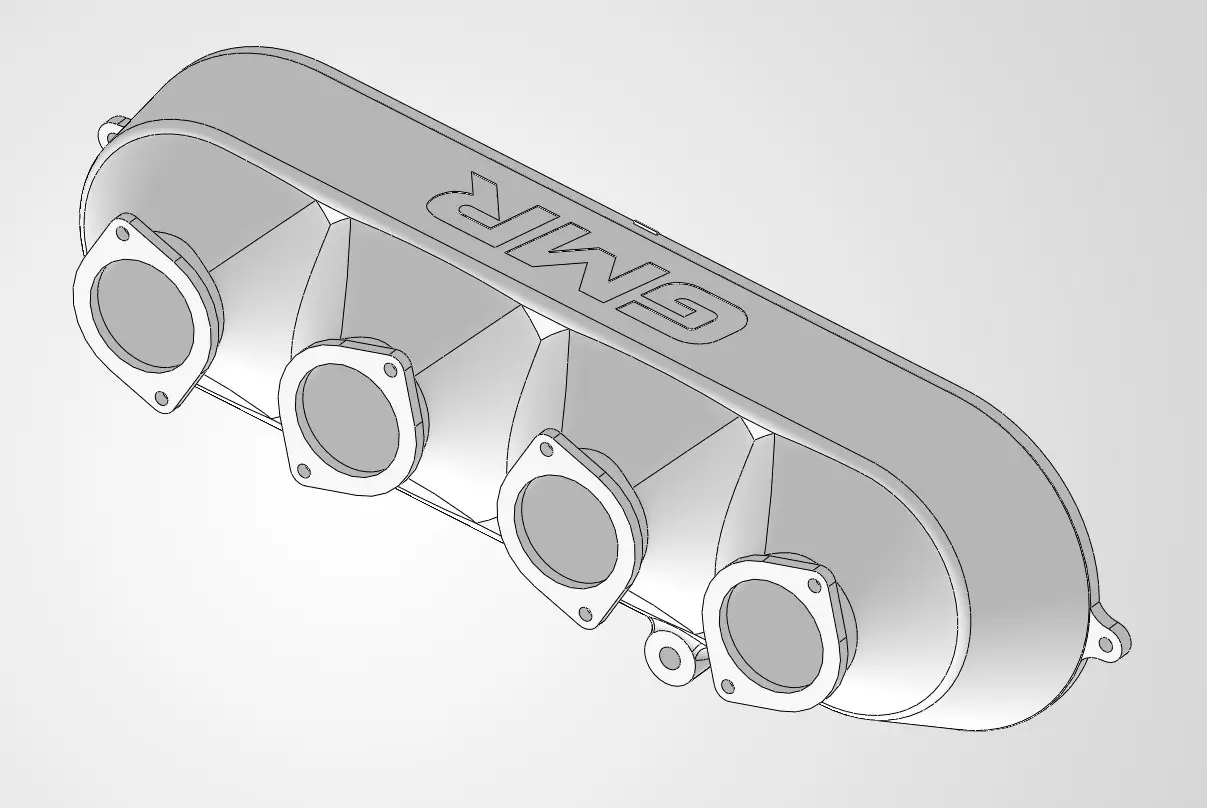
But it has hard limits. You cannot laminate a closed internal cavity, a tuned-length runner or a smooth internal transition in one piece — you’re stuck with what a mould can release, plus bond lines. That’s where a DDM composite part earns its place. We manufacture using Direct Digital Manufacturing in PPA-CF (carbon-fibre reinforced polyphthalamide), and it opens up geometry that a mould simply can’t produce.
What DDM composite lets us do that a laminate can’t
- Hollow, closed cavities and internal transitions. We can print a box with a trapped-air insulating cavity in the wall, an integrated bellmouth entry, and smooth internal ducting — all in one component, with no bond lines to leak or delaminate.
- Genuine thermal isolation. This is the point that matters for a K20 airbox. Aluminium has a thermal conductivity of 150–220 W/m·K; a reinforced polymer wall is orders of magnitude lower, and adding a trapped-air cavity lowers charge heat pickup further still. The box resists soaking heat into the air on the way through — exactly the failure mode that kills open-cone setups.
- Weight. PPA-CF has a density of 1.25 g/cm³ — under half aluminium’s 2.70 g/cm³ before you even count the hollow section.
- Real port and feed matching. The scoop, feed and throttle-body transition are designed around your engine and engine bay — no universal-fit compromise.
- CAD-to-dyno iteration. We can revise geometry, print it, and test it against real data in days, so the shape is optimised on measured numbers rather than assumption.
On temperature, don’t be misled by the material’s 85°C glass transition. PPA-CF is semi-crystalline and fibre-reinforced, so it keeps its load-bearing capability well above Tg — the figures that matter under the bonnet are a heat deflection temperature of 196°C at 1.8 MPa (227°C at 0.45 MPa, ISO 75) and a Vicat softening point of 232°C. Those are the numbers that describe what the part actually survives.
Orientation is the one honest caveat. Layer adhesion means Z-axis tensile strength is 57±5 MPa against 168±4 MPa in XY, so a DDM part has to be designed and printed with loads running in-plane. That’s an engineering decision we make deliberately, not a limitation we ignore. Where Z-axis strength governs, or the temperature is extreme and sustained, a bespoke laminated composite part can be the better tool — and we’ll tell you when that’s the case. For the deeper background on where additive manufacturing genuinely earns its keep in motorsport, this piece on motorsport 3D printing is worth a read.
Does a carbon airbox matter on a race K20?
On track, yes — but for reasons beyond peak power. Carbon induction is standard on the racing K20; a genuine Arena-built BTCC EP3 runs a Neil Brown K20 around 280–300 bhp with a carbon inlet and TOCA EFI ECU. On a car that’s on full throttle for long stretches, the pure insulation benefit narrows because the charge spends less time sitting in hot air. Where the enclosed box keeps winning is consistency: stable IAT lap after lap, no timing pulled during out-laps and in traffic, and a filter protected from debris. The bigger the thermal swings in your session, the more a sealed, insulated box is worth. For a road-and-track car that idles in queues, it’s a clear win at idle and heat-soak; for a pure sprint car at sustained WOT, weight and packaging may matter more than the last degree of IAT.
FAQ
Will a carbon airbox on my K20 actually add power?
By keeping IAT low it protects the timing the ECU would otherwise pull, which preserves power an open cone loses to heat soak. Vendor claims of 5–15 bhp are unverified marketing; treat them with caution and prove any change with a same-day, same-dyno back-to-back test. The most reliable, repeatable gain is IAT stability, not a big peak number.
Is a carbon airbox or an intake manifold the right upgrade first?
They do different jobs. The airbox manages the temperature and cleanliness of the air reaching the throttle body; the manifold governs how that air is distributed and tuned into the ports. If you’re chasing consistent, cool charge and tidier packaging, start with the induction side. If you’re chasing runner tuning and top-end airflow, that’s manifold and throttle-body territory.
Do I need a bigger throttle body if I fit a carbon airbox?
Almost certainly not on a near-stock K20. Dyno testing repeatedly shows 68–72 mm throttle bodies give little or no gain on stock-internal engines because the pressure drop across the standard 62 mm body is already negligible. Larger throttle bodies only pay off on high-output engines flowing enough air to make the pressure drop significant.
Can a carbon airbox suck in water and hydrolock the engine?
A properly designed box won’t, because it has a drain hole in the base so water drains out rather than pooling around the filter. Keep that drain clear, and don’t route the cold feed anywhere it can scoop standing water.