
2026-08-23
ITB Airbox Sizing, Backplate Clearance and Fitment
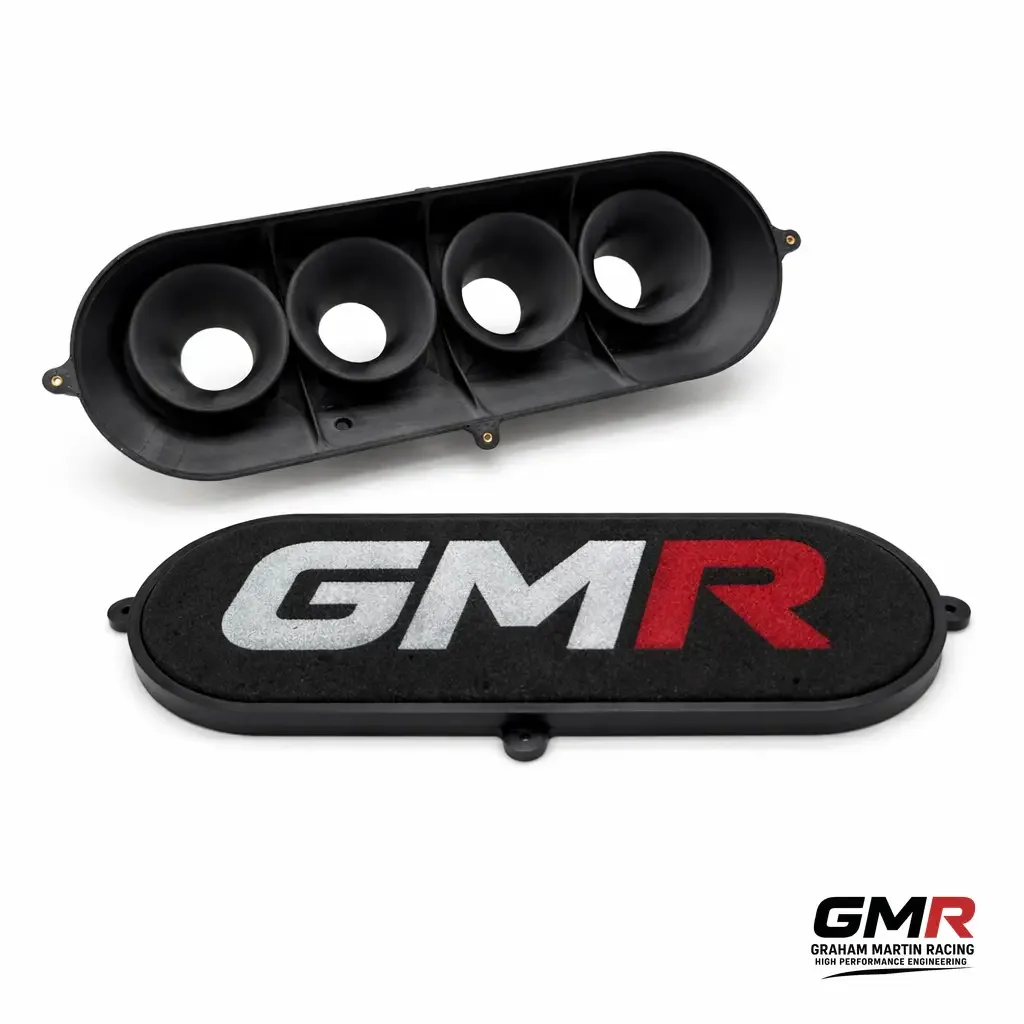
An ITB airbox does two jobs at once, and most people only think about one of them. The obvious job is filtration and ducting cold air to the trumpet mouths. The less obvious — and more important — job is acoustic: the flat front face of the box sits a controlled distance from the air horns and reflects the induction pressure pulse back down the tract. Get that spacing and volume right and every cylinder sees the same signal, so fuelling and torque even out across the bank. Get it wrong and you have effectively built an expensive dust cover.
Jenvey’s current airboxes are built around a 6 L internal volume with a 76.2 mm (Ø3″) inlet on the popular 75 mm-inlet units, and the whole range is designed to work as a matched system with Jenvey throttle bodies, backplates and air horns. Below is how the parts actually interact, the fitment numbers that decide whether a box will physically clear your fuel rails, and how a made-to-fit DDM composite box differs measurably from an off-the-shelf laminated one — on mass, wall construction and thermal conductivity.
What an ITB airbox is actually doing
The induction system from trumpet mouth to exhaust tip is one resonant whole. The air horn sets the primary tuned length; the airbox front face adds a second reflecting surface. As Jenvey’s own design notes put it, the flat front surface is there to direct pulse reflection back into the airhorn, and the closer that surface sits to the trumpet mouth, the stronger the reflection. That is why any serious tuner will tell you to run the airbox — or at least its top plate — fitted during dyno work. Strip it off to chase a number and you have tuned a different engine to the one that will run on the road or the grid.
Volume matters because a box that is too small chokes the resonance and behaves like a restriction, especially with a poorly considered air feed. Jenvey are blunt about this: any air feed to an airbox or filter can have a large effect on the power curve and must be considered carefully, particularly if the box is small. A 6 L box fed through a single 76.2 mm inlet is fine for a four-cylinder up to sensible airflow; feed a hungry high-revving engine through a kinked 3″ pipe and you will see it in the top-end curve.
Under-length induction is the number-one mistake
Before you even choose a box, get the tract length right. Induction length is one of the most important aspects of fuelling a performance engine, and in Jenvey’s experience an under-length system is the single greatest cause of disappointment — losing up to a third of the engine’s power potential. The airbox backplate, air horn length and butterfly-to-valve distance all live in that budget. For a 7,000–9,000 rpm engine the practical minimum butterfly-to-valve distance is around 200 mm, with the maximum dictated by fitting an air horn of reasonable length to give a good overall tract shape. Choose the box last, once you know the length you need and the space you have.
Off-the-shelf airbox ranges at a glance
Jenvey have manufactured induction systems in Britain since 1994, machining every housing, manifold, fuel rail and air horn in-house, with their own foundry for cast components. The airbox line-up splits by material and by how compact it needs to be:
| Product | Material | Volume | Inlet Ø | Notes |
|---|---|---|---|---|
| ABT2xx (75 mm inlet) | Fibreglass laminate | 6 L | 76.2 mm | 100 mm deep; good noise absorption; 4 inlet positions (LB/LT/RB/RT) |
| ABTC2xx (75 mm inlet) | Carbon laminate | 6 L | 76.2 mm | Remote filter needed; fits GRP and aluminium backplates |
| ABCF1 + base kit | Carbon laminate | 9.4 L | 100 mm | 400 × 150 mm, 160 mm deep; blank base to drill; remote filter |
| ABLS1 (pair) | Carbon laminate | 7.16 L | 94 mm | Designed for Chevrolet LS; base plates need machining; LH/RH side-inlet options |
| DBMZ01-ABX / CKCT03 | Carbon laminate | — | — | Model-specific MX-5 NC kits; made to order; coil packs need lowering; aftermarket ECU required |
Note the naming convention I’m using deliberately: these are laminated composite boxes — GRP or moulded carbon laid up in a tool. That is one legitimate manufacturing route. It is not the only one, and it is not automatically the right one for your engine bay, as I’ll come to.
Backplates: the part that decides whether it fits at all
The backplate is the interface between the throttle-body flanges and the box or filter, and it is where most fitment problems live. Jenvey’s 50 mm dished carbon backplate (ABB2/50C) exists precisely to clear the fuel rails on SF, ST and TH-style bodies — the dish creates room for the rail and throttle linkage and lets you run a slimmer filter. With 90 mm air horns you use a 90 mm-deep filter, which is far easier to get in and out with the box in place. It ships as a blank, 1.75 L in volume, that you cut to your own layout.
The spacing limits are the numbers to check before you buy anything:
| Backplate / body style | Max spacing (outer air-horn centres) |
|---|---|
| SF + TB | 292 mm (≈ 112 mm max between throttle-body centres) |
| SFD (large individual) | 286 mm |
If your bank of four throttle bodies puts the outer trumpet centres beyond 292 mm, a standard dished backplate will not enclose them — no amount of persuasion changes that. The flat aluminium backplate (ABB2/0) is the choice where there are no clearance problems, and a 6-cylinder flat carbon plate (ABB5/0C) covers straight-six applications. On tight installs the offset matters too: on the MX-5 NA/NB kit, for example, the backplate is offset 12 mm to clear the master cylinder while the 90 mm internal depth still leaves room above a 50 mm air horn.
Jenvey’s style codes are worth learning so you order the right interface: SF individual, SFD large individual, ST small 2-bolt, TH and TB DCOE-style. Their DCOE-style bodies come in three lengths, the standard 118 mm TB matching a Weber DCOE, with two shorter versions for limited clearance or where you want a longer horn.
Filters and clearance — don’t strangle the trumpets
If you are running a remote filter (which the carbon boxes require), the filter face has to sit far enough off the trumpet mouths that it does not act as a restriction or, worse, get drawn onto the horns under load. Jenvey’s mesh air horn filter (ABF6-90) is matched to specific 61 mm-tall air horns and filters down to around 80 microns. Community best practice cites roughly 30 mm minimum between trumpet mouth and filter face and a caged filter rather than an unsupported foam sock — sensible advice, though I’d flag it as builder consensus rather than a published Jenvey figure. What is not in dispute: open trumpets on the road are a mistake. You need filtration, and it needs to keep its clearance.
How a DDM composite airbox compares with a laminated one
Laminated boxes are proven and, in a carbon layup, light. But the laminate process constrains what geometry you can actually make: a hand-laid or tooled box is essentially a shell, and the interesting airflow features — tuned internal transitions, closed cavities, integrated horn radii — either can’t be moulded in one piece or need multiple bonded parts. This is where our DDM composite route earns its place. We print in PPA-CF, a carbon-fibre-reinforced polyphthalamide, and Direct Digital Manufacturing lets us build features a laminate simply cannot.
First, geometry. DDM lets us print genuinely hollow, closed internal cavities, tuned-length runners and internal transitions in a single part — no split lines, no bonded seams to fail. We can integrate the horn radii and the reflecting face into one optimised volume that is impossible to lay up.
Second, thermal. A reinforced polymer wall plus a trapped-air cavity keeps intake-charge heat pickup far lower than an aluminium equivalent. Aluminium’s thermal conductivity of 150–220 W/m·K makes it a superb heat pump into your charge; PPA-CF is orders of magnitude lower. That benefit is real at idle and heat-soak — sitting on the grid, in the paddock, in traffic — and less decisive at sustained wide-open throttle where mass airflow dominates. I’ll always tell you which case you’re in rather than pretend the box fixes everything.
Third, mass. PPA-CF has a density of 1.25 g/cm³ — under half aluminium’s 2.70 g/cm³ before you even count the hollow section.
Fourth, fit. Every part is designed around your specific throttle-body spacing, fuel rail and bay clearances with genuine port matching — no “universal fit” compromise — and because it’s CAD-to-dyno, we iterate the geometry on real data.
On heat resistance the material holds up under load far past the figure people misread. PPA-CF’s glass transition is 85°C, but it is semi-crystalline and fibre-reinforced, so load-bearing capability persists well above that — which is why its heat deflection temperature is 196°C at 1.8 MPa (227°C at 0.45 MPa) and Vicat softening is 232°C. For under-bonnet intake service, HDT is the number that matters, and it is comfortably in range.
| Property (PPA-CF datasheet) | Value |
|---|---|
| Tensile strength (XY / Z) | 168 ± 4 MPa / 57 ± 5 MPa |
| Young’s modulus (XY) | 11,800 ± 670 MPa |
| Bending strength (XY) | 208 ± 6 MPa |
| Impact strength (XY) | 41.7 ± 2.8 kJ/m² |
| Density | 1.25 g/cm³ |
| Heat deflection temp | 196°C @ 1.8 MPa / 227°C @ 0.45 MPa |
| Vicat softening | 232°C |
| Saturated water absorption | 1.30% |
Be honest about the trade-off: the Z-axis tensile figure (57 MPa) is a third of the XY figure (168 MPa), so print orientation governs strength and we design load paths around it. Where you genuinely need very high sustained temperature or maximum through-thickness strength, a laminated/autoclave carbon box can still be the right call — and I’ll say so. We reach for DDM because the engineering supports it, not as a default.
Matched systems we build
The same logic drives our platform-specific boxes. If you’re running Jenvey or DCOE-type bodies on a Peugeot XU, our Peugeot 205/306 GMR airbox for Jenvey & DCOE-type throttle bodies is designed around that exact install, and we make a GMR airbox for Jenvey OBX SF-type bodies too. For the theory behind horn length inside the box, read our guide to how velocity stack length and radius actually make power, and if you’re spec’ing a whole K20 induction system see our carbon composite airbox for the K20 and ITB kit fitment guide.
FAQ
What volume should an ITB airbox be for a four-cylinder?
Jenvey’s standard 75 mm-inlet boxes are 6 L with a 76.2 mm inlet, which suits most four-cylinders through a well-routed 3″ feed. A small box is more sensitive to a restrictive air feed, so if you’re chasing top-end airflow, prioritise a clean, generous inlet duct over shrinking the box.
Do I need to dyno tune with the airbox fitted?
Yes. The box’s flat front face reflects the induction pulse back into the horn and shifts the tuned curve, and the effect grows as the face gets closer to the trumpet. Tuning without it — then bolting it on afterwards — means you’ve calibrated the wrong system.
How do I know a backplate will clear my throttle bodies?
Measure the distance between the centres of the two outer air horns. For SF + TB bodies the dished backplate handles up to 292 mm; for SFD it’s 286 mm. Beyond that you need a different backplate or a bespoke box built around your spacing.
Is a DDM composite airbox as strong as a laminated carbon one?
For intake service, yes — PPA-CF’s heat deflection temperature (196–227°C) and XY tensile strength (168 MPa) are well within intake duty, and it’s lighter and better insulating than aluminium. The caveat is Z-axis strength (57 MPa), which we manage through print orientation. For extreme sustained heat or through-thickness loading, a laminated box can still win.