
Carbon Intake Manifold for a Race Engine: What Actually Works
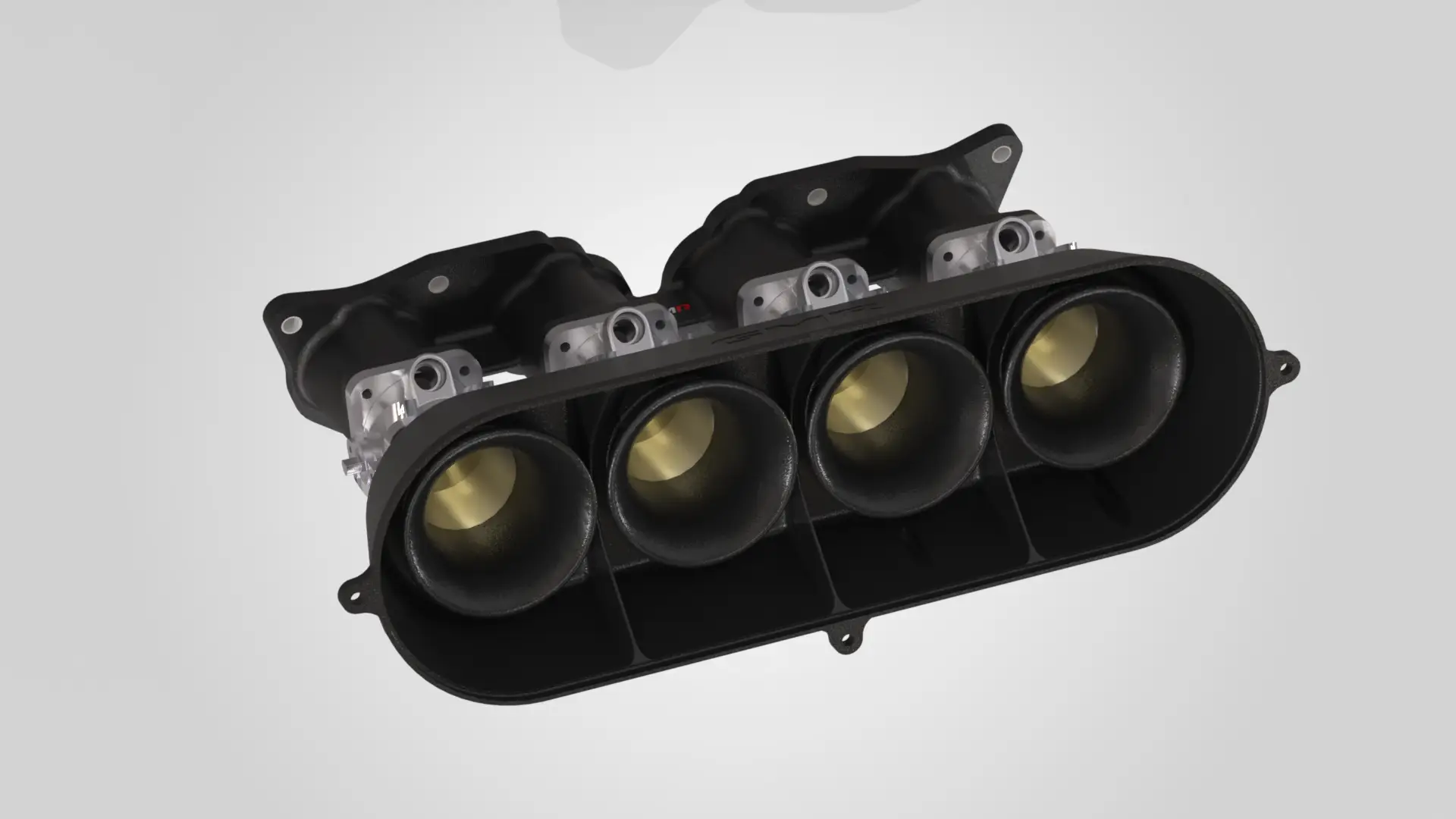
Ask ten people what a carbon intake manifold race engine setup buys you and you’ll get ten different answers — most of them lifted straight from a product listing. So let me cut through it. I’m Graham Martin, and I design and build these parts in Northampton for race teams, engine builders and serious club racers who want a manifold engineered around their combination, not a universal-fit shape that “should be close enough.” Here’s what a carbon-impregnated polymer manifold genuinely does, what it doesn’t, and how to spec one that earns its place on the engine.
What the manifold actually does
The intake manifold’s core job is simple to state and hard to do well: distribute air — or an air–fuel mixture — evenly to every cylinder. It’s a key factor in how the engine breathes and in how power is delivered, and that matters even more on forced-induction builds where you’re stuffing a lot of air through a small window.
Get the distribution wrong and you’ve got cylinders running leaner or richer than their neighbours, uneven thermal loading, and a calibration that fights you the whole way up the rev range. Get it right — even static pressure across the plenum, equal charge to each runner — and the engine becomes predictable. That predictability is the whole game.
Why carbon-impregnated polymer, not aluminium
First, let me be precise about what we’re talking about, because the terminology gets abused. A carbon-impregnated polymer manifold is printed from a thermoplastic filament with chopped (short) carbon fibre blended into the matrix — not a laid-up continuous-fibre composite, and not the same as moulded carbon. The fibres are carbon yarns chopped into particles around 2 mm or less and mixed into a base polymer such as nylon (PA6, PA12, PAHT), polycarbonate, PETG, ABS or, at the high end, PEKK, PEEK or PEI (ULTEM). You’ll see these sold under names like PA6-CF, PA12-CF, PAHT-CF and PPA-CF. Get that distinction right up front and the rest of the engineering conversation makes sense.
The honest, physics-based reason to choose a carbon-impregnated polymer plenum over aluminium is thermal insulation, not magic airflow. Aluminium is an excellent conductor of heat. Bolt it to a hot cylinder head and sit it in a heat-soaked engine bay, and it happily transfers that energy into your charge air. A carbon-filled polymer has far lower thermal conductivity — it resists soaking engine-bay and head heat into the air on its way to the valves.
Why does that matter? Lower intake air temperature means denser air, more oxygen per stroke, and more consistent power — especially across an extended track session when everything under the bonnet is cooking. As a working rule of thumb, roughly every 10°C rise in intake air temperature costs you in the order of 3% power. Hold the charge cooler and you hold the power.
Let me be straight about the marketing here: you’ll see vendors claim carbon has “superior heat dissipation.” That’s loose wording bordering on wrong. The benefit is low thermal conductivity — insulation — meaning the material resists passing heat into the charge. It is not “dissipating” heat better than aluminium. Anyone telling you otherwise hasn’t done the test.
What the chopped fibre actually buys you — and what it doesn’t
This is the bit the filament listings gloss over. Infusing chopped carbon fibre into the base polymer makes a printed part stiffer, lighter and far more dimensionally stable — the fibres help prevent the part shrinking and warping as it cools, and they give that matte finish that hides layer lines. What they do not reliably give you is more outright strength. Because the fibre is broken into short fragments rather than running in continuous strands, it only delivers carbon’s stiffness at the points where those fragments sit — it can’t distribute load along its length the way continuous fibre does. In fact, over-load the filament with fibre and you can end up with mechanical properties lower than the unfilled plastic, while wrecking surface finish and dimensional accuracy. So I treat carbon-impregnated polymer as a stiffness-and-stability play, not a strength miracle, and I lean on the base polymer to set the core behaviour: nylon for toughness and chemical resistance, polycarbonate for heat tolerance.
One more engineering caveat that bites the unwary: these prints are anisotropic. The fibres align along the print direction (X/Y) and not through the layers (Z), so a part is markedly stronger in-plane than it is between layers. Part orientation on the bed is a design decision, not an afterthought — get it wrong and a plenum that’s stiff in one axis delaminates in another.
Be honest about the power gains
This is where I lose customers who’ve been promised the moon. A carbon-impregnated polymer manifold in isolation is a modest power upgrade. Where it earns its keep is combined with a proper calibration and the rest of your airflow path sorted. Realistically, material-and-design gains in the order of 10–25 hp are achievable when paired with an ECU tune and supporting airflow upgrades — and the real prize is improved thermal efficiency, throttle response and repeatability rather than a giant peak number.
For a concrete, platform-specific example: a carbon manifold on a stock Subaru FA20 (BRZ/86), with nothing more than a panel filter and a stage 1 tune, returned gains as high as 11 wheel-hp and 12 lb·ft, mostly in the mid-to-high rpm range. That’s a real, measured figure — but it’s that engine, on that day. It does not transfer to your K20 or EJ. Treat every quoted number as platform-specific until you’ve seen it on your own dyno.
The bit nobody likes to admit about temperature claims
Here’s the catch with all the IAT marketing: on most engines there’s no sensor measuring air temperature at the port. IAT is read upstream, so port-level heat-soak effects are genuinely hard to quantify with the data you’ve got. The only honest way to prove a manifold is back-to-back testing — same engine, same day, same conditions — measuring hp and torque, not waving a temperature sensor around in the wrong place. I’d rather show you a dyno overlay than a brochure adjective. If you want somewhere to gather that back-to-back data, the team at Trackday Finder has a practical guide to Silverstone track days.
How a carbon-impregnated polymer race manifold is actually built
There’s more than one valid way to build these, and the right method depends on whether you’re after a production part or a one-off race component. For the wider context on specifying parts that fit and last, see our guide on custom race engine components in the UK.
Choosing the filament and the matrix
The base polymer dictates the part’s core behaviour, so the choice isn’t cosmetic. For a heat-soaked engine bay I want a matrix that holds up to temperature, and here the datasheet matters more than the marketing — heat deflection temperatures for carbon-filled nylons swing wildly by grade and test method. A carbon-filled nylon can quote heat deflection around 112°C at 0.45 MPa and 186°C at the heavier 1.80 MPa load (ISO 75), and high-temperature grades like PAHT-CF push the 0.45 MPa figure toward 194°C — but you’ll also find PA12-CF grades rated as low as ~48°C HDT. So I always spec against the specific product datasheet at the relevant test load, never a generic “carbon fibre” number. Worth noting too: chopped carbon is abrasive, so these filaments need a hardened nozzle to print — a small but non-negotiable detail.
Hybrid: carbon-impregnated plenum, metal or polymer runners
The most common production approach is a hybrid. The plenum is printed in carbon-impregnated polymer for the stiffness-to-weight ratio, dimensional stability and heat-soak resistance, while the runner pack is CNC-machined billet aluminium (typically anodised 6061-T6) or a glass-filled nylon such as PA6GF30 for light weight and low conduction. On well-engineered designs the runner bank bolts through the carbon-filled plenum into an internal velocity-stack plate and is sealed with O-rings — a properly located, repeatable joint rather than a smear of sealant and hope. Done right, a hybrid like this can shed around 4–5 kg versus a comparable aluminium tunnel-ram manifold.
Full carbon-impregnated polymer print
For race and prototype work the more interesting route is to print the whole plenum in carbon-impregnated polymer. This is exactly where additive manufacturing earns its place: you can produce a functional intake in virtually any geometry. That geometric freedom is the point — organic, flow-conducive shapes that let you equalise static pressure across the plenum and deliver an equal charge to every cylinder, which a CNC’d aluminium box simply can’t match. The trade-off is the one I flagged earlier: the print is anisotropic and chopped fibre buys stiffness rather than raw strength, so I orient the part to put the layers in compression where I can, design generous wall sections, and validate the result rather than trusting a headline figure. This is the DDM philosophy we use at GMR — and if you want the wider picture on how 3D printing slots into the motorsport workflow, the team at Ask The Nozzle covers the additive side in detail. If you’re running your own printer for cores, they’ve also covered the best Creality K2 Plus mods.
Spec it around your engine, not a catalogue
Runner length and plenum volume are not styling choices. Longer runners build torque lower down via intake pressure-wave tuning; shorter runners shift the resonance peak up the rev range. Plenum volume affects throttle response and how the manifold copes with transient demand. None of this works if it’s borrowed from another engine. This is why I push so hard against “universal fit” — a manifold tuned for the wrong displacement and rpm window is just expensive jewellery.
If you’re building an ITB top end rather than a single-throttle plenum, the same discipline applies — see our guides on the individual throttle body kit and the bespoke intake manifold spec process. The airbox feeding it matters just as much — see our guide on the carbon composite airbox for motorsport. Platform-specific builds matter too: there’s detail on the Honda K20 and the Peugeot GTi6 and Mi16, and if you’re on the Peugeot XU platform we make a dedicated GTi6 intake manifold. For more on how and why we build the way we do, have a read of Why GMR.
FAQ
Is a carbon-impregnated polymer intake manifold worth it for a race engine?
If you want lower charge temperatures, weight saving and consistent power across a long session, yes — provided it’s tuned to your engine and backed by a calibration. As a standalone bolt-on chasing a big peak number, expect modest gains in isolation. The value is in repeatability and thermal stability.
How much power does a carbon-impregnated polymer manifold add?
Realistically 10–25 hp when combined with a tune and supporting airflow work, and that’s platform-dependent. A stock FA20 saw around 11 wheel-hp with just a filter and stage 1 tune. Treat any quoted figure as specific to that engine until you’ve proven it on your own dyno.
Does carbon-impregnated polymer really run cooler than aluminium?
A carbon-filled polymer has much lower thermal conductivity, so it insulates the charge from engine-bay and head heat far better than aluminium. The accurate framing is “thermal insulation,” not “heat dissipation.” Just remember port-level air temperature is hard to measure directly, so prove the benefit with back-to-back power testing.
Isn’t carbon-impregnated polymer the same as carbon fibre?
No — and the distinction matters. Carbon-impregnated polymer uses chopped (short) carbon fibre blended into a thermoplastic and printed, which boosts stiffness, weight and dimensional stability. It is not continuous-fibre or moulded carbon composite, which distributes load along the fibre and is genuinely stronger. We pick the approach to suit the part, and we’re honest about which one you’re getting.
Can you make a manifold to fit my exact engine?
That’s the whole point of what we do at GMR. We design carbon-impregnated polymer and DDM manifolds around your displacement, rev range, packaging and calibration — off-the-shelf where it fits, fully bespoke where it doesn’t. Get in touch and we’ll spec it properly.