
2026-11-26
Subaru Impreza WRX Remap: What a Proper Flash Actually Gives You
A Subaru Impreza WRX remap works by reading the engine ECU's standard calibration, changing the numbers that govern fuelling, boost and ignition timing, and writing the revised file back through the OBD port or on the bench. On a healthy classic turbo EJ WRX that isn't already running a Prodrive Performance Pack, a well-executed Stage 1 flash with a few supporting parts commonly returns 40–45 bhp — one non-PPP car we'd expect to see go from around 250 to 286 bhp. That is the headline. Everything that matters sits underneath it: how the map is made, what the OEM ECU is doing while you tune it, and where the EJ's mechanical limits actually lie.
I calibrate engines cell by cell on a load-bearing dyno, with proper knock detection running the whole time, until the numbers repeat. That discipline is the difference between a remap that lasts and one that eventually lets go of a ringland. Here's how I'd approach a WRX, and what I'd want you to understand before you book it in.
Why a flash beats a piggyback on a Subaru specifically
There are three broad ways to change what a WRX does: flash the original ECU (a remap), bolt on a piggyback that sits between the sensors and the ECU, or fit a standalone aftermarket ECU. For a Subaru, the flash is almost always the right answer, and the reason is in the factory software.
A remap works directly inside the ECU, so every parameter — injection timing, boost target, ignition advance, limiters — is available at once and set against each other coherently. A piggyback works by intercepting and altering signals to trick the ECU into doing something different. That's a compromise by definition, and it's a particularly poor fit on a Subaru because the OEM ECU is self-learning for both fuelling and ignition. Feed it falsified signals and it spends its time learning around you. A piggyback also can't raise the rev limit or clear error codes — those live inside the stock software where only a flash can reach them.
Standalone has its place: when the factory ECU genuinely can't cope with the hardware, you move to an aftermarket unit. I calibrate those too — Syvecs, DTA, GEMS, Cosworth and the rest — but on most road and club WRX builds the OEM ECU, properly mapped, is the cleaner, more reversible solution. A remap can usually be returned to stock with a re-flash, provided the original data was saved on the day.
The platforms: COBB, open-source and EcuTek
Flashing a Subaru ECU is done through one of a handful of toolchains, and which one is already on the car matters enormously if you're buying second-hand.
| Platform | What it is | Notable features / caveats |
|---|---|---|
| COBB Accessport | Plug-and-play handheld that reflashes via OBD in minutes | Off-the-shelf and custom maps, live logging, code reading, map switching. Locks the ECU (from Accessport v2, during 2008) against other software. |
| Open-source (RomRaider + EcuFlash + Tactrix) | Enthusiast-developed editor, logger and flash utility with a Tactrix cable | Full tuning and logging without expensive licences. Won't read or flash an ECU locked by COBB or EcuTek. |
| EcuTek ProECU | Reprograms the original ECU via OBD and adds the RaceROM feature suite | Launch control, flat-foot shifting, per-gear rev/boost limits, speed density, flex fuel. Licence-locked — open-source tools can't read it. |
That last column is the trap on a used car. A COBB Accessport locks the ECU, so you can't read or flash it with EcuFlash. An EcuTek-locked ECU won't open in standard open-source software, and clearing it may mean having an EcuTek dealer flash it back to stock first. Before you buy a tuned WRX, find out which platform wrote the current map — it dictates what any tuner can do next.
On an EcuTek-mapped Subaru, the speed-density strategy interpolates between maps for each cam angle to work out the injector open time needed to hold Lambda 1. That's the kind of detail that makes OEM flashing powerful: you're working within a strategy the factory already validated, not bolting a crude correction on top of it.
Realistic gains by WRX generation
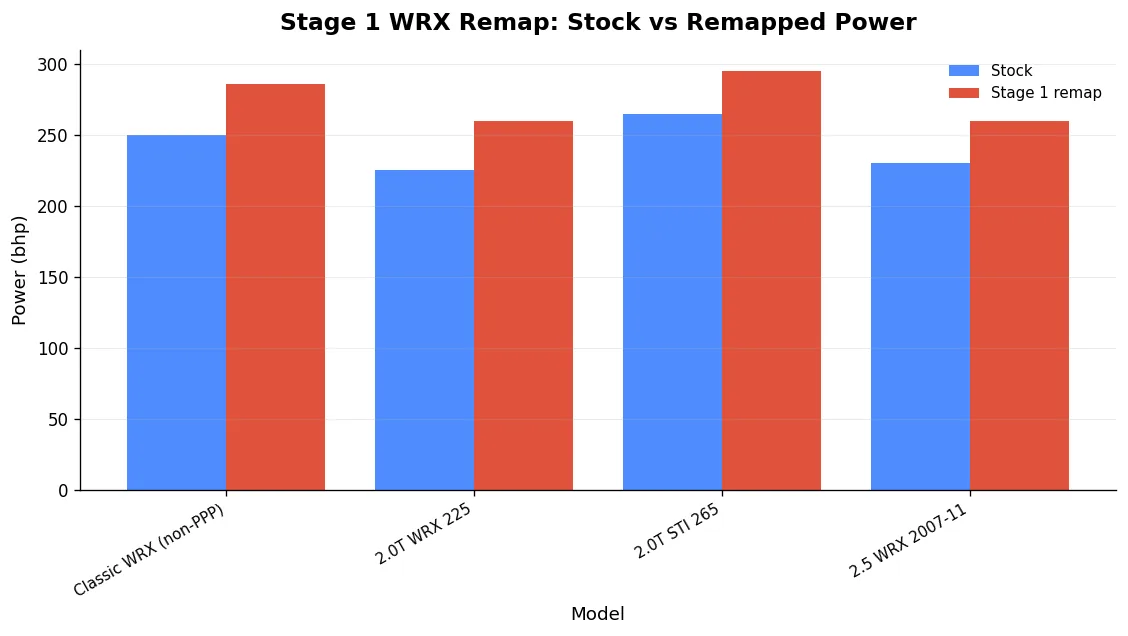
The figures below are indicative ranges from Stage 1, software-focused tunes. Real results depend on the exact car, its condition, the fuel and the dyno — treat them as what's reasonable, not a guarantee.
| Model | Stock | Stage 1 (indicative) | Torque gain |
|---|---|---|---|
| Classic turbo WRX (non-PPP) | ~250 bhp | +40–45 bhp (e.g. 250 → 286 bhp) | — |
| 2.0T WRX 225 | 225 bhp / 300 Nm | ~260 bhp / 360 Nm | +60 Nm |
| 2.0T WRX STI 265 | 265 bhp / 340 Nm | ~295 bhp / 400 Nm | +60 Nm |
| 2.5 WRX (2007–2011) | 230 bhp / 320 Nm | ~260 bhp / 380 Nm | +60 Nm |
Prodrive PPP cars already sit at 250–260 bhp, so the delta from a remap is smaller — you're mapping up from a raised baseline, not stock. As a rule of thumb, a Stage 1 remap on a turbo petrol adds 15–30% power and torque while staying inside what the standard turbo, injectors, clutch and cooling were built to take.
Where the stock hardware runs out
Stage 1 is a software exercise on standard hardware. Push further and specific components become the limit, in a predictable order.
First, the turbo. On a classic WRX, an uprated fuel pump and a better air filter take you towards roughly 280 bhp, which is about as far as the stock TD04 goes while remaining cost-effective. Beyond that you're into a hybrid or larger turbo and a Stage 2/3 conversation.
Second, fuelling. Stage 2 is typically a turbo-back exhaust and heat shielding — no new injectors required. Stage 3 is where injectors and a bigger pump become mandatory. Subaru sized injectors for about 80% duty at stock output until 2006 (WRX) and 2007 (STI), when the blue 565 cc injectors appeared on nearly everything; those tap out at around 315 whp before they hit 100% duty. The stock pump copes at Stage 1–2 levels if it's healthy, but past roughly 75,000 miles I'd fit something like a Walbro 255 before the dyno — a tired OEM pump that won't hold pressure at high load is a quiet way to lean out and detonate.
Third, flex fuel. With an ethanol-content and fuel-pressure sensor, the ECU can add timing and boost when you put E85 in the tank. On the newer FA24 WRX, E85 behaves like 105+ octane: lower intake charge temperatures, far less knock and LSPI risk, and 30–60+ whp over a 93-octane tune on the same bolt-ons. It needs a flex-fuel sensor kit, upgraded injectors or fuel capacity, and a dedicated protune — not an off-the-shelf map.
The reliability conversation: knock and ringlands
The reason I keep knock detection live on every pull isn't ceremony. Piston ringland failure is the known weakness of the turbocharged EJ family, from the EJ20 through the EJ257. The mechanism is simple: when the mixture ignites prematurely or unevenly, pressure spikes crack the ringland. An improper tune that allows detonation places immense stress on the pistons and is a leading cause of that failure.
The good news is that it's largely preventable — through proper tuning, quality fuel and respecting the engine's limits. The EJ257 is calibrated for high-octane fuel; run it on something lower and you invite knock, and combining high boost with middling octane is exactly the recipe for detonation that shocks the ringlands. So fuel quality isn't a detail, it's part of the calibration.
I'll be honest about the nuance, because a knowledgeable owner will ask. Knock isn't the only factor: some analysis points at heat and the narrow OEM ring gap, arguing that even a knock-free tune at high enough output can let the rings go. Forged pistons with thicker ringlands tolerate knock better, which is why serious power builds go forged. Failure-rate claims vary wildly across the community, so I won't quote one as fact. What I will say is that supporting mods earn their keep here: an air/oil separator (AOS) to keep oil mist out of the intake, and attention to the oil pickup tube, which is known to crack at the welds and starve the engine. A map that respects the hardware, on good fuel, with knock monitored properly, is how you keep an EJ together.
Legal notes for UK road cars
Several common supporting parts for a classic WRX — decat uppipes, second-cat deletes, sports-cat downpipes — affect emissions compliance. In a UK road context those are generally track-only items, and you should tell your insurer about any remap or modification. A Stage 1 flash that leaves the catalysts in place is the road-friendly route; anything that removes emissions control is a decision to make with the car's use in mind.
If you're planning dyno days or want somewhere to shake the car down after mapping, our sister sites list UK and European trackdays and every UK motorsport event.
How I map a WRX
The process is deliberately unglamorous. I check the car for stored faults before and after, and I keep the original file so it can go back on. Mapping happens on a load-bearing dyno, cell by cell, with knock detection running continuously so I can see the engine's response in real time rather than inferring it from a couple of road pulls. The target is a calibration that's repeatable — the same numbers, run after run, on the fuel you'll actually use.
If you want this done properly, our Subaru Impreza WRX ECU mapping covers it, and there's matching work for the WRX STI, Forester, Legacy and Outback and BRZ. Competitors who need more than a map can enquire about race engineering support through our contact page.
FAQ
How much power does a Stage 1 WRX remap add?
On a healthy classic turbo WRX that isn't a Prodrive PPP car, 40–45 bhp is reasonable with a few supporting parts — one non-PPP example went from 250 to 286 bhp. Later 2.0T and 2.5 cars typically see around +30–35 bhp and +60 Nm. As a rule, expect 15–30% more power and torque within the engine's safe limits.
Will a remap damage my Subaru's engine?
Not if it's done properly. The EJ's weak point is piston ringland failure caused by detonation, and that is largely preventable with a correct tune, high-octane fuel and knock detection running throughout mapping. A map that respects the hardware limits — stock turbo to around 280 bhp, 565 cc injectors to about 315 whp — is what keeps the engine together.
Can a WRX remap be returned to stock?
Usually, yes — a re-flash puts the original calibration back, provided the stock data was saved before mapping. The exception is platform lock-outs: a COBB- or EcuTek-locked ECU can only be read and flashed by that platform, so always establish which tool wrote the current map before any work begins.
Is a piggyback tuner a cheaper alternative to a remap?
On a Subaru it's largely wasted money. The OEM ECU is self-learning for fuelling and ignition, so a piggyback that tricks it tends to get learned around, and it can't raise the rev limit or clear codes. A flash of the original ECU extracts more power and does it coherently.