
2026-10-16
106 GTI Bike Throttle Body Kit: The Honest Engineering Guide to a GSX-R Conversion
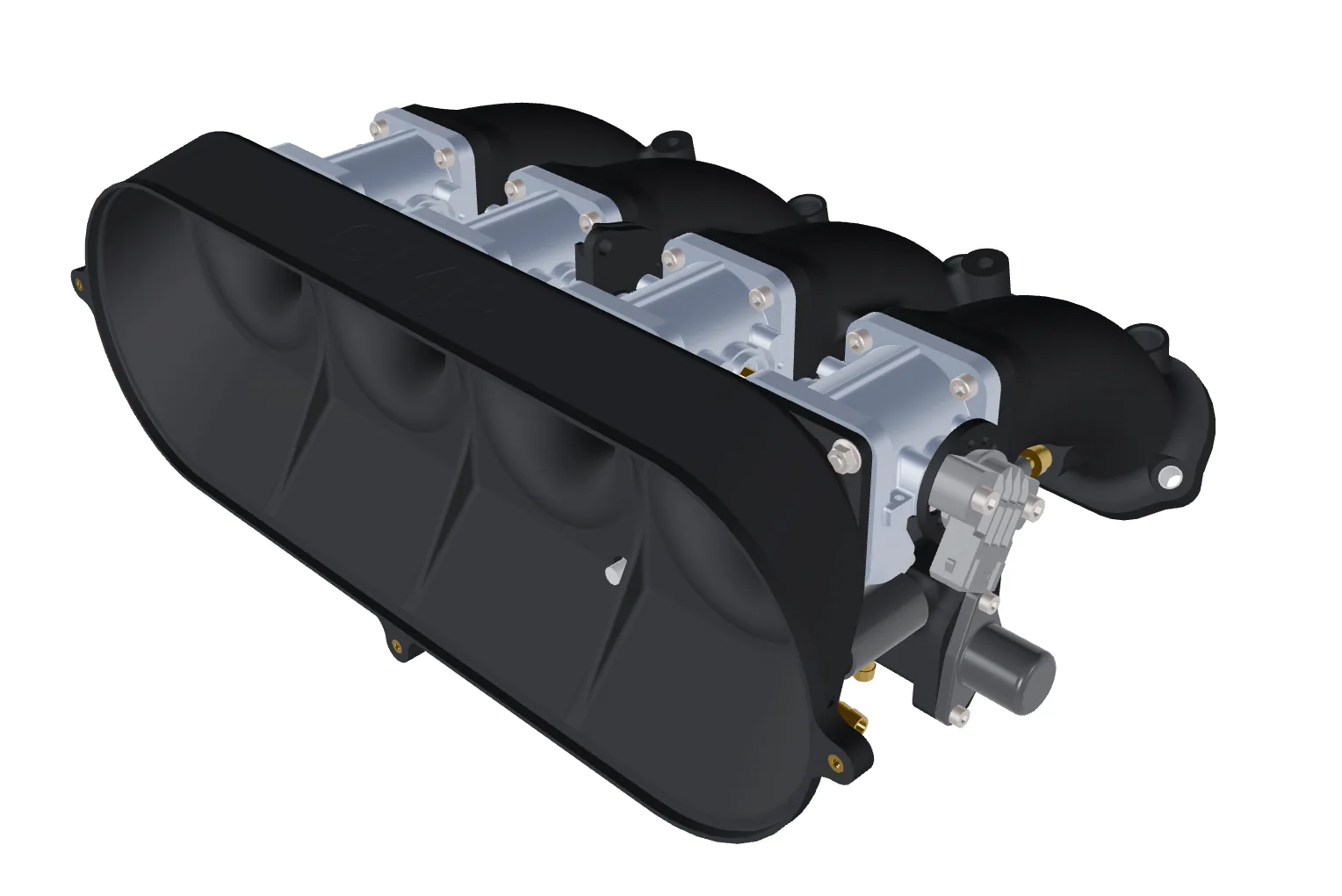
A 106 GTI bike throttle body kit takes a set of motorcycle throttle bodies — almost always Suzuki GSX-R units — and adapts them to the TU5J4 16-valve head via a bespoke inlet manifold. Done properly it gives you four individual throttles feeding four ports, with the responsiveness and top-end breathing that the standard single-throttle plenum simply can't deliver. The appeal is obvious: bike bodies are mass-produced to a very high manufacturing standard, they're compact, and they cost a fraction of purpose-made car ITBs. The catch is that everything that matters — spacing, taper, runner length, trumpet choice, linkage and, above all, engine management — is down to the manifold and the installer, not the bodies themselves.
This is the detail that decides whether your 106 GTI (or the Saxo VTS / C2 VTS it shares the engine with) picks up 30+bhp or loses power versus standard. Let me walk through what actually matters.
The engine you're working with: TU5J4
The Peugeot 106 GTI runs the TU5J4 — a 1.6-litre, double overhead cam, 16-valve naturally aspirated unit. The numbers worth having in front of you before you spec any intake:
| Parameter | Figure |
|---|---|
| Displacement | 1587 cm³ |
| Bore × stroke | 78.5 × 82.0 mm |
| Valves | 16 (DOHC) |
| Compression ratio | 10.8:1 (most sources; auto-data.net lists 10.2:1 — worth confirming on your actual unit) |
| Peak power | 120 PS @ 6600 rpm |
| Peak torque | 145 Nm (107 lb·ft) @ 5200 rpm |
| Kerb weight | ~925–950 kg (varies by source/spec) |
| Engine codes | NFX TU5J4 (early) / TU5JP4 (later) |
Because the TU5 16v is shared with the Citroën Saxo VTS and C2 VTS, kits are almost always cross-listed for all three — the head and port layout are common, so a manifold made for one fits the others.
Bike throttle bodies vs car ITBs — what you're actually choosing
"Bike bodies" means throttle bodies lifted from a motorcycle — most commonly a Suzuki GSX-R — and adapted to the car. The usual choice for a 1.6 16v is the GSX-R600 at 38mm, which is well matched to this engine's port size and airflow demand. Larger bodies exist — GSX-R750 SRAD and GSX-R1300 Hayabusa — and fit via specific manifolds, but on a 1.6 they're generally more body than the engine wants unless it's heavily built.
The honest comparison isn't "cheap vs good". Bike bodies fitted well are just as effective as car ITBs; the manufacturing quality of GSX-R throttle bodies is excellent. What separates a good conversion from a bad one is the engineering around them — spacing, tapering, trumpet length and linkage. Get those wrong and you'll either make no gain or go backwards.
| Route | Typical bodies | ECU required | Indicative cost |
|---|---|---|---|
| Bike TB kit (DanST) | GSX-R600 38mm | Standalone (per vendor) | £850 Starter / £1,700 Fast Road (ex-VAT) |
| Jenvey ST 45mm | 42mm butterfly car ITB | Standalone or remap | Higher |
| Jenvey SF 48mm | 45mm butterfly (needs port matching) | Standalone or remap | Higher |
| AT Power 38mm Direct-to-Head | Shaftless twin-housing | Can retain OE ECU/fuel rail/TPS | £1,265.00 |
The DanST GSX-R 38mm kit in detail
The DanST Engineering kit is the main off-the-shelf bike throttle body kit for the TU5 16v, sold in two levels. The Starter Pack (£850 ex-VAT) covers the mechanical conversion; the Fast Road Pack (£1,700 ex-VAT) adds engine management.
Starter Pack contents
- 1× TIG-welded aluminium inlet manifold
- 1× set of GSX-R600 throttle bodies, retaining the original 240cc injectors (suitable for power outputs in excess of 200bhp)
- Fitting kit: 4× fluoro-lined silicone hoses, 8× stainless Mikalor clamps
- 50mm diameter aluminium trumpet kit (available in 25/50/90mm lengths)
- 1× Pipercross PX500 or PX600 filter kit
- Universal throttle linkage kit
- 4× injector plug connectors
Fast Road Pack additions
- GSX-R600 bodies respaced with extended linkages and fuel rail
- Motorsport Electronics ME221 ECU and Vauxhall loom kit, pre-loaded with a basemap to get the car running (rolling-road mapping still required)
- Air intake temperature sensor, coolant sensor and housing
The manifold itself is high-quality aluminium with a precision CNC-cut 10mm flange and TIG-welded 48mm outside-diameter runners with a 3mm wall, and all internal joints are fully ported and ground for smooth flow. (An older listing describes a water-jet cut flange — that's a wording inconsistency, current spec is CNC.) Every DanST-supplied throttle body goes through inspection, strip, ultrasonic clean and rebuild, and the bodies are balanced before dispatch. Kits are made to order on a 10-working-day lead time. If you already own GSX-R bodies, DanST sell a standalone manifold cut for GSX-R750 SRAD and Hayabusa (K1–K2) bodies — 54–55mm OD, 42mm ID, spaced 80-80-80mm — with a profiled plate matching the cloverleaf body shape and the bodies angled upwards for bulkhead clearance.
The real difference: bike TBs need a standalone ECU
This is the single most important practical point and the one that trips people up. In DanST's specification, a bike throttle body conversion requires a standalone ECU to run the injectors and ignition — it is not an "OE-ECU remap" job. That's because you're moving away from the OEM fuelling and load-sensing architecture entirely, and the standard ECU wasn't designed to see four individual throttles.
The sensor inputs a standalone ECU needs:
- Crank position. The ECU needs to know where the engine is relative to TDC, read from a toothed trigger profile (Ford 36-1, Vauxhall 60-2) on the flywheel or front pulley. If the ECU doesn't support the OE tooth pattern, an aftermarket sensor and trigger wheel go on the front pulley.
- Load sensing. Via TPS or MAP. On a naturally aspirated engine TPS is the favoured method (and all DanST kits come with a TPS as standard); the bodies also have MAP connections, which are useful for balancing. MAP becomes essential only with forced induction.
- Air and coolant temperature. Needed for correct fuelling and timing. The original air temp sensor can't be piggy-backed, so a dedicated sensor usually goes in the filter backplate or near the inlet.
DanST supply either the ME221 or an Omex 600 with the relevant loom and crank/air/water sensors. The ME221 is a capable unit — fully sequential fuel control for a four-cylinder, flex-fuel, closed-loop boost and VVT control, windowed DSP knock control, programmable inputs, custom sensor tables and full 3D fuel and ignition maps. Whatever you fit, budget for a proper mapping session: the bodies are balanced mechanically before dispatch, but the fuel and ignition maps must be built using AFR equipment under real-world load, which in practice means a rolling road.
If you take one thing from this: the cost of a bike TB conversion is the kit plus a standalone ECU plus a mapping day. Budget for all three or don't start.
The contested bit: running bike bodies on the standard ECU
DanST's documentation is firm that you need a standalone ECU. That said, there's a genuine real-world divergence here worth being honest about: owners on the 106 Rallye forum report running GSX-R bike bodies on the standard ECU remapped, as a drivability-focused route — no cam change, mapped for the bodies, aiming for a car that pulls hard from the mid-range rather than chasing peak power. Whether that works for you depends heavily on the mapper's capability and the OE rev-limiter and load-table constraints. It's a legitimate path for a road car, but it's not the kit vendor's official line and it caps what you can extract up top. Go in with your eyes open.
Inlet tract length — where most conversions are won or lost
The thing that separates a gain from a loss isn't the throttle body size, it's runner geometry. The intake behaves as a tuned pressure-wave system: as the inlet valve closes, a pressure wave travels up the runner, reflects at the open trumpet mouth and returns. Time that returning wave to arrive just as the valve reopens and you get a free supercharging effect in the rev band you've tuned for. Get the length wrong and you lose cylinder filling exactly where you wanted it.
For the TU5 16v the target is roughly 350–370mm from valve to trumpet mouth. That's a tight packaging problem in the 106 engine bay, which is precisely why the manifold design is critical — and why Satchell, for example, works to a 350mm valve-to-trumpet-lip distance to make best use of the available space and get effective pulse tuning. Short trumpets shift the torque peak up; longer ones bring it down. The DanST trumpet kit offering 25/50/90mm lengths is there so you can trim the resonant tuning to your engine on the dyno rather than guessing.
Realistic power expectations
Treat every number here as indicative — these are vendor claims and enthusiast dyno reports, not guarantees:
- Vendor window for a good car-ITB set-up on this engine: ~150–220bhp (Satchell/Jenvey with 42mm butterflies), with the upper end implying supporting engine work.
- Forum consensus on well-set-up throttle bodies on an otherwise standard 16v: around 80–85 bhp/litre and a substantial torque increase.
- On already-tuned engines: the right TB set-up can bring roughly 15% more torque and power plus much sharper response.
- Anecdotal figure for a standard-engine conversion: roughly a 30–40 bhp increase for about the same outlay as other routes.
- And the warning that underpins all of it: with a less-than-ideal set-up you might see no gain at all, or a loss.
Where a purpose-made manifold earns its keep
Bike bodies are the value route, and a well-made aluminium manifold like DanST's does the job well. But it's worth understanding what else is possible, because intake geometry is where I spend most of my time. A TIG-welded aluminium runner is limited to what you can weld and grind by hand — the internal transitions and taper are a compromise between what flows well and what's manufacturable.
This is where DDM composite — direct digital manufacturing, printed carbon composite in PPA-CF (carbon-fibre reinforced polyphthalamide) — changes the design space. First, geometric freedom: you can print hollow closed cavities, tuned-length runners and smooth internal transitions in one piece that simply cannot be laminated or machined. Second, thermal management: a reinforced polymer with a trapped-air section picks up far less heat into the intake charge than aluminium, which sits at 2.70 g/cm³ and conducts at 150–220 W/m·K — orders of magnitude more than the polymer. That benefit is most valuable at idle and under heat-soak in a cramped engine bay, and matters less during sustained wide-open-throttle; I'll always tell you which case you're in. Third, weight: PPA-CF is 1.25 g/cm³, under half aluminium's density before you count the hollow section. And PPA-CF holds up to under-bonnet heat — heat deflection of 196°C at 1.8 MPa and 227°C at 0.45 MPa, with Vicat softening at 232°C. (Its 85°C glass transition is often misquoted as a ceiling; because the material is semi-crystalline and fibre-reinforced, load-bearing capability persists well above it, which is exactly why the HDT and Vicat figures sit where they do.)
Where is aluminium or a laminated/autoclave part genuinely the right call? When Z-axis strength governs a loaded joint — PPA-CF is 168 MPa tensile in XY but 57 MPa in Z, so print orientation matters — or at very high sustained temperatures. I reach for DDM composite when the engine's geometry and packaging call for it, not as dogma. We build exactly these parts for the related Peugeot GTi6/Mi16 platforms; our XU intake manifolds and plug-and-play ITB kits show the approach, and if you're choosing between kits the guide on picking a kit that fits your head and makes real power applies directly to the thinking here.
FAQ
Do I need a standalone ECU for a 106 GTI bike throttle body kit?
In the kit vendor's specification, yes — a bike TB conversion needs a standalone ECU (ME221 or Omex 600) to run the injectors and ignition, plus crank, air-temp and coolant sensors and a TPS. Some owners run bike bodies on a remapped standard ECU as a drivability-focused road set-up, but that's not the official spec and it limits top-end potential. Budget for a standalone ECU and a mapping session unless you've specifically confirmed the OE-ECU route with your mapper.
How much power will bike throttle bodies add to a standard 106 GTI?
On a standard engine, well-set-up bodies typically give around 80–85 bhp/litre with a substantial torque gain — anecdotally a 30–40 bhp increase. But a poorly executed install (wrong runner length, no proper map) can gain nothing or lose power. The map and the manifold geometry matter more than the bodies.
Are GSX-R bike throttle bodies as good as car ITBs?
Fitted well, yes. GSX-R600 38mm bodies are manufactured to a very high standard and are well matched to the 1.6 16v. The difference is in how they're spaced, tapered, trumpeted and linked — and in the manifold that carries them. A good bike TB kit can match a car ITB kit; a bad one won't.
What inlet runner length should I aim for on a TU5 16v?
Around 350–370mm from valve to trumpet mouth for effective pressure-wave tuning across the useful rev range. It's tight in the 106 engine bay, which is why manifold design is critical and why adjustable trumpet lengths (25/50/90mm) let you fine-tune the torque curve on the dyno.