
K20 Individual Throttle Bodies for Sale: How to Choose a Kit That Actually Fits and Performs
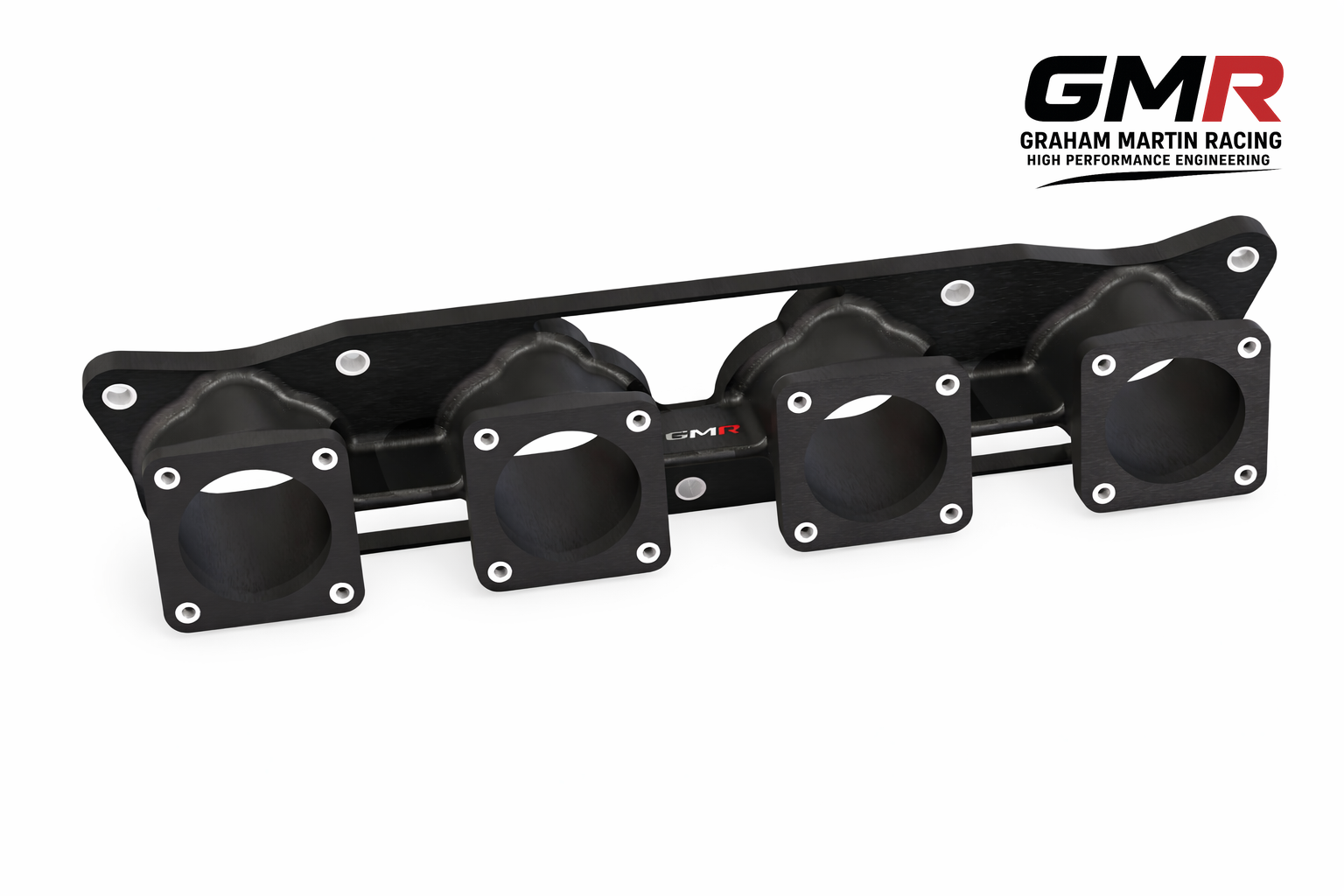
Search “k20 individual throttle bodies for sale” and you’ll find plenty of kits, plenty of marketing, and very little straight talk about what actually matters once the parts are bolted to your head. I’m Graham Martin, and I build and calibrate this stuff for a living. So let me cut through it: ITBs on a K20 are a brilliant tool when they’re sized and packaged correctly around your combination — and an expensive disappointment when they’re bought on butterfly diameter alone because a forum told you bigger is better.
This guide covers what K20 individual throttle bodies actually do, how to size them, what the real products (Jenvey, Toda, and our own kits) specify, and what you need on the management side to make them work. No “universal fit” shortcuts.
What individual throttle bodies do on a K20 — and what they don’t
ITBs replace the single throttle body and cast plenum with one throttle per cylinder: four butterflies feeding four runners, instead of one big throttle feeding a shared box. The headline benefit is throttle response and per-cylinder control — instant, linear pickup that matters enormously on a circuit car, hill climb or anything with a lot of mid-corner throttle modulation.
Here’s the part nobody selling you a kit wants to say out loud: ITBs are not a guaranteed peak-power win. A well-designed plenum manifold with the right runner length and diameter can match or even beat ITBs at the top end. Ported RBC-style manifolds and purpose-built plenums have made more power than ITBs on plenty of dynos. Runner size, diameter and length drive peak power far more than whether you’ve got one throttle or four.
So why fit ITBs? Two real reasons:
- Throttle control. Per-cylinder metering and razor-sharp response that a single plenum simply can’t replicate.
- Tunability. With ITBs you can change trumpet length, fit spacers and adjust butterfly size to shift the powerband. That’s a genuine engineering advantage if you know how to use it.
If you want the longer version of this argument, I’ve written it up in detail in Individual Throttle Body Kit for the Honda K20: What Actually Works.
Butterfly sizing: the bit everyone gets wrong
This is where most K20 ITB purchases go off the rails. The stock K20 port is roughly a 47 mm equivalent. Off-the-shelf plate sizes you’ll see advertised run 45, 48, 50, 51, 52, 55, 56 and 60 mm — and the “right” number depends entirely on your engine and where you want the power.
There are two camps, and both are correct in their context:
- The big-bore school (US, drag-leaning). Given the ~47 mm equivalent port, the argument goes you need a minimum of 54 mm to account for flow loss across the plate and shaft, with 57 mm for a stock long block and 60 mm for a built K20 making power everywhere. Joe McCarthy at 4 Piston is the well-known voice here.
- The European/circuit school. Most manufacturers run smaller — 45, 50, 52, 55 max — because a smaller bore keeps gas speed up and gives a broader, more usable midrange. With the right cam, 45 or 48 mm suits a stock bore/stroke and mild cam nicely.
The principle to take away: bigger throttle bodies bias the powerband upward. The bigger the bore, the higher the rpm where it works. On a K20, 50 mm is about the smallest you’d want, 52 mm is where most road/track builds land, and you only go to 57–60 mm if you’ve got the cams, displacement and rpm to feed it.
The “mm” trap: inlet vs butterfly vs exit
A single quoted “size” can describe three different diameters on a tapered body — and this is where buyers get burned. Jenvey’s standard tapered K20 SF body, for example, measures 51 mm at the opening, 48 mm at the butterfly and 45 mm at the exit over its 66 mm length. So one body is legitimately “51 mm” and “45 mm” at the same time.
Before you buy anything, get the supplier to confirm whether the advertised figure is the inlet mouth, the butterfly plate, or the runner exit. If they can’t answer that cleanly, that tells you something.
The real products on the market
Jenvey (UK)
Jenvey kits come built and balanced, including manifold, throttle bodies, fuel rail and air horns/linkage, all fully port matched to the Honda K20–K24 port angle of 17.5 degrees. The common variants:
- EP3 tapered race kit (CKHA07): manifold, four 51 mm tapered SF throttle bodies, levers, fuel rail and four tapered air horns. Note: standard Honda injectors won’t fit, and the water pump housing needs modifying.
- EP3 curved bonnet-clearance kit (CKHA11): a short 7-degree manifold with 51-to-50 mm tapered SF bodies (50 mm butterfly). It does not clear the standard alternator/belt tensioner.
- Drag kit (CKHA07-60): adaptors for four 60 mm tapered SFD bodies with carbon air horns.
Jenvey’s design detail is worth understanding because it shows where the engineering effort goes: injectors sit further upstream than standard, directly in the part-throttle turbulence behind the butterfly, giving fuel more time and distance to mix; spindles are profiled to minimise cross-section at full throttle; and an 8-degree shut angle (shallower than most) gives finer control at small throttle openings. Indicative UK pricing runs from around £1,517 for the SF51 curved and standard kits up to roughly £2,142 for the SFD60 drag kit — verify current figures before you order, as prices move.
Jenvey Honda Civic Type R EP3 ITB Kit (CKHA12) — the genuine no-machining direct fit
The three kits above are Jenvey’s hardcore motorsport offerings, and every one of them demands you butcher something to make it fit — water pump housing modification, alternator/belt-tensioner changes, and injectors that won’t accept the standard Honda units. For a lot of EP3 owners that’s a dealbreaker, which is exactly why Jenvey’s dedicated Honda Civic Type R EP3 ITB Kit (SKU CKHA12) matters: it’s a separate, purpose-developed kit — designed and developed alongside Honda specialists Tegiwa Imports — engineered to bolt straight into the EP3 engine bay without any major modification while significantly increasing performance and throttle response, leading to a reduction in lap times.
The kit comprises four 48 mm parallel SF throttle bodies, a curved manifold to avoid changes to the pulley so you don’t have to touch the pulleys or belt routing, a Jenvey cable linkage kit, short 20 mm billet air horns, a standard TPS adaptor, and an ITG air filter with backplate sized to the available space. Crucially it’s designed to retain the standard fuel rail and injectors, throttle position sensor, map sensor and canister purge valve, and includes fittings for the PCV, brake boost and oil breathers. In practice there are no modifications required to the pipes, pulleys, sensors or fuel rail to fit it — the curved manifold is the enabling design feature, clearing the auxiliary pulley that is the main packaging conflict in the famously tight EP3 bay. Jenvey went through a few design iterations to nail that clearance, so “no machining” here is a genuine engineering result, not a marketing line. As with all Jenvey ITB kits, it requires an aftermarket ECU; pricing is on application, so contact Tegiwa Imports for current figures.
Here’s why that no-machining fitment matters if you’re buying. The race kits force you into permanent, irreversible modifications to OEM parts — a machined water pump housing, altered tensioner mounting, swapped injectors — which means more labour, a higher fitting bill, no easy route back to standard, and a car that’s harder to sell or revert. The CKHA12 kit sidesteps all of that: it’s reversible, the fitting cost is lower because there’s no machine work to farm out, you avoid the risk of a botched machining job on irreplaceable parts, and you’re not committing your block or ancillaries to a one-way change. Retaining the standard fuel rail, injectors, TPS, map sensor and purge valve also means a cleaner sensor strategy for the ECU and far less hunting for adaptor parts. For a road-going or club-level EP3 that’s often the deciding factor over the motorsport kits. On Tegiwa’s own development car the ITBs took a standard-manifold baseline of 237.2 bhp up to 251.1 bhp — about 14 bhp over a car already running airbox, manifold and exhaust — though treat that as one car on one dyno rather than a guaranteed figure, since the real prize with ITBs is throttle response, not peak numbers. One caveat worth flagging: while the kit physically retains the standard injectors, Tegiwa’s demo car was tuned with larger Honda RDX 410 cc injectors (100 cc up on the standard 310 cc units, which run close to full duty on a tuned car) to maximise power, so larger injectors may be advisable if you’re chasing the top of the range.
Toda Racing (Japan)
Toda’s Sports Injection Kit for the K20A (EP3/DC5) runs a Ø50 mm throttle valve with a 33 mm trumpet as standard (a 63 mm trumpet is available, and the latest version offers 45 or 50 mm bodies with improved runners). The big practical plus: it fits the PRB-style K-series head and uses a fuel rail sized for standard K-series injectors, so you don’t have to re-spec injectors. As with any ITB kit, it needs standalone management — AEM, Hondata KPRO or similar — to run properly. Injectors aren’t included.
GMR kits and components
Our approach is to engineer the intake around your actual combination rather than sell a one-size box. For builders who want a compact, well-packaged answer, the Honda K20 SF OBX Short Manifold is a strong starting point, and we supply GMR velocity stacks/air horns so you can tune trumpet length to move the torque curve where you want it. If you’re cross-shopping platforms, the same engineering thinking runs through our Peugeot GTi6 ITB work too. Related: see our Peugeot 205/306 GTi6 Mi16 ITB Kit and the Peugeot GTi6 SF OBX Intake Manifold for the equivalent parts on that platform.
Where an off-the-shelf body doesn’t suit a packaging or airflow target, we manufacture bespoke parts using Direct Digital Manufacturing. If you’re curious how 3D printing fits a serious motorsport workflow, our partners cover it well in Custom Race Engine Components in the UK.
Don’t forget the management side
This is non-negotiable: K20 ITBs require proper engine management. The stock ECU cannot meter four throttles with the part-throttle resolution ITBs demand. You’ll be running Hondata KPRO, AEM, or a comparable standalone, and you need a calibrator who understands the alpha-N or speed-density blend that ITBs typically run. A beautifully built ITB kit with a lazy map will feel worse than a good plenum. Calibration is half the result here, not an afterthought — it’s one of the core services we offer at GMR for exactly this reason.
How to choose: a quick buying checklist
- Decide your powerband first. Stock long block and mild cam? 48–52 mm. Built, high-rpm, big cams? 55–60 mm.
- Confirm the diameter you’re quoted — inlet, butterfly or exit.
- Check fitment clearances: bonnet height, alternator, belt tensioner and water pump housing all bite on K20 installs.
- Confirm injector strategy — does the rail take stock injectors or not?
- Budget for management and calibration, not just the hardware.
FAQ
Do K20 individual throttle bodies make more power than a manifold?
Not automatically. A well-designed plenum manifold with correct runner length and diameter can match or beat ITBs at peak power. ITBs win on throttle response, per-cylinder control and tunability — which is why they dominate circuit and hill-climb cars rather than drag setups chasing one big number.
What size throttle bodies should I run on a K20?
50 mm is about the smallest sensible choice; 52 mm suits most road and track builds. Go to 57–60 mm only on a built, high-rpm engine with cams to match, because larger bores shift the powerband upward and hurt low-end response on a mild engine.
Can I run K20 ITBs on the stock ECU?
No. You need standalone or fully reflashable management such as Hondata KPRO or AEM, and a proper calibration. The factory ECU can’t meter individual throttles with the resolution they need.
Will K20 ITBs fit under a standard bonnet?
Only with the right kit. Tall race manifolds suit Formula and prototype cars with no bonnet limit; for a road car you want a short or curved manifold like the bonnet-clearance variants — and check alternator, tensioner and water pump clearance before buying.
Is there an EP3 ITB kit that fits with no machining at all?
Yes — the Jenvey Honda Civic Type R EP3 ITB Kit (CKHA12), developed with Tegiwa, bolts straight into the EP3 bay with no major modification. Its curved manifold clears the auxiliary pulley, and it retains the standard fuel rail, injectors, TPS, map sensor and purge valve. That makes it reversible, cheaper to fit and lower-risk than the race kits, which require water pump housing machining, tensioner changes and injector swaps.
If you want a kit specified properly around your engine instead of guessed from a dropdown menu, that’s exactly what we do in Northampton. Tell me your spec and target, and I’ll size it correctly the first time.
Related: Engine Calibration Specialist in Northampton: How GMR Tunes for Real, Repeatable Power